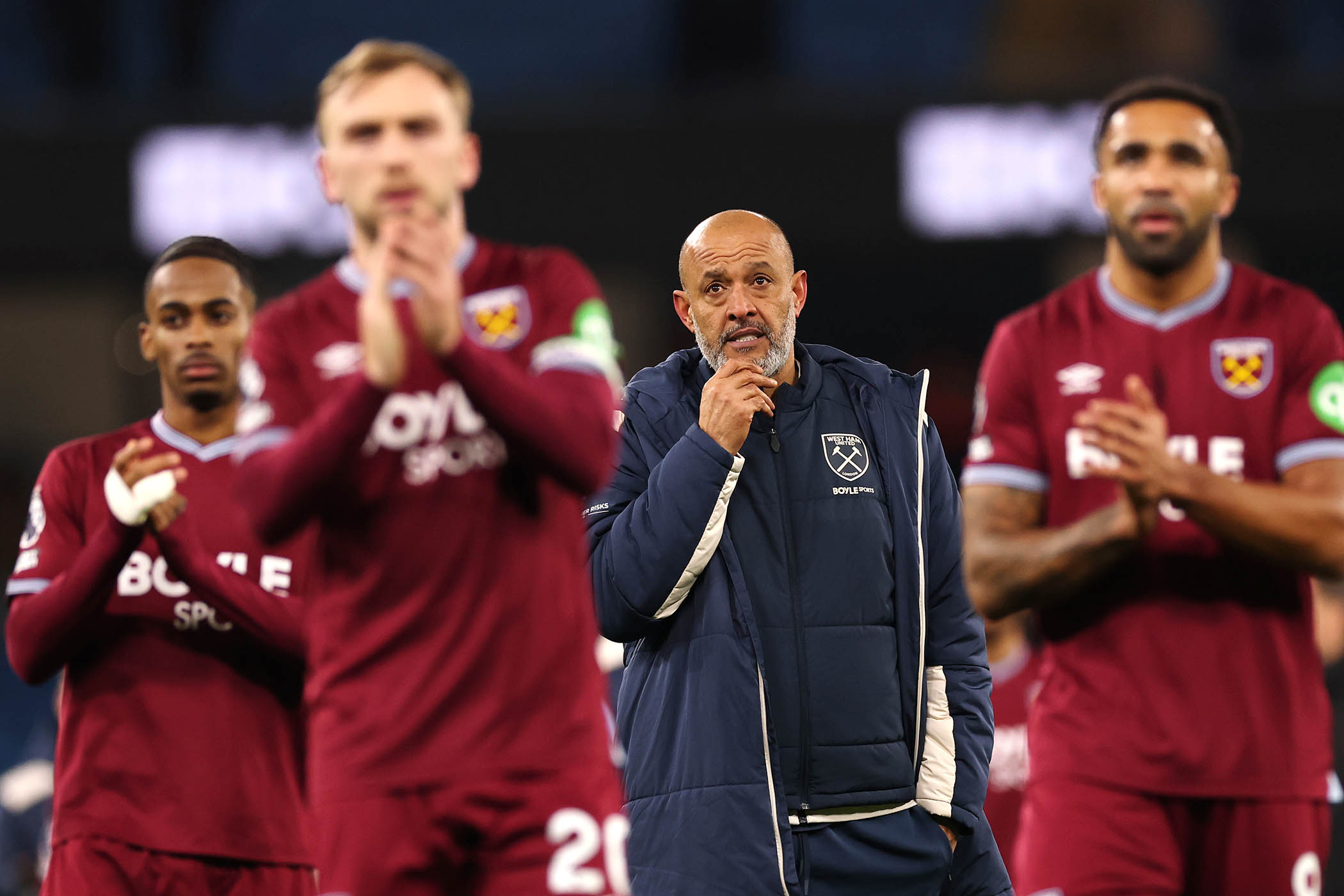



The problem with trying to pick the perfect example to illustrate the demise of West Ham United is that it is just so hard to choose. There are so many. Which is your favourite? Mine might be when they decided to sack David Moyes in favour of a progressive, attack-minded coach, and ended up with Julen Lopetegui.
But then maybe that’s not as quite as telling as the time Moyes allegedly banned the club’s sporting director, Tim Steidten, from the training ground. “Allegedly” because Steidten always insisted that was not what happened at all. He had, in fact, just stopped going to the training ground because his relationship with Moyes had collapsed so completely, so it was actually all fine.
It is tempting just to write a list of the money the club has frittered away in the transfer market – £40m on Max Kilman, £30m on Gianluca Scamacca, £27m on Niclas Füllkrug, £25m on Nikola Vlašić and the same on Luis Guilherme, a Brazilian teenager sold for roughly half that two years later – although it is striking that none of these is a particularly bad player. They were all just bad at West Ham.
It is not to take any pleasure in West Ham’s relegation to suggest that it was both predictable and warranted. They have been drifting impotently towards this since the unquestioned high point of their modern history, Moyes’s conquest of the Conference League in 2023. The next season, they finished 9th. Last year, they scrambled to 14th.
This year their luck ran out. Tottenham’s win against Everton condemned Nuno Espirito Santo’s presumably soon-to-be former side to 18th, to the Championship, to an imminent financial reckoning. Who among us could have seen this coming?
There is a consensus among the Premier League’s voluble commentariat that this is, in some way, the fault of West Ham’s fans. They were the ones, after all, who were guilty of committing football’s gravest sin: ingratitude. They were the ones who grew frustrated with Moyes’s conservative football and agitated for change. Ever since, they have been cast as a cautionary tale, a morality play about the perils of ambition, the importance of being happy with what you have got.
This is, in many ways, a modern version of the fable a previous generation was repeatedly told about Charlton. In both cases, the story is a fabrication. West Ham have not been relegated because their fans asked for too much, too soon. They have been relegated because they were the last surviving specimens of a species that may now be on the verge of extinction: the truly incompetent Premier League club.
West Ham had been in the world’s richest league for 14 years. They had finished in the table’s top half in seven of those seasons. For that comparatively modest record, they received somewhere north of £1bn in television revenue alone. It has turned them, as they have long pointed out with considerable pride, into one of the world’s 20 richest clubs.
In perhaps one or two of those seasons could they have been said to have pulled their weight in terms of attracting international eyeballs to the Premier League. With only the occasional exception, they have been a subplot, a supporting act, a passenger. It is only a little unkind to say they earned a billion pounds for just sort of hanging around.
But that is not all. West Ham were, as Paul Hayward pointed out in The Observer last week, presented with a stadium, a prime entertainment venue in a city that regards itself as Europe’s cultural capital, that was rented at a discounted rate and underwritten by the taxpayer. Few clubs have ever received such a generous gift, such a colossal advantage. West Ham have utterly squandered it.
Newsletters
Choose the newsletters you want to receive
View more
For information about how The Observer protects your data, read our Privacy Policy
They have done so because, under the ownership of David Sullivan, they have become a relic, an anachronism. In the 14 years West Ham have been there, the Premier League has modernised at an astonishing clip. Brentford, Brighton and Bournemouth are often, rightly, heralded as the standard-bearers for English football’s equivalent to the Enlightenment, but, over time, most of their peers have followed in their wake.
Crystal Palace identified the Championship as an undervalued market and recruited Michael Olise, Eberechi Eze and Adam Wharton. Aston Villa handed almost complete control to Unai Emery. Newcastle had the artificial edge of Saudi support but have afforded Eddie Howe time to shape his vision. Almost everyone, to some extent, has invested in data, in information, in knowledge.
Islands of short-termism remain, of course: Nottingham Forest, where the whim of Evangelos Marinakis holds sway; Chelsea, where Todd Boehly and Behdad Eghbali are such inveterate disruptors that they are now largely doing it to themselves; Everton, still recovering from the reign of Farhad Moshiri. Manchester United have made some questionable calls in recent years. Liverpool are threatening to become a cautionary tale of how even a decade of prudence can be undone in a year or two.
But none comes close to West Ham, a club that – according to Transfermarkt – has spent more on transfers in the past five years than all but nine teams on the actual planet; a club that has the 11th highest wage bill in the Premier League and yet will do well to attract premium buyers for more than a couple of players; a club that sold Declan Rice for £105m, a potentially transformational sum, and wasted all of it.
The blame for that lies not with the fans but with the owners. West Ham may well be the last Premier League side without any obvious long-term strategy or any coherent plan. They are not a data club or a springboard club. They have not tapped some underappreciated market. They do not have a consistent style, a clear identity.
They are, instead, what clubs used to be maybe a quarter of a century ago: inherently reactive, entirely capricious, reliant on the money they earn for simply existing to pull them through. Their recruitment policy has long been run much like a medieval court, defined by whichever unctuous courtier happens to have the ear of the king at any one time.
For a while, in English football, that was enough. Wealth does solve an awful lot of problems. But it is not enough any more. For a start, everyone has a lot of money; that alone is no longer quite such a potent differentiating factor. What counts now is all of the stuff West Ham have ignored. The teams that rise are the smart ones, the agile ones, the ones that stand for a broader idea. West Ham were so comfortable being in the Premier League that they did not notice it changing around them.
And now they have been caught out. For their fans, relegation will be a harrowing prospect. It will mean pain, humiliation, adjusting to a bleak new reality. But for everyone else, it is almost an indication that the league is working as it should. It has become a place where intelligence is – or at least can be – rewarded, and incompetence, eventually, is punished.
Photograph by Carl Recine/Getty Images