
Leicester City were still basking in the warm afterglow of lifting the Premier League title when, a few weeks later, the chief executive of one of English football’s great powers could be found in the well-appointed basement of a Marylebone hotel, patiently outlining why it could not be allowed to happen again.
An outsider winning the title once, he explained, was welcome. It was vivid, concrete proof of the game’s meritocracy, of the vitality of the pyramid, of all the things the Premier League likes to believe about itself. It was the exception that proved the rule. If it kept happening? That was different. That might make people question how hard the league was to win in the first place. And that would be a problem.
There’s every chance that, a decade on, at least a few of European football’s power brokers might be starting to harbour similar thoughts about Bodø/Glimt. By now, anyone who has remotely been paying attention knows the outline of Bodø’s story: it has been told so often over the past couple of years that its key elements can be presented on half a dozen easily shared Instagram flash cards.
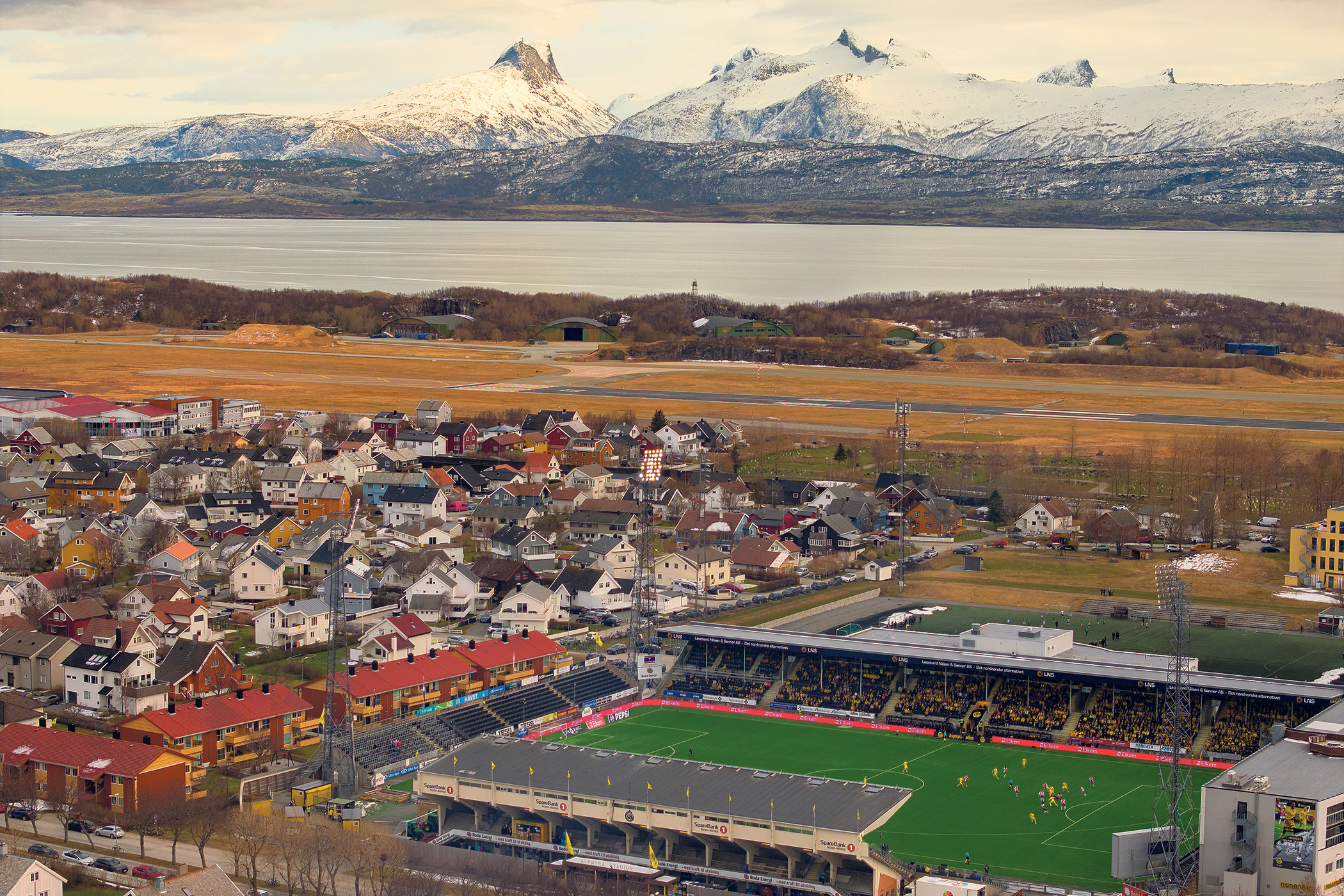
Bodø come from a town with a population of 42,000 in Norway’s frozen Arctic north; their Aspmyra stadium, with its artificial pitch and its mountain skyline, has a capacity of just 8,000; the club’s coach, Kjetil Knutsen, cycles to games; his players, the vast majority of them drawn from the region, tend to stroll down, their boots in their hands.
And yet, despite all of that, Bodø have managed not only to win four of the past six Norwegian championships, but to find a way to thrive among Europe’s elite. Last year, Knutsen’s team reached the semi-finals of the Europa League, the furthest a Norwegian team have ever gone in a European competition.
This season, they finally made the group phase of the Champions League. They drew three and lost three of their first six games; they had, understandably, found the air a little thin. But then Manchester City went to the Arctic Circle – has anyone mentioned they are in the Arctic Circle? – and lost. The following week, Bodø went to Atlético Madrid and won, slipping into the competition’s elimination round.
They had a taste for it now. They beat Inter Milan at home, and this week repeated the trick at San Siro. Bodø have not played a domestic game since November. Their squad have played at least one game every month since March 2024. They are simultaneously undercooked and exhausted. In a few weeks, they will face Sporting for a place in a Champions League quarter-final.
One Bodø/Glimt is tolerable to the aristocrats, every now and again. But they wouldn’t want it happening too often
One Bodø/Glimt is tolerable to the aristocrats, every now and again. But they wouldn’t want it happening too often
They are, in other words, almost a Platonic ideal of a sporting fairytale. Bodø have not only defied gravity, but the received wisdom of modern football. Plucky small teams exist to be torn to shreds by the game’s rapacious, unapologetic capitalism: the players go first, then the coach, enticed away by brighter horizons and deeper pockets, and all that is left are memories and a vague sense of regret.
That is the true miracle of Bodø: not that they arrived, but that they have stayed. Knutsen has rejected dozens of offers from elsewhere. A handful of players left, only to find their way back. As the club’s executives told The Observer last year, they came to the conclusion that nothing quite compared with playing elite football for their home-town club, alongside their friends.
That is not, admittedly, entirely consequence free. In a domestic context, Bodø are no longer lovable underdogs. Several seasons in the Conference and Europa League had already given them a considerable financial edge over most of their rivals in the Eliteserien; the tens of millions they will earn from a Champions League run will make them a comparative juggernaut. This is European football’s central structural problem: the game’s economic engine is all but designed to have a distorting effect on domestic leagues.
Newsletters
Choose the newsletters you want to receive
View more
For information about how The Observer protects your data, read our Privacy Policy
Still, the game more broadly should revel in the (relatively) uncomplicated wonder of Bodø’s rise: a story where enjoyment does not come at the cost of moral compromise, one free from the shadow of a nation state or a private equity group or the oblique machinations of some dubious billionaire.
The game should, in fact, wonder whether it might be a good idea if this sort of thing happened rather more often, or even just as often as it used to.
That Bodø seem so remarkable, so rare, is in many ways testament to how homogeneous the Champions League, in particular, has become. Their presence is a chastening reminder that something has been lost: a richness, a diversity which once illuminated European football has all but disappeared as the elite have reshaped the landscape to suit their interests. That Bodø have generated such enthusiasm – such engagement, to use the term that the game’s executive class prefers – is proof of the benefits to be had from rewilding the game.
In reality, the response will be quite the opposite. The logic of Europe’s aristocrats mirrors that of the Premier League’s superpowers: there comes a point where some team from Nowheresborg, Norway humbling the great and the good is bad for the product, at least by their self-serving definition.
One Bodø/Glimt is tolerable, every now and again. But you wouldn’t want it happening too often. Otherwise people might get the wrong idea about what they want to watch.
Photography by David B Torch for The Observer