
The 2026 Formula One season has long been the great unknown and yet even after its official unveiling in Melbourne there is still so much uncertainty.
It has been a massive logistical operation to get the season opener in Australia under way, with hundreds of F1 personnel who were due to fly Down Under via the Middle East having to be rerouted.
And as things stand, it seems unlikely the Middle East races in Bahrain and then Saudi Arabia on April 12 and 19 respectively will be able to go ahead. Both countries have been repeatedly hit by retaliatory attacks from Iran since the US-Israel strikes began. Even with Iran’s president saying yesterday that they would stop targeting their neighbours, the official line from the governing body, the FIA, and from Formula One itself is a watching brief with regards to two of the most lucrative races on the calendar, worth a combined £100m to F1’s coffers.
F1 has sought to buy itself time by saying: “Our next three races are in Australia, China and Japan not the Middle East. Those races are not for a number of weeks.”
Meanwhile, FIA president Mohammed ben Sulayem, who hails from the United Arab Emirates which has also been subject to attacks by Iran, said that “safety and well-being will guide our decisions”.
Should the races be scrapped, different options have been discussed, from second races in Melbourne or Japan to potential European stand-ins courtesy of Imola in Italy, Portugal or the Paul Ricard circuit in France.
But the likelier outcome is there will be no replacements and, instead, there will be a full month – April – without any grands prix, and the season’s calendar will be reduced from 24 to 22 races. Whatever the outcome, the sport’s lawmakers have about 10 days in which to make a decision before F1 freight will have to begin making its way to the Middle East.
‘It’s a bit of a surprise just how far ahead Mercedes are’
‘It’s a bit of a surprise just how far ahead Mercedes are’
Oscar Piastri
Far more predictable is the action at the front of the track, with George Russell and Mercedes living up to their long-time billing as the pre-season favourites in qualifying yesterday.
No one was entirely sure how big the German manufacturer’s anticipated advantage was until the first competitive outing of the season. After they secured the front row in qualifying, McLaren’s Oscar Piastri said what many of his peers were left thinking: “It was a bit of a surprise just how far ahead they are.”
Russell and Mercedes are clearly the benchmark in terms of pace for the rest of the grid to pursue in the developmental race after such seismic changes to the cars over the winter. Power is now split roughly 50-50 between the combustion engine and electrical, the impact of which was clear for all to see in Melbourne with the manner in which drivers had to lift and coast at points to harness the necessary power around Albert Park.
Newsletters
Choose the newsletters you want to receive
View more
For information about how The Observer protects your data, read our Privacy Policy
In addition, sustainable fuels are being used and the car chassis have been overhauled to make them shorter and narrower, thereby in theory improving the chance of overtaking. For his part, Russell described adapting to the changes in car as “the new normal” comparing it with the porpoising he experienced during Mercedes’ nadir under the last set of regulation changes.
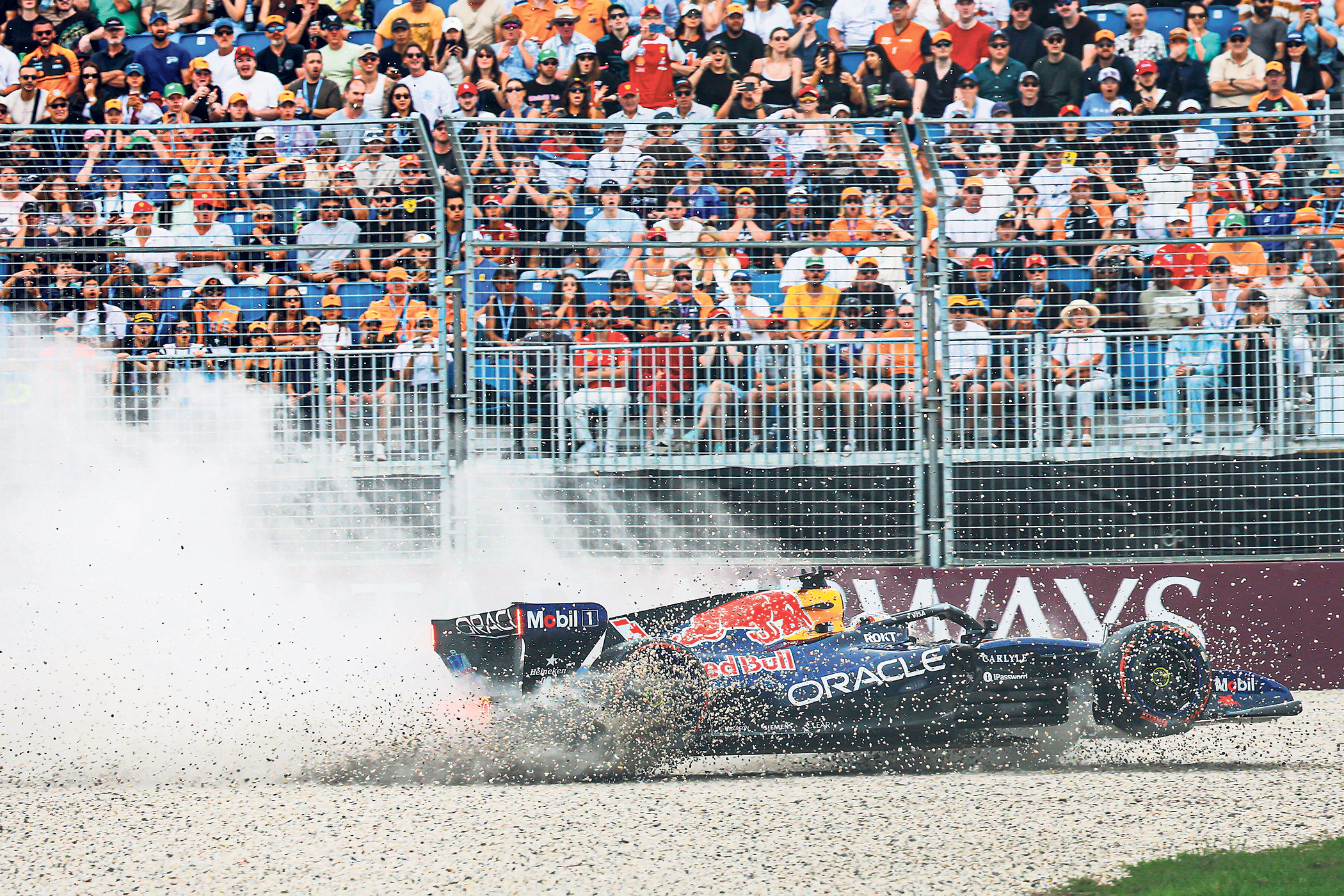
It is no surprise the 28-year-old seems the most content with the rules revamp such is his position, but others have been far more critical. Max Verstappen, who had the worst possible start to his campaign with a high-speed crash on his first flying lap, has already described the new format as “Formula E on steroids”.
And the truth is, as things stand, it is not the purest form of racing. But Albert Park has often been an anomaly of a circuit and lays bare the realities of this new-look F1 probably more starkly than any track on the current calendar.
While Mercedes are the clear frontrunners, what’s telling is that the likes of Ferrari, Red Bull and McLaren are not necessarily a million miles off the pace, Red Bull perhaps the most surprising in pace terms of that triumvirate, having built their own power unit for the first time in their already storied history.
No team will arguably be happier to pack up and leave Melbourne than Aston Martin. The entire weekend has exposed the size of the challenge they are facing to right the wrongs of their car and the Honda power unit in particular. Only one of their drivers, Fernando Alonso, managed even to make it on track for qualifying, and team principal Adrian Newey has been brutally frank about their plight, apportioning the blame at Honda’s door.
Photography by Hoch Zwei