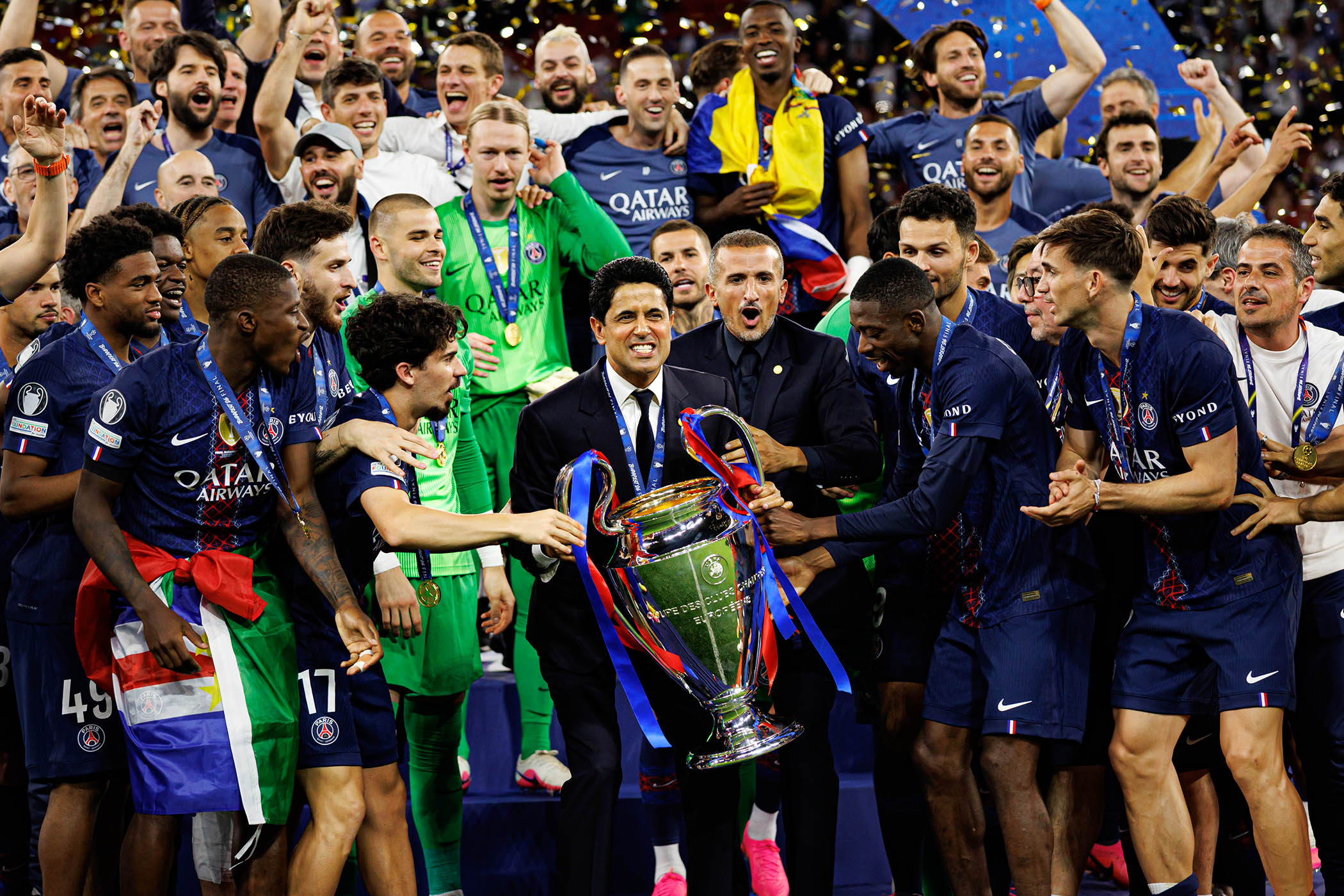

Nasser al-Khelaifi at least had the decency to go through with the pretence. Quite possibly the most powerful man in football had strolled over to join his Paris St-Germain players – his Paris St-Germain, his players – on the podium erected inside the Ferenc Puskás Stadium as they prepared to lift the Champions League trophy for the second season in succession.
As tradition dictates, Marquinhos, the club captain, had been the first to hoist the European Cup, to the slightly less traditional backdrop of glitter cannon and wheeling fireworks. Achraf Hakimi, his deputy, had gone next. And then the players had turned to al-Khelaifi, their boss, ushering him forward.
The rigmarole in these situations follows roughly the same rule that governs allowing your in-laws to pay for dinner. Etiquette dictates that you must refuse the first offer, even though, as Boomers, they only paid £17 for their house. On the second, you waver: only if you’re sure? Or we could split it? This is an important process designed to invert the conventions of politeness, so that by the third time, everyone knows it is rude not to let them pay.
Al-Khelaifi followed the pattern impeccably; it is a dance he knows well. He started off with a bashful smile. No, no, I couldn’t possibly. This is your moment. I might be standing here on this podium with you, but this is your trophy. No, really, don’t worry. Oh, well, if you absolutely insist, I suppose I could just lift it once. What’s that? Shall I have another go? Only if it’s no trouble.
By the end, if PSG’s chairman had been grinning any more widely, the top of his head would have fallen off. This was a stark contrast, a minute or two later, to Luís Campos, PSG’s sporting director, who exhibited a refreshing directness. He unabashedly took the trophy directly from a player’s hands, whirled around, and brandished it just a little deliriously in front of the waiting bank of cameras.
Campos, evidently, felt he deserved to celebrate, and to be celebrated. He is probably right. He is, after all, one the three principle architects behind PSG’s transformation into the game’s pre-eminent modern superpower. He found the players; Luis Enrique, the coach, has expertly shaped them into a formidable team; Al-Khelaifi has directed, and paid for, all of it.
The result goes beyond PSG beating Arsenal in Budapest on Saturday, beyond their undisputed status as the world’s best team. They are now the only club, other than Real Madrid, to retain Europe’s signal honour since 1990. Luis Enrique, Campos and Al-Khelaifi have, between them, created something that stands comparison with the finest sides of the century.
Quite where they stand, in relation to the game’s other modern greats, is a matter of personal taste. They are certainly the best team in the world. Are they better than Pep Guardiola’s imperial-phase Manchester City? Or Luis Enrique’s 2015 Barcelona vintage? How do they compare to the Barcelona built by Guardiola between 2009 and 2012?
Regardless of where that entirely subjective line is drawn does not diminish the scale of the achievement. With Jürgen Klopp, Carlo Ancelotti and Pep Guardiola all absent from the Champions League’s dugouts, Luis Enrique is now unquestionably the club game’s pre-eminent coach; PSG are its pre-eminent team. This is not just their moment; it increasingly resembles their era.
That is not just because they have helped to define the nature of the modern game; it is because they are defined by it, too. PSG are in every sense a product of their environment; they can be regarded as an almost perfect encapsulation of the reality of football as it exists at the point where globalised digital culture meets late-stage capitalism.
Newsletters
Choose the newsletters you want to receive
View more
For information about how The Observer protects your data, read our Privacy Policy
First and foremost, PSG should still be regarded effectively as an arm of Qatari foreign policy, nation-building and influence-harvesting. That is what has allowed them to become the game’s premier lifestyle brand, their shirts and their stores and their endless lines of merchandise now essentially ubiquitous.
That they have done so while striking a delicate balance between authenticity and broader cultural appeal – meaning the Parc des Princes is now home to the best atmosphere of all of Europe’s mega-clubs, while its executive boxes host the exact people who are supposed to be dulling the game’s edge – is quite a trick.
It is also what has turned Al-Khelaifi into the game’s great powerbroker. Nobody has quite as many fingers as quite as many pies. He is the president of the European champions and chairman of European Football Clubs, the body that lobbies for the interests of the continent’s teams. He sits on the board of Uefa and acts as an observer to Fifa’s council. He is also chairman of beIN, one of Uefa’s most important broadcast partners. His relation to pies, in other words, extends beyond putting his fingers in them. He bakes them, chooses who gets to sell them, and also runs the company that makes the ovens.
Most importantly, though, the club’s ownership has given them access to a level of wealth that has done more than inure them to their mistakes, to create a sense of inevitability that, once they had worked it all out, this beautiful game would be exposed as nothing but an economic equation.
It has permitted them to crush any form of domestic resistance to their primacy, to turn Ligue 1 into little more than a procession, a tournament they can win without breaking a sweat. The result is that they can now smoothly navigate the twin challenges presented by the game’s increasingly saturated calendar and the wealth of the Premier League.
Most of the team that Luis Enrique named in Budapest had played about half the football of their Arsenal counterparts this season. PSG’s total domestic dominance means they can afford to breeze through the autumn, keeping their powder dry and their stars fresh for the moment the tournament they actually care about gets serious.
This is the model that their peers – Bayern Munich and Real Madrid and everyone else with aspirations of one day standing on that podium – must try to follow. Outside of the pitched battle of the Premier League, it is what European football has become: a contest defined by who can use their best players the least. PSG deserve to be European champions, yet again. But they are also the champions the game deserves.
Photograph by Grzegorz Wajda/Eurasia Sport Images/Getty Images