Let’s start with the joy, the sprinting and leaping and screaming and weeping and hugging. José Canale, a curly-haired centre-back starting his first game for Paraguay at 29, lumbered towards the penalty spot. His teammates had missed consecutive spot-kicks to earn Paraguay perhaps its greatest sporting moment. Four months ago Canale said he believed he would never represent his country.
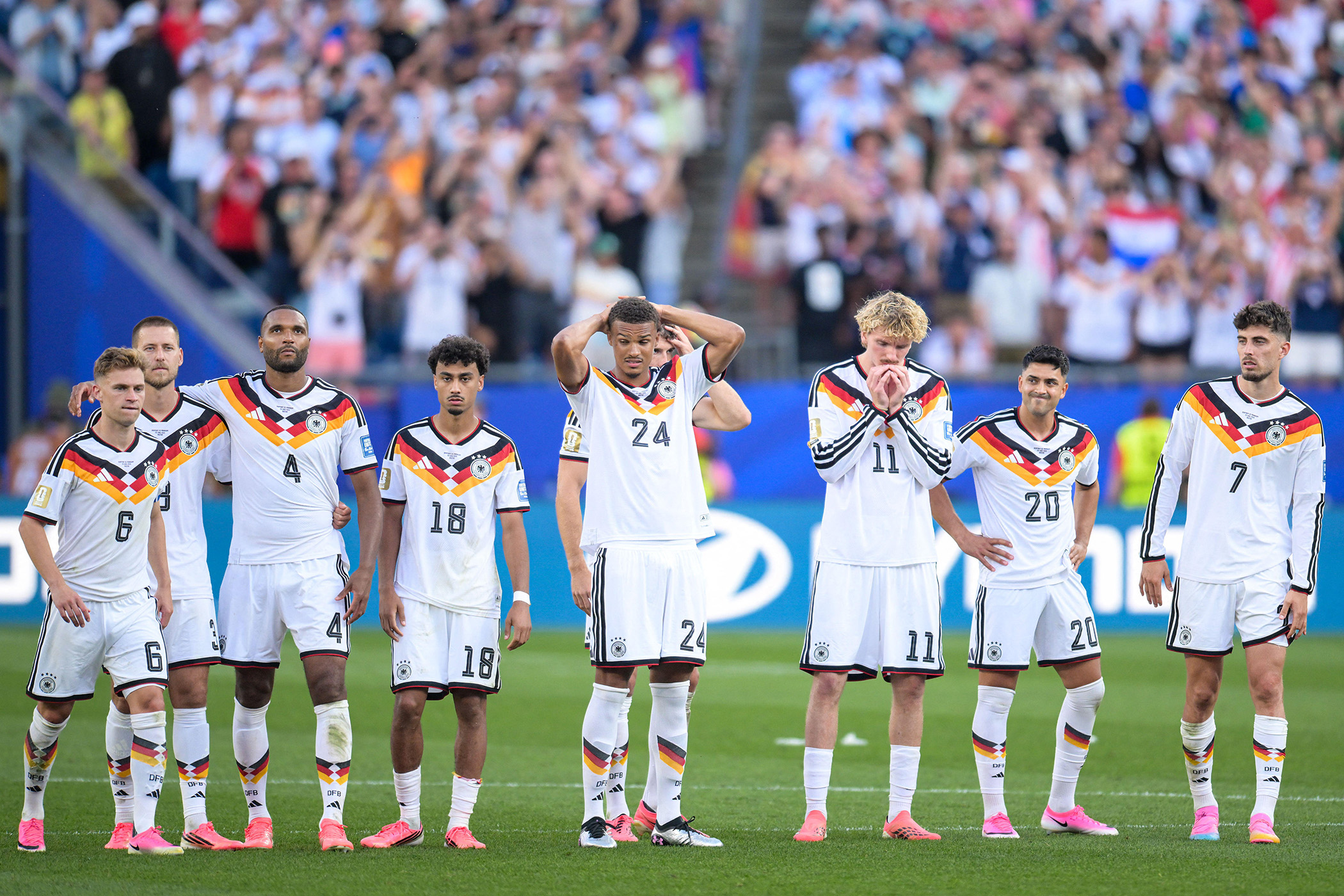
On a pastel pink New England evening he stared at Manuel Neuer – 40 and creaking but still Manuel Neuer – and guided the ball into the roof of the net. Enter chaos, enter wheeling and wailing. A Paraguayan journalist stood bolt upright as though electrocuted, before breaking into inconsolable sobs and hiding under his desk. Lost within the euphoria were 11 Germans, desperately alone, most barely acknowledging each other behind shell-shocked stares.
They knew they had just shattered Germany’s last lingering facade of invincibility and greatness, severed it totally from its past. They had never previously lost a World Cup shootout and were last beaten on penalties at Euro 76 by the original Panenka. Kai Havertz, Nick Woltemade and Jonathan Tah became the second, third and fourth German men to miss World Cup spot-kicks. Tah had never taken a professional penalty before. This is what it came to, how it ended: with an act of well-intentioned incompetence.
But on the evidence of the past eight years, maybe this should really be a story about a plucky German team doing their best in the face of an overwhelming lack of elite players, of structural failings and institutional self-harm, of Julian Nagelsmann and Neuer and reality. Germany last progressed past the quarter-finals of a major tournament a decade ago, haven’t made it to the last 16 for 12 years. Their last World Cup clean sheet was the 2014 final. They’re 12th in Fifa’s world rankings, below Mexico, Belgium and Colombia, and will fall further. This is just what they are now, what they have been for almost a decade: a middling footballing nation with an ego problem. The empire has long fallen and yet nothing had seemed to alter their self-perception as one of the game’s great houses, deserved confidence giving way to arrogance and then outright delusion. This felt like the night that changed; Nagelsmann said “if Paraguay knocks you out, you’re not a first-level team.” Losing is a habit too. When Deniz Undav becomes the answer, you have to wonder if you’re asking the right questions.
But perhaps the most obvious point of concern is quite how fundamentally unserious, how funny, the entire German set-up looks from outside, increasingly tending to the farcical. Julio Enciso, the 17th-shortest of 1,248 players at this World Cup, headed in the opener unmarked. Germany didn’t manage a shot on target in the first half despite having 79% possession. Even pre-tournament, Jamie Leweling, a competent if uninspiring right-winger, was given the No 9 shirt then promised to shave the Ronaldo triangle into his hair if Germany won. Then there was the, um, mixed messaging after the Ecuador game: Nagelsmann aggressively arguing “they didn’t want it more,” while Joshua Kimmich admitted “the opponent wanted to win more than us,” and Undav said the same. This is good stuff, but it feels like something has broken irreparably within German football.
Of course, there are two stories here. Paraguay’s president declared Tuesday a national holiday. Post-match, manager Gustavo Alfaro spoke for almost an hour about football as collectivism and vessel of joy for the masses, about how “resilience is etched into our identity,” called this “a display of blood, utopia and conviction” from a nation who “come from playing barefoot on the red earth”. It can simultaneously be true that this is lovely, that they were defensively immaculate, and that they are not a particularly good football team, stodgy and limited, should not be used to give Germany anything approaching an excuse.
Although Germany’s sporting director Rudi Völler half-heartedly defended him, this will be the end of Nagelsmann, soon to have been hired and fired by both Bayern Munich and Germany, increasingly feeling like football has moved beyond him before his 40th birthday. The three boldest decisions he staked his reputation on – convincing Neuer to return from retirement, starting Leroy Sane and keeping Kimmich at right-back despite him not playing there for Bayern for two years - were perhaps the three most significant factors in Germany’s failure. Through the group stage, no goalkeeper who played all three games had a lower save percentage than Neuer. Against Paraguay, Sane completed zero dribbles and zero crosses, while Kimmich was fascinatingly bad, melting like soggy cardboard under the slightest pressure from Enciso. Neuer at least saved a penalty, the death rattle of his international career.
Next up in the pain cave will almost certainly be Jürgen Klopp, who has spent the past month advertising hotels and bad lager on American TV, and his own suitability for the national team job he has always admitted he wants on the German broadcaster. But he will inherit an entitled team enduring a crisis of identity and confidence, a youth system producing fragile players who are then not adequately nurtured and developed. An inquest into the Bundesliga is looming: 19 squad members and seven starters against Paraguay play in the German top flight, which has to be a contributory factor to how mentally and physically weak so many of these players seem. But then Florian Wirtz left Bayer Leverkusen and now looks like he apologises when someone bumps into him, so there are myriad factors swirling.
There is a sense of a new footballing world order being established, not least by nine African nations reaching the last 32, France and Spain and perhaps even England the sport’s enduring powers. The three most successful World Cup nations – Brazil, Germany and Italy – are either crumbling or entirely crumbled without obvious paths back. Bastian Schweinsteiger’s comments that African football is “wild”, “unorthodox” and “perhaps not tactically driven” (which Ivory Coast head coach Emerse Fae called racist) more obviously apply to his former team. It will be four years until Germany can really attempt to rebuild and redeem themselves. Perhaps they never will.
Photograph by Markus Fischer/Alamy Live News
Newsletters
Choose the newsletters you want to receive
View more
For information about how The Observer protects your data, read our Privacy Policy