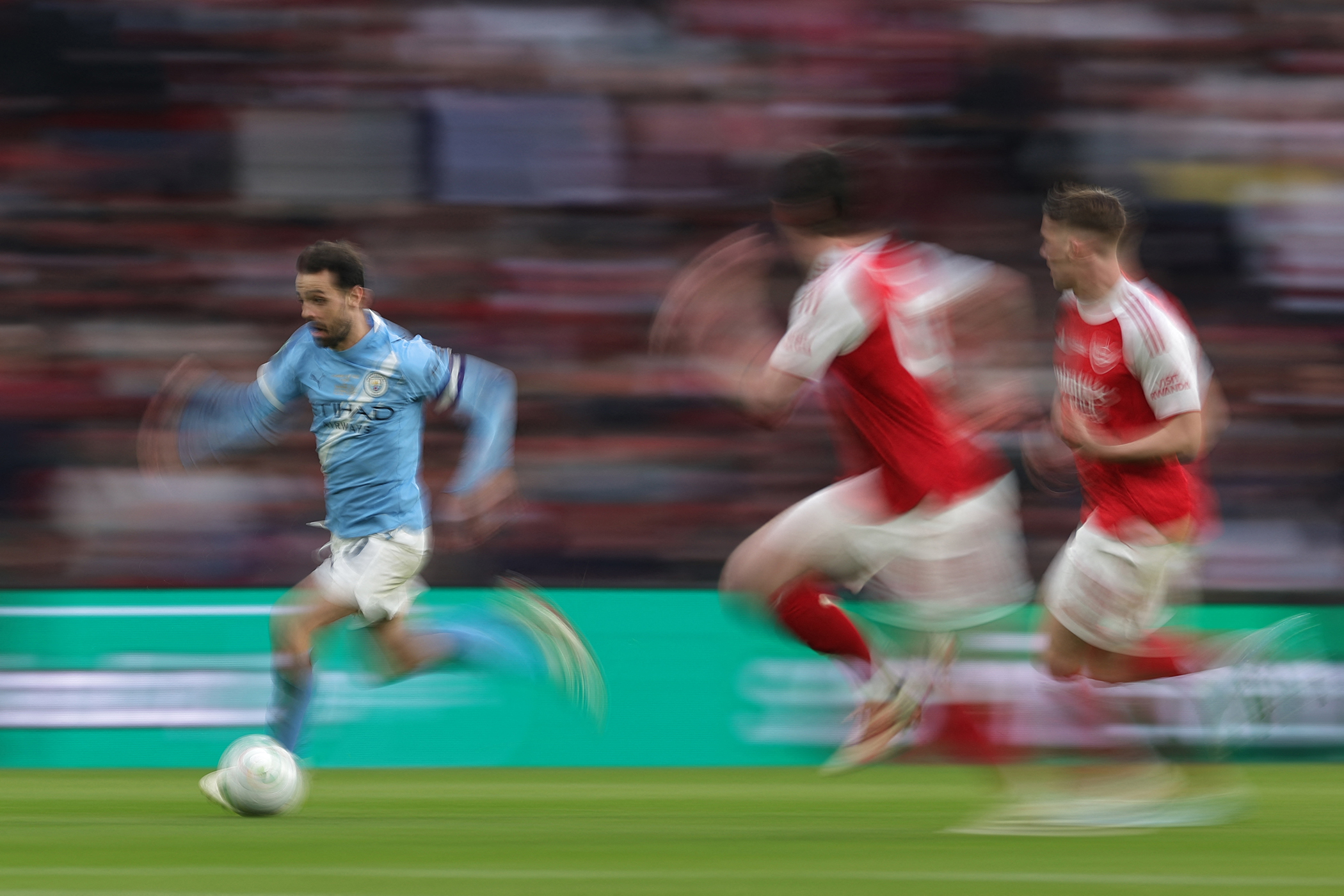

In Benfica’s academy, they called him “Little Messi”. He was small and spry and left-footed, yes, but he could also see the future, see three passes ahead, understand where his opponents were going and why they were going there. More than 15 years, and six Premier League titles and a Champions League trophy, later Bernardo Silva has grown into one of few truly unique, incomparable, irreplaceable footballers. No one has played more matches under Pep Guardiola and only five have won more Premier League titles than Silva. Last season was his first without a major honour since 2016.
Arguably Manchester City’s whole Guardiola era doesn’t function without Silva; a pressing machine, erstwhile false nine, left-back once tasked with stopping Bukayo Saka, No 6 and No 10, creator and destroyer, master and commander.
Guardiola said in December “[Silva] knows exactly what we need to play better, more fluid.” Appointed captain last August, he has long been the club’s spiritual and emotional leader, life force and driving force. He was always going to be better appreciated after he’s gone, when the ceiling starts sagging and the pipes are leaking and no one is left who knows where the fuse box is.
There’s a genuine malice to Silva, an insatiable competitiveness. Even as a Guardiolan disciple, he has always felt like José Mourinho’s fantasy. Opposing supporters roundly loathe him, even Pep Lijnders – Jürgen Klopp’s former assistant who now supports Guardiola – said “I didn’t like him before, now I love him.” He sipped coffee while refusing to applaud in a guard of honour for Liverpool’s 2019-20 side, later saying, “When I win a title, I don’t need anyone else to clap for me.”
And he doesn’t just understand football, he understands people and how to motivate them, how to embellish team-mates’ strengths and exploit opponents’ weaknesses. If you want to thump the beard off his face, he’s done his job, knowing his stature has so often bought him clemency. Diogo Jota called him “the most intelligent footballer I’ve known”, while Roberto Martínez said his “football intelligence” means he will almost certainly become a manager. Guardiola opted for “one of the best players I ever trained in my life”.
But his primary aim has always been to drive you insane, and he thinks faster and better than you, but also runs further than you, cares more and tries harder. He gets bigger in big moments. At 31, Silva has run four of the seven greatest distances in a match this season among all Premier League players. He’s also the only City player to feature in every league game in 2025-26 so far. He has missed just nine matches through injury since 2017 and made at least 45 appearances in every season in that period.
Bruno Fernandes called Silva the Premier League’s most annoying player, a real Jordan-Lebron debate, like Gianni Infantino endorsing your penchant for sycophancy. He called his French bulldog John Stones, explaining his decision to the man himself by saying: “Because I want every time I get my dog or shout my dog, I’ll think of you and telling you to come to me like I own you.”
This is not to ignore his one-match ban and £50,000 fine for posting a “racist” joke about Benjamin Mendy, which the Football Association concluded Silva “did not intend to be insulting” but was equally deeply insulting and offensive.
But how do we remember a player like Silva? How do we assess his legacy? Who are his equals? Where does he fit in the pantheon of Manchester City greats, of Premier League greats? Statistics are wholly inadequate, like trying to put a mountain sunset into words.
It was said of Sergio Busquets that if you watch him, you see the whole game. If you watch Silva, you see the parts that actually matter.
The Ewing Theory, based on NBA legend Patrick Ewing, suggests that teams tend to improve after losing a star player who dominates media discourse. The Silva Theory would be the opposite; that every great team depends upon a player who is the centre of gravity rather than centre of attention, malleable and moveable yet singular. Does Kevin de Bruyne achieve what he has without Silva? What about Rodri? Foden? Does Antoine Semenyo assimilate as smoothly?
Newsletters
Choose the newsletters you want to receive
View more
For information about how The Observer protects your data, read our Privacy Policy
For all their recent resurgence, City are flirting with an identity crisis, staving off a dying light, increasingly conscious of a murkier and less secure future. Guardiola is yet to decide whether he can bring himself to do this again, to keep proving something he has proven multiple times over. However suitable, the next manager will be inferior, will take time to make this squad their own, with less power and influence than their predecessor. The verdict on the 115 charges facing City still looms.
The club feels trapped in transition until Guardiola leaves, caught between eras, planning for an unknown world having lost first Fernandinho, then Kyle Walker and İlkay Gündoğan and De Bruyne and now Silva. John Stones is out of contract this summer. There is the sense of a centre which cannot hold.
How much interest does Guardiola have in doing this without Silva, perhaps his favourite player of the City era? On Friday he spoke about the “trust and confidence” his attack dog provides. City are losing security and constant excellence which underpins the belief that they are never down and out, that they always have a 16-game winning streak to hand. For all the questions over what Manchester City are without Guardiola, what are they without Bernardo Silva?
Photograph by Adrian Dennis/AFP via Getty Images