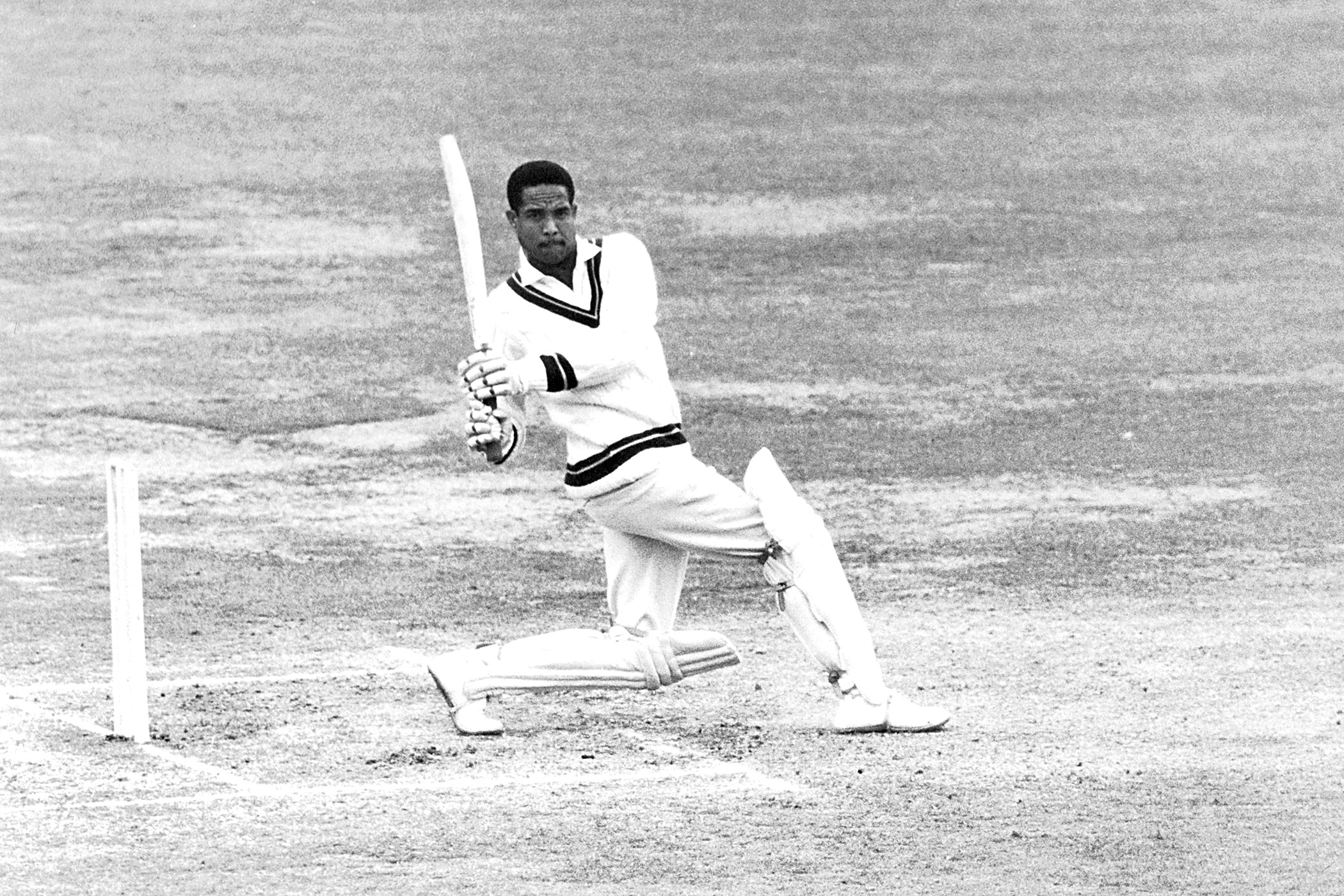

When George Gershwin was plucked from life in 1937, at the age of 38, John O’Hara said: “I don’t have to believe it if I don’t want to.” Cricket-lovers of a certain vintage may borrow the novelist’s tribute as they reflect on the death of Sir Garfield Sobers, who has left the crease aged 89.
In the 52 years since Garry – always two Rs – retired, cricket has changed almost beyond recognition. Two generations have grown up knowing little about a man who was, in the eyes of those who caught him in his prime, the greatest cricketer who ever picked up a bat.
Facts alone do not make the case. They rarely do. Many batsmen have made more than his 8,032 runs in Tests. Many bowlers have taken more than his 235 wickets. To many young people, raised on instant forms of the game, his name may be a blast from a past they never shared. Even so, perhaps his most famous feat would have pleased them. On 31 August 1968, playing for Nottinghamshire at Swansea, he hit six sixes in an over off the Glamorgan bowler Malcolm Nash – the first time anyone had done such a thing in a first-class match.
All the more reason, therefore, to spell it out. Garfield St Aubrun Sobers of Barbados, West Indies and Nottinghamshire will always stand supreme for his achievements, and for the way he played the game. In the eyes of John Woodcock, the great cricket writer, he represented an ideal. And Johnny spoke for all who saw him.
WG Grace, the bearded Victorian doctor, was the Father; the man who created modern cricket, with some sharp practice along the way. Don Bradman, the Australian run-stealer, was the Son; he triumphed on all fields, and ended his Test career with an average of 99.
Sobers was the Holy Spirit; unsurpassable for 20 years from 1954 until 1974, a year before Vivian Richards of Antigua, a very different man, assumed his identity as King of the Caribbean. What riches those islands shared with the world.
Left-handed with bat and ball, Sobers mastered the game as naturally as breathing. He was the most handsome batsman, bringing down his blade in a way Brian Lara was to do three decades later, with a generosity he did not extend to bowlers. Bradman, after watching Sobers make 254 not out for the Rest of the World at Melbourne in 1972, declared it to be the finest innings ever played in Australia.
As a bowler, his run-up alone was worth paying good money to watch; it was so elegant. When the mood took him, he could bowl as quickly as any of the other ferocious West Indians, like Wes Hall. Later, when the ball had lost its shine, he could spin the ball both ways, out of the front and back of the hand. As a fielder, he caught pigeons.
He wasn’t perfect. A gambling man, he lost all the money he earned, and depended on the kindness of benefactors to see him through some difficult days. He was also a drinker. When he joined Notts in 1968, he was often seen on the town with Jim Baxter, Nottingham Forest’s Scottish midfield player. “Drunk and Sobers”, they were called.
“Whisky Jim” didn’t stand a chance, because Sobers’s capacity for grog was astonishing. Steve Camacho, a colleague with Barbados and West Indies, said: “I never saw Garry without a drink in his hand – and I never saw him drunk.”
Newsletters
Choose the newsletters you want to receive
View more
For information about how The Observer protects your data, read our Privacy Policy
Sobers knew that the best way to silence doubters was to excel on the field. In 1973, playing for the last time at Lord’s, he went on the razzle on the first evening, midway through his innings. The next day he walked off 150 not out, and West Indies won by an innings and 226 runs.
Like Pelé, whose status as the greatest of all footballers has been challenged by those who never saw him play, Sobers was loved by his peers as well as spectators. John Giles, the Irish footballer, and later the most clear-eyed of pundits, thought Pelé’s greatness lay in the fact that, for all his unparalleled virtuosity, he started from a simple premise: how do I help my team win this match?
There were times when Sobers acted maladroitly. A generous declaration at Port of Spain, Trinidad in 1968 allowed England to win a Test, and an unhappy captain was found drinking alone in a bar that night, scorned by locals who felt he had surrendered the team’s honour.
As sportsman and comrade, Sobers led the field. No angel, he carried himself with the dignity of a prince, taking West Indies to the summit of world cricket with grace and modesty. They were more innocent days, but don’t think their runs and wickets counted for less. Sobers was of his time, and was for all time.
Just how good, a critic once asked an orchestral musician in New York, was Toscanini? “It was worth being born to have been conducted by that man,” he replied. That was Garry Sobers. A cricketer who charmed as he conquered.
Photograph by PA Images/Alamy Stock Photo