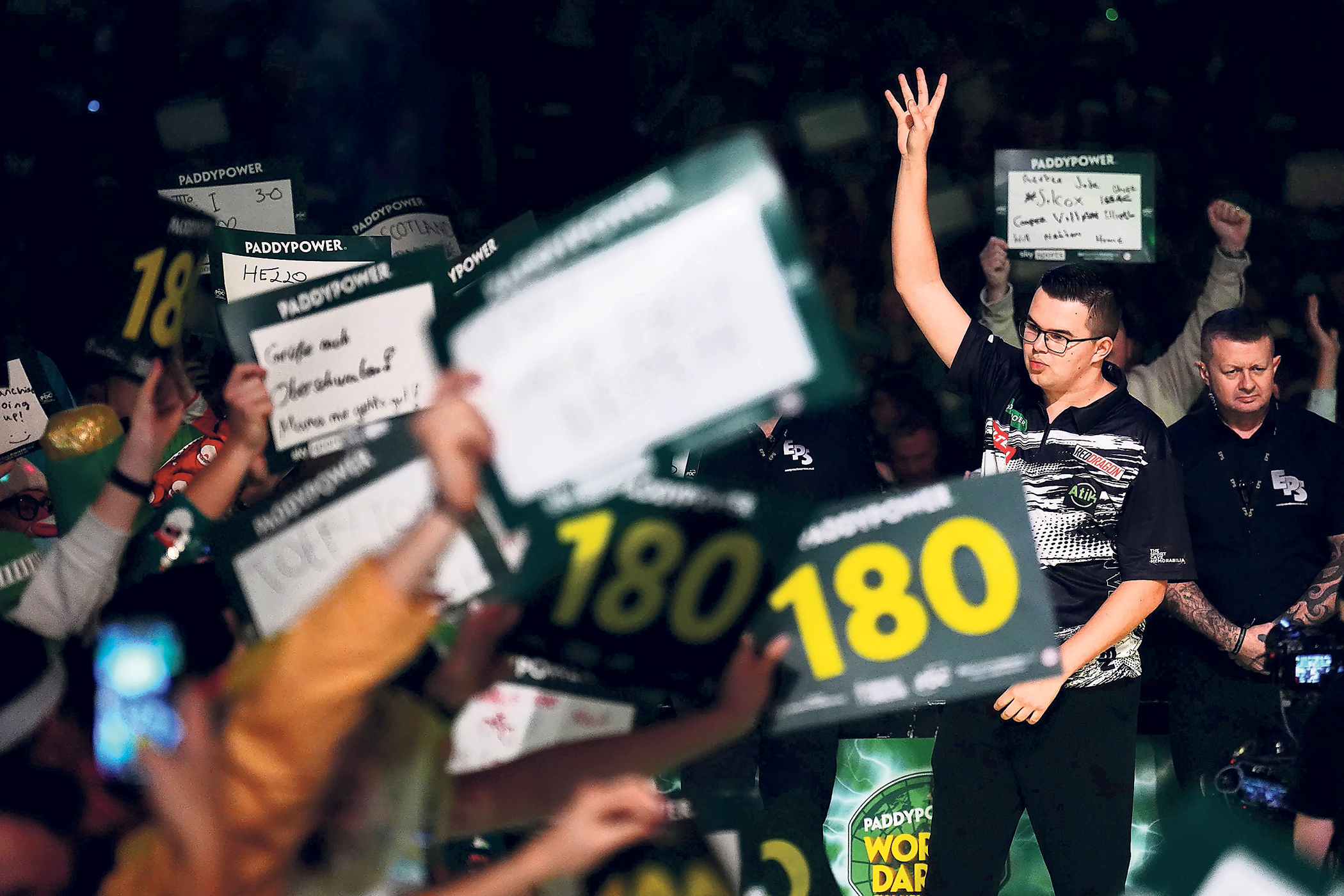

In late 2020, during the height of the pandemic and some of the lowest days of his life, Gian van Veen stood in a near-empty Barnsley Metrodome and sobbed. A first-year aerospace engineering student, his fingertips once held the darting world, something of a prodigy. Now he could not physically peel them off the flight to throw.
Just over five years later, a 23-year-old Van Veen averaged 108.28 in his 3-1 second-round victory over Scottish firefighter Alan Soutar on Monday, the best performance of the World Championship so far. Having lost the first set, he then produced the highest set average of the first two rounds (121.86) to win the second. Only five players have ever sustained a higher level across a PDC World Championship match – Phil Taylor, Michael van Gerwen, Raymond van Barneveld, Luke Humphries and Gary Anderson. All of them have lifted the Sid Waddell Trophy at some point.
In darts as much as any sport, learning how to win, how to psychologically bend the wires and odds in your favour, is perhaps a more valuable skill than any other. Peter Wright once called the sport “90% mentality and 10% practice”, which probably overvalues practice. And once he managed to beat the dartitis, Van Veen’s great challenge was working out how to turn his potential into ability. Even before his game collapsed, he was known as a bottler. Before October, he had neither won a game at Alexandra Palace ever nor made it past the last eight of a major.
But then he became the third-youngest major winner ever in October this year, lifting the European Championship in Dortmund, exactly two weeks older than Michael van Gerwen was when he won the Grand Prix in 2012. He edged Humphries in a sudden-death mind-blender of a match by taking out 100 while the then-world No 1 sat on tops. “My self-belief and confidence went through the roof after that tournament,” he said. It shows.
For the past four months, Van Veen has unquestionably been among the world’s top three players, with the highest checkout percentage (47.13) and the second-highest average (99.26), only behind Littler. As the Dutchman has said, Littler has helped divert the spotlight and allow him to find his feet – in any other era, Van Veen would be considered the boy king. He has won the past two PDC World Youth Championships after all.
Van Veen has now beaten Humphries in four consecutive matches, particularly significant when they are in the same quarter of the Ally Pally draw. Van Veen has averaged over 100 in 26 of his 55 matches since 1 September, Humphries in just 16 of his 52. It is increasingly difficult to argue the younger man does not have the higher ceiling, alongside the form and confidence.
After their World Matchplay quarter-final in July, James Wade called Van Veen “that guy”, as though he was barely worth remembering. On Monday “that guy” overtook Wade in the provisional world rankings, climbing from a pre-tournament tenth to seventh. If he reaches the final at the Palace, he will begin the 2026 season as world No 3, usurping Van Gerwen.
He will almost certainly be selected for the Premier League next year, a golden opportunity for him to reframe the accepted axis of the sport and show that perhaps it is he, not Humphries, who can push Littler over a sustained period. He is third favourite to win the £1m prize next month.
Perhaps most remarkably, as more seeds than ever before have fallen away in the early rounds, from Wade to the indomitable Gerwyn Price, he has only appeared stronger.
One of the crutches Van Veen picked up during his recovery from dartitis was stopping before crucial throws, particularly in big combination finishes. The vast majority of players do everything in their power to maintain their rhythm as the pressure rises, or even speed up.
Newsletters
Choose the newsletters you want to receive
View more
For information about how The Observer protects your data, read our Privacy Policy
But against Soutar, having hit the two requisite treble 20s to leave the bullseye for a 170 finish, the game’s highest, to win the second set, Van Veen paused as though to ask the crowd whether he should go for it, to build the tension ever higher out of pure showmanship, before pinning it.
There is no greater sign that he now controls a sport which once controlled him.
Photograph by John Walton/PA Wire