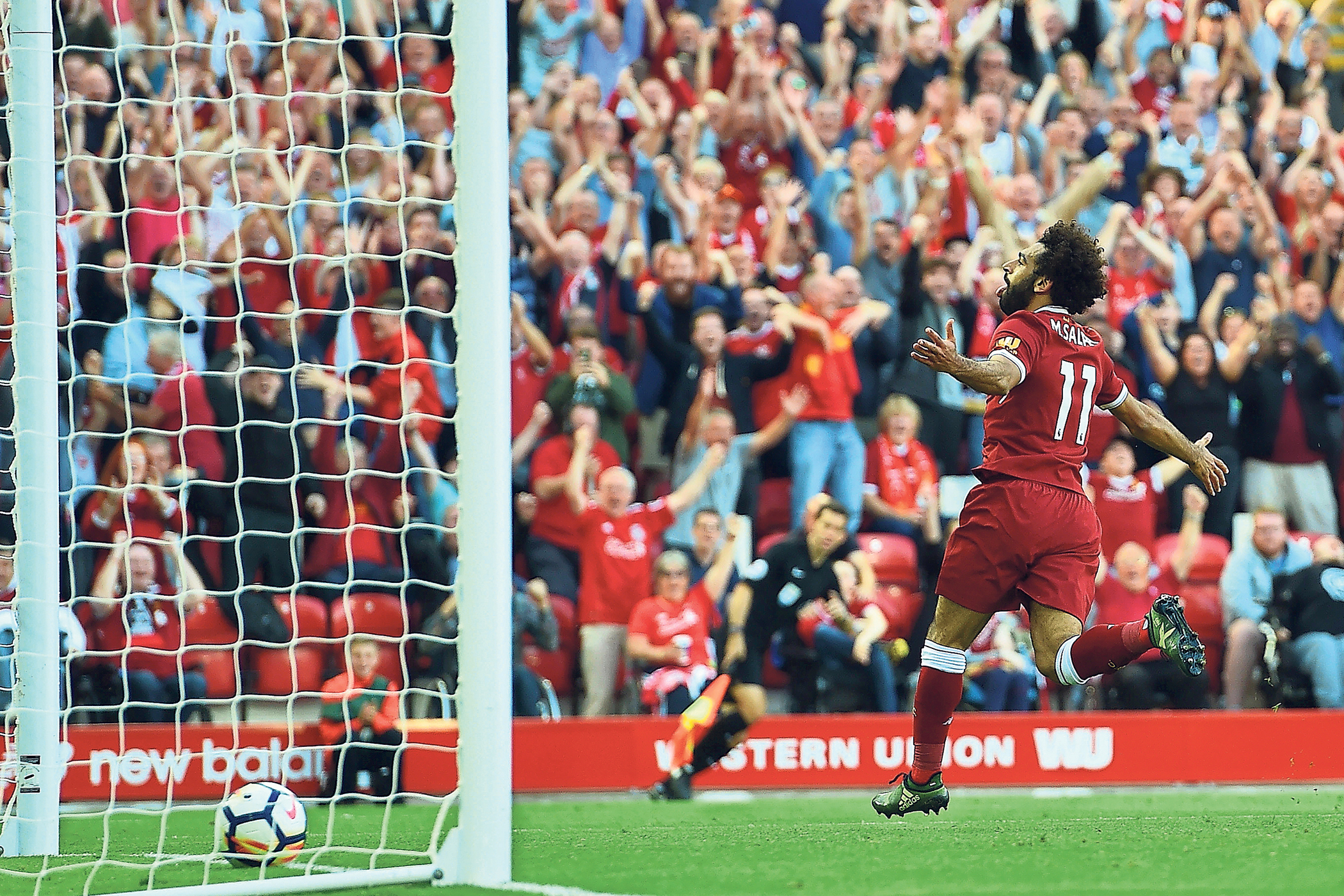

It would be convenient in the extreme if I could reasonably claim to have seen what was coming. The first time I saw Mohamed Salah play in the flesh was on a sun-drenched summer’s day, late in August 2017. He had joined Liverpool a couple of months previously. He was, most agreed, something of a gamble.
He had excelled over the course of a couple of seasons in Italy, but had struggled in his brief spell at Chelsea a few years earlier. Later, we would learn Jürgen Klopp had acceded to his signing only because of intense lobbying from the club’s data department. The German had initially preferred the candidacy of Julian Brandt.
By the time Arsenal – the faded, haunted Arsenal of late-era Arsène Wenger – arrived on Merseyside, Salah had already suggested he was a risk worth taking. He had scored on his debut, against Watford, and then on his first start at Anfield, in a Champions League qualifying tie against Hoffenheim. The signs were promising.
His display against Arsenal did not just reinforce that impression, it calcified it. Not simply because of the nature of his performance – devastating, breathless, relentless – but because of the context of it. Some games carry more weight in the collective imagination than others. Salah did not just shred Arsenal. He did so live on television, on the first truly Super Sunday of the nascent season.
Given all that he would go on to achieve, it is tempting to say that game – the one that I just so happened to be at – was where we first glimpsed the contours of his greatness, that everything he has done in his nine years at Liverpool unspooled from that moment.
But he was not the only story of the afternoon. My focus was on Arsenal, and the gruesome prospect of Wenger stubbornly lurching through another lost season. The BBC picked out Sadio Mané as the key figure. Gallingly, Gary Neville did make Salah his man of the match on Sky. Thankfully, he rather undercut his claim to clairvoyance by saying Emre Can ran him close.
‘There was nothing certain about Salah when he arrived, but there was a thrill of exhilaration’
‘There was nothing certain about Salah when he arrived, but there was a thrill of exhilaration’
There was nothing certain about Salah. Even as he picked Héctor Bellerín’s pocket and streaked half the length of the pitch to score the third of Liverpool’s four goals, nobody knew for sure he would go on to be – arguably – the greatest player in Liverpool’s modern history, and – less arguably – one of the finest to grace the Premier League. All you had was a feeling, a thrill of exhilaration, a sense that something might be starting.
In the years since, Salah has transformed utterly. He has had three acts across almost a decade at Liverpool: the electric, unyielding winger of his first few years; the ruthless, unstoppable force of nature of his peak; the decisive, impactful finisher of his elder statesman phase, at least prior to the baleful evanescence of this season.
Together, they have brought him every major club honour, as well as a cascade of individual awards. They have allowed him to break far too many records to list; there was a phase, a couple of years ago, where it seemed that every time any other Premier League player reached some milestone, it came with the caveat, “except for Mohamed Salah”.
How we have thought of him as a figure has changed, too. Given his fame, Salah has managed to remain surprisingly enigmatic. In his first incarnation, he was all twinkly eyes and boyish grins, a distinctly low-key superstar. As time rolled on, the innocence of that first impression gave way; Salah came to be seen as a little more calculating than had once been assumed.
Newsletters
Choose the newsletters you want to receive
View more
For information about how The Observer protects your data, read our Privacy Policy
It started with whispers of a feud with Mané. He developed a tendency to make sure his contract talks were played out at least a little publicly. His outburst – maybe that is too loaded – at Elland Road in December, when his place in the Liverpool team came under scrutiny for the first time, seemed to bear out the idea that Salah was not as free of ego as had been assumed.
These are the ways in which we invariably discuss footballers: they are data points, lists of achievements, tactical conundrums. They are reduced to their goalscoring records or their trophy hauls. They are assessed as machines, in terms of their effectiveness and their output, or else pored over as characters in a drama, our assumptions of their personalities imposed on to them and their motivations reverse-engineered to fit our impressions.
That, certainly, is how Salah has been presented since he announced – the content no great surprise, the timing unexpected – that this would be his valedictory season with Liverpool. He is what he has won, the trophies claimed and the goals scored and the records broken, and he is what we have perceived him to be: a player who stayed one season too long, who has struggled over the last few months to accept that he might not be what he once was.
This is not, though, how he will be remembered. Or, rather, it is not solely how he should be remembered. The goals, of course, will last. The glory, too. But most of all, what he will leave behind is the same thing that he brought almost as soon as he arrived.
It cannot be folded into a pointless debate about his relative merits to other greats, but it is what stays with us, long after a player has departed. What we will remember of Salah, as with all of the greats, is how he made us feel.
Photograph by Andrew Powell/Getty