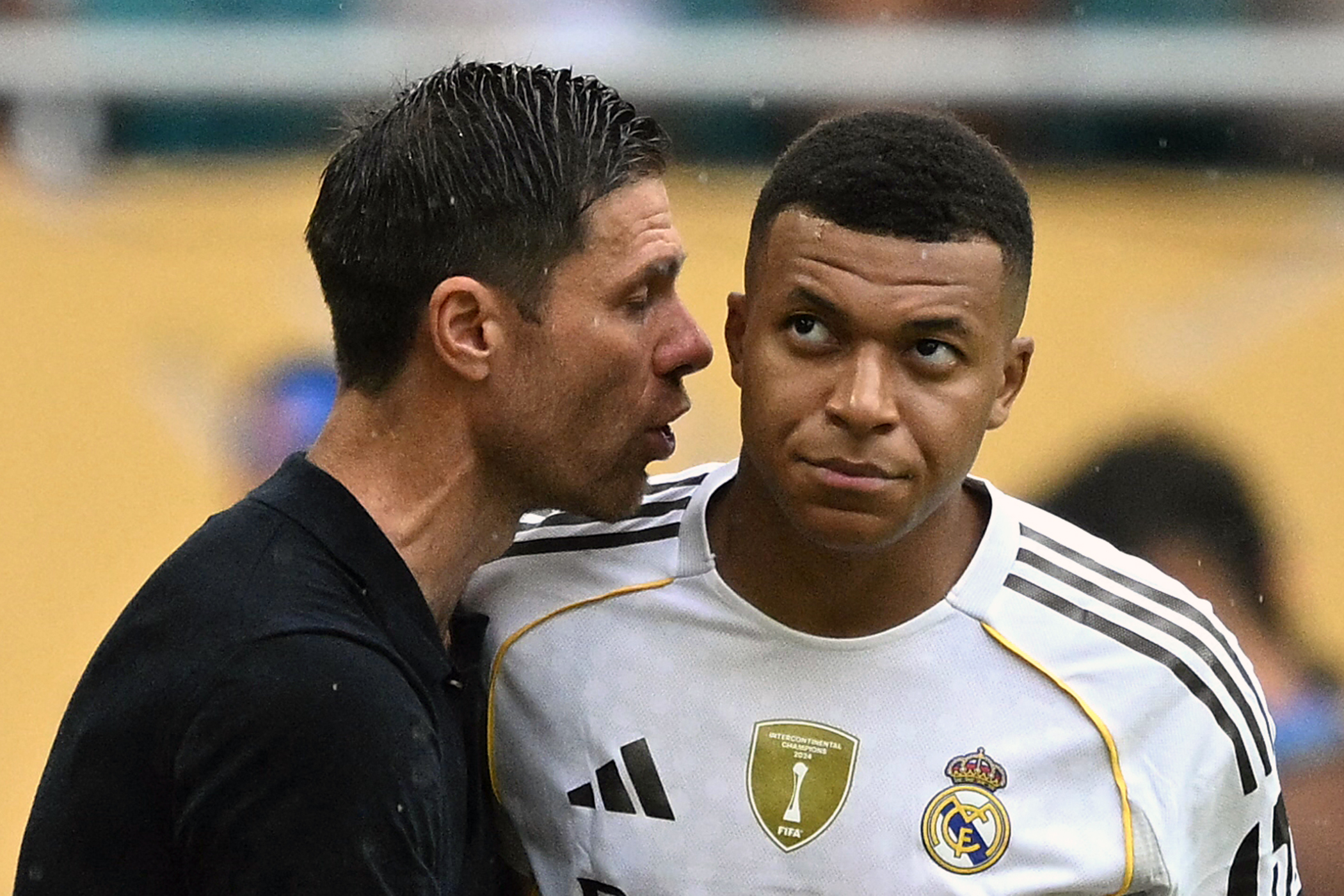

It is madness, of course it is, or one of its cousins: impatience or foolishness or hubris or caprice, or some noxious combination of the above. In the 24 hours since Xabi Alonso, apparently by mutual consent, was removed as manager of Real Madrid, there has been the usual rush to explain the inexplicable, to reverse engineer a reality in which the decision makes sense.
The justifications have been many and varied. Alonso’s “technocratic” style alienated some of his players, according to some accounts in Spain. The 44-year-old had tried to change too much too quickly. He had sidelined key members of the club’s staff, favouring his own lieutenants. He had failed to win over some of the more famous members of his glittering squad.
And then, of course, there have been results. Yes, to the innocent eyes of the child, it might look a lot like Real Madrid currently sit second in La Liga and among the primary contenders to win the Champions League, but wiser analysts knew that was an illusion. After all, Alonso had lost six of his 34 games in charge, most recently being beaten by Barcelona in the final of the Spanish Super Cup, which like all very serious tournaments is held in Saudi Arabia in January. By Real’s standards, that counts as a crisis.
If none of that seems especially convincing, it is because it isn’t. Alonso arrived in Madrid eight months ago as the most promising sophomore coach in Europe: the visionary who had, in his first full season in management, guided Bayer Leverkusen to the first Bundesliga title in their history, as well as victory in the German Cup. That team, featuring both Florian Wirtz and Jeremie Frimpong, lost precisely one game all season: the final of the Europa League.
He was brought to the Spanish capital tasked, essentially, with modernising Real Madrid.
Protected by his status as a beloved former player, he was supposed to take the immensely gifted but somewhat free-form squad bequeathed to him by Carlo Ancelotti, his predecessor, and turn it into a sleek, smart, sophisticated team, one capable of playing the sort of high intensity, tactically flexible football that stands as the sport’s cutting edge.
The mistake he made has been actually trying to do any of that. As El País noted, if it was losing a clásico which ultimately led to Alonso’s downfall, his fate was sealed by the one that he won. In October, with his team narrowly leading Barcelona at the Santiago Bernabéu, Alonso removed Vinícius and replaced him with Rodrygo.
His logic – which to outsiders may not seem desperately controversial – was that the latter might track back rather more than the former. He was right. Real held on to win. Vinícius, though, did not see it that way. He ignored his manager, stomping down the tunnel in a rage. When he came to apologise for his behaviour, he did not mention Alonso.
The club did not discipline him for his tantrum. The tacit message was the same as it always is in Madrid: the players come first.
It has, from that moment on, been abundantly clear that Alonso would not last; not as long as he might have liked, anyway, not as long as he would need to craft this Real Madrid team into something like his own image.
When Real drew three domestic games in November, there was little institutional attempt to bolster his position, to offer public support. By the time his team lost at home to Celta Vigo in early December, a distinct froideur had descended. Alonso played at Real Madrid for long enough to understand what the silence meant.
Real Madrid do not need a manager with a vision. They need a manager who wants to keep the players, and the president happy.
Real Madrid do not need a manager with a vision. They need a manager who wants to keep the players, and the president happy.
Real has always been the sort of place where the individual comes before the system. By trying to change that, Alonso had irked not only some of the club’s third-generation Galácticos, but the one person who matters more than anyone else: Florentino Pérez, the club’s all-powerful president. He was, it seems, awaiting an excuse to act. He eventually found one on Sunday in Jeddah.
Alonso will, in all likelihood, sustain no lasting damage because of this. Being fired by Real Madrid does not really count as a blemish on a manager’s record, certainly when it seems so obviously impulsive, so rash, so senseless. Indeed, plenty of clubs might see Alonso’s attempt – failed or not – to bring Madrid’s superstars to heel as proof of his convictions.
There will, certainly, be no shortage of suitors for his services. At Leverkusen, Alonso had a clause in his contract allowing him to leave for the clubs he graced during his playing career. He was, at various points in 2024, the first port of call for both Liverpool and Bayern Munich. A close friend of Pep Guardiola, he would be an obvious contender to succeed him at Manchester City.
Manchester United, the one Premier League titan currently looking for a permanent manager, is more complex. Alonso’s children are all, by his own admission, Liverpool fans. Would he risk the affection he inspires at Anfield by taking the job? And, just as importantly, are United’s supporters sufficiently desperate by their plight that they would overlook his playing résumé? It may not matter. Alonso, whenever he decides to return to work, will not be short of options.
Received wisdom would suggest that the effect on Real Madrid might be more profound. The club turned immediately to Alvaro Arbeloa, a friend of Alonso’s from Liverpool, Real and Spain; the pair, Arbeloa has acknowledged, had a long and amicable conversation after Alonso’s dismissal.
It is not the sort of appointment that suggests Real spend much time on succession planning. Arbeloa is, by all accounts, a gifted coach, but he has yet to manage at senior level; he has spent his career, thus far, in Real’s junior ranks. This seems, on the surface, to typify Real’s peculiar madness: impatience, intolerance and indulgence have compelled them to replace their manager with someone who is obviously less qualified.
But the problem with Real Madrid is that, for reasons that are not really possible to explain, the madness works. Or works sometimes, anyway. It is hard to think of a club that more often contradicts what the rest of European football regards as best practice, that so willingly eschews so many of the tenets by which the rest of the game’s elite operate. Alonso failed at Madrid because he is a product of those assumptions, a systems coach at an individuals’ club.
And yet – thanks to their wealth, their history and mainly their preponderance of ridiculously talented footballers – the results still come. Pérez, initially, was sceptical of promoting Zinedine Zidane to manager; he ended up winning three Champions Leagues in a row. There is no reason to believe Arbeloa will do the same, but then that has never stopped Madrid before.
Cast through that lens, it becomes vaguely possible to discern some sort of sense in Alonso’s dismissal. It is a stretch, but still: perhaps, on some level, it represents an odd form of self-awareness.
Real Madrid tried to change. They may even have wanted to change. But they know, now, that they cannot. They do not need a manager with a vision, with ideas, with structure and philosophy. They need a manager who wants to keep the players, and the president happy, who understands that the madness is not there to be tamed.
Photograph by Chandan Khanna/AFP via Getty Images
Newsletters
Choose the newsletters you want to receive
View more
For information about how The Observer protects your data, read our Privacy Policy