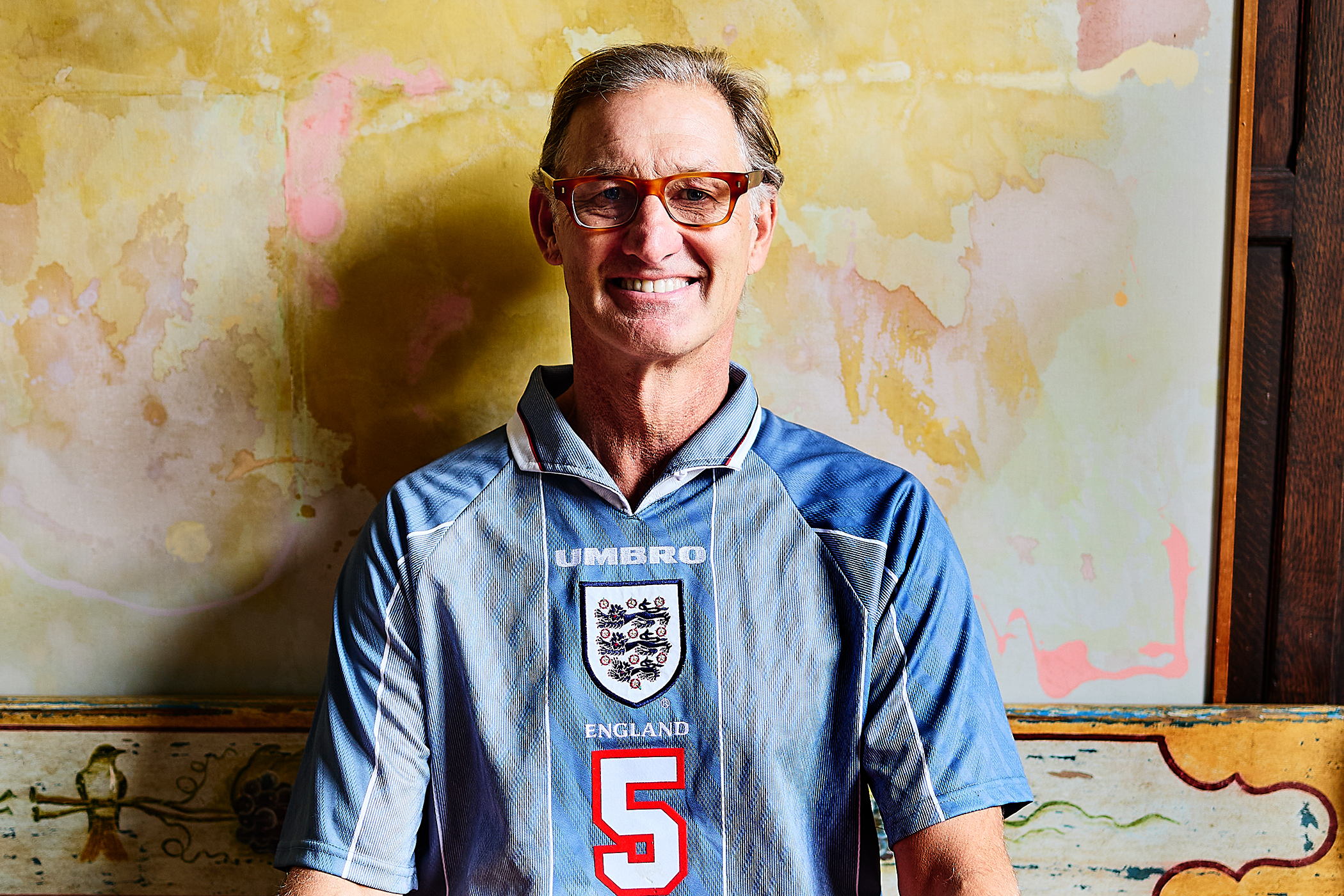
Tony Adams calls it a “celebration of recovery.” It’s a monument to candour too. Gruesome memories come with smiles. With almost a look of jubilation he says: “I’ve not wet the bed for 30 years.”
Many will think they know the story of Adams’ salvation in the year of Euro 96, when Gareth Southgate’s penalty was saved and the leader Arsène Wenger called “the doctor of defence” went on a 44-day bender.
But the fresh detail in his new autobiography, 1996: Reflections on the year that changed my life adds layers that are both harrowing and redemptive as he goes about the work of helping others.
Telescoping his previous books Addicted and Sober into a single, filmic year, Adams remembers sharing a table at a function with a police officer who told him he was on duty at Holloway station when a cab driver brought Adams in “with cocaine all the way down the front of my clothes.”
The old life he escaped in 1996 reads like a Pogues song: Ra Ra’s nightclub in Islington, the Railway Tavern in Stepney, The George off Holloway Road, The Greyhound in Bethnal Green. At all those stops Adams lived the parallel lives of an Arsenal and England captain and an inveterate pub punter with no moorings.
To recap, he was drinking crazily in 1996, got injured, got fit in time for Euro 96, was made captain by Terry Venables, England lost to Germany on penalties then Adams watched the team disperse at Burnham Beeches Hotel (“I’ve never been so lonely and so desperate and sad”). Then he hurtled towards perdition before the inner illumination that turned him into the inspiration behind the charities Sporting Chance and Six Mental Health Addiction.
“There were moments when I was in pubs [after Euro 96] and people were going, ‘Ah, Tony, you did brilliant, I’m really proud of you, have a drink.’ It had stopped working.”
He talks about “ending up in the Grafton [hotel] with a prostitute. What’s all that about? The one solution I had was drink, and then that stopped working as well. So you’re left with… the end. You’re wanting out.”
Adams’s rebirth was to realise he wasn’t the person he thought he was: the drunk driver who went to prison, the broken dad passing his children to his in-laws to look after, the Arsenal legend who would have been in Wham’s “Club Tropicana” video had he not fallen in the water. “Shitfaced. It’s funny. It’s funny. The drunk is funny, but it’s so dangerous and I could have died…
“That behaviour… I can see that’s a sick man, there. That’s a real sick man. I can see it, like the fog’s been lifted. And I’m well today, which is… hallelujah.”
Newsletters
Choose the newsletters you want to receive
View more
For information about how The Observer protects your data, read our Privacy Policy
On Adams’ CV, England, Arsenal, personal degradation, salvation and societal problems converge with a force found in no other sporting biography.
And in our interview he went to a place previously unvisited, in public at least: childhood, upbringing and the woundings psychotherapy often looks for to explain self-destruction.
Even Adams, super-candid, hesitates before going there. But he does: “My grandfather was a really serious drunk, angry, used to go down the pub and come home, and, you know, had a bunch of keys on the table. If you’d said a word, they’d end up in your face. So what you do, you go inside, don’t you, when you’ve got rage around the place. And as a small child, I had panic attacks at school and stuff.
“I didn’t come home and say, ‘Hi, dad. I had a panic attack.’ He [his father] was on the docks when he was 12. He’d have been like, ‘What are you talking about, son?’ You know. ‘Get a job.’ I’m not blaming them. It’s just that it’s a fact. It’s just the way that they were brought up.
“I got all the wrong messaging, I suppose – that I was to toughen up and suppress, suppress, suppress. And I think that’s where it came from, and I realised football did that for me. It suppressed.”
I got all the wrong messaging, I suppose – that I was to toughen up and suppress, suppress, suppress
I got all the wrong messaging, I suppose – that I was to toughen up and suppress, suppress, suppress
Tony Adams
Rejecting drink, because he saw what it did to his own father, Adams’ dad would “punch the wall”. He smoked heavily instead and died at 63 from lung cancer.
“It’s not unkind [to tell the story], because he’s a great man, but what I saw, I thought, was a very sick man, you know, a very sick man, because he didn’t understand his thoughts and feelings.
“My mum brought me up. I didn’t go to school. She used to sit on the sofa and eat cakes. You know, watch movies. She’d whisper, ‘Don’t go to school, don’t go to school.’
“I used to go over the park and play football. And, of course, she’s obese, and, you know, dies of bone cancer; really good woman, but, you know, it wasn’t particularly a great diet and stuff.”
He talks of himself almost as a different human being, in another time, when he would pour his brandy into a pint of Guinness to stop himself throwing it back up. “We talk about the jumping off point in Alcoholics Anonymous, and I got to that moment where I just, I gave in.
“When I went to prison in 1990 [for two months], not one person came up to me and said: ‘Do you think you’ve got a problem with alcohol?’ Four-and-a-half times over the legal limit, 85mph across an A-road, clip a lamp post, through the front door of a house.
“The Lee Dixons of the world were kind of going: ‘Tone, what the fuck are you doing? What are you doing that for?’ And I was like, ‘You’re a bit weird. Martin Keown’s a bit strange.’ You kind of ignore people or get rid of them, because you don’t want to have a look at yourself.”
In the Arsenal changing room, the new, sober Adams would say things like: “Does a Jesus Christ have to appear in every generation for people with lack of imagination?” He grins again. “And the lads used to go, ‘What the fuck?’
“I used to come from this character, this bully, this captain, with the mask on and going out and getting pissed, and then all of a sudden I’m meditating, and dropping them pearls of wisdom from religious books and stuff and they’re like… Jesus.
“I was doing such a good job [when he was drinking]. I was playing at 70% of my capacity [he mimics Wenger], ‘because 70% is bigger than Martin Keown’. Sorry Martin.” Wenger, known as “Windows” by the Arsenal players when he arrived on account of his spectacles, remains a hero. Adams calls him “a very spiritual man. It’s honesty, you know, it’s love, it’s kindness, it’s compassion. And he only wants the best for you. He’s a lovely man. That’s spirituality, for me.”
The one solution I had was drink, and then that stopped working as well. You’re left with the end. You want out
The one solution I had was drink, and then that stopped working as well. You’re left with the end. You want out
Tony Adams
From the six years Adams spent living alone comes a recollection of him picking his daughter up from school. “She said, ‘Dad, you’ve done really great, you know.’ I’m popular. It’s lovely and it’s supposed to be beautiful, but I was so… so traumatised, I suppose, from my behaviour.”
A couple of years ago on St. George’s Day his son came to him and said: “Dad, I’m fucked. I’m done.” Adams says: “So I took him to a meeting. I said, American Patrick’s over there. He’s your sponsor. There’s the big book. There’s the meetings. Go. And he wanted it. It’ll be three years ago in July.
“There are 17,000 BACP [British Association for Counselling and Psychotherapy] registered psychotherapists, and 380,000 under-18s on the mental health waiting list. You just ain’t got the resources.
“Rehab’s working at about 14% – 14% get recovery, which is super low and super crap. But don’t diss the 14%, they tell me. We’ve got to get nurses and doctors in society, judges, teachers, to point in the right direction, so that there’s an education, an understanding and an acceptance.”
In football, he says, gambling is the new drug of choice for players who would be found out in training ground fitness data for using drink or drugs. “It’s an epidemic, you know, within football and society.” Of wall-to-wall gambling ads he says: “Come on now, Jesus Christ. Will they get a grip? I’ve been saying for years, let’s just knock advertising on the head. Just do it. What’s stopping us?”
The intensity of the conversation is lightened by epiphanies. A mention of his wife Poppy prompts this reflection: “I got to a place after six years that I was quite comfortable living on my own. And then all of a sudden Poppy Teacher went through the door, and who could have thought that I’d get such a wonderful, wonderful, emotionally and mentally beautiful woman.
“She’s got no addiction in her whatsoever, she’s purely balanced. If she’s angry she tells you appropriately. If she’s sad, she cries. Perfect, perfect human being, sweet. Yeah, lovely.”
A nightclub owned by Venables was the scene of a smaller win. “At Scribes West, I went there one night and got absolutely shitfaced. I was on the mic doing ‘Wild Thing’.” A year later he returned. “We went there and I did it sober. I went up on stage again and I did ‘Wild Thing’. I sang it and came off stage and everyone thought I was shitfaced. Everyone was – he’s pissed again, he’s drunk again.”
With his 60th birthday coming up in October, Adams decided against the big party Poppy was originally planning at Scott’s restaurant in Mayfair – where he had met Venables before Euro 96, after “a couple of pints in the pub for Dutch courage” – in favour of a meal for “12 of us”. He explains: “Twelve of my winners are going to go for a bit of Sunday lunch. Twelve guys that I’ve known in recovery that have been part of my journey.”
He stops when he realises they’re all men. “I don’t know what that’s about, but I’ll be taking that into therapy, I think.”
1996: Reflections on the year that changed my life, by Tony Adams with Ian Ridley (Floodlit Dreams; floodlitdreams.com)