


It’s a June Sunday evening at Fenway Park, Boston Red Sox vs New York Yankees, the sky a mille-feuille of silken blues and whites. Baseball has always been something I don’t remotely understand but have summarily rejected as trivial and American, like small talk and optimism. It’s a little after 9pm and each team has played seven of their nine innings. The Yankees have not made a single successful hit, let alone a home run. For the slightly less initiated than me: this is bad. This is getting 70 minutes into a football match without taking a shot. The impudent frat boy next to me informs his girlfriend that a Yankees “no-hitter” – going an entire game without a hit, which happens less than 0.1% of the time – would be the worst day of his life. His unblemished face and soul make me believe him.
Having now spent three weeks in the land where nothing’s free, including my jaunt to Fenway (the oldest baseball ground in the US, inaugurated five days after the Titanic sunk, which somewhat stole its thunder), seven World Cup games in four states, partying into the New York night with Knicks fans and quizzing Americans in Foxborough and Atlanta and Fort Worth, here is what I’ve learned.
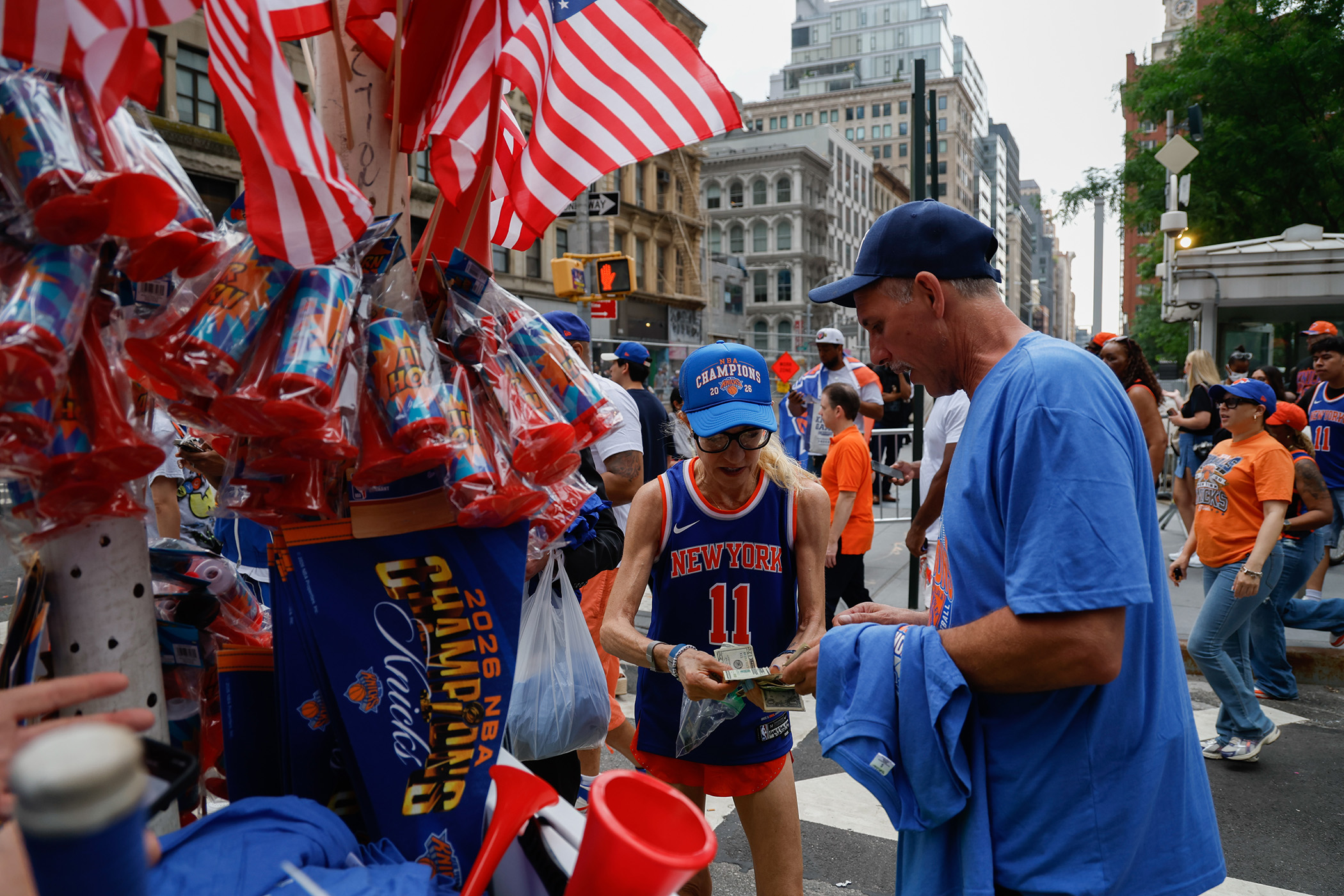
The instantly confronting common thread between every city and sporting event has been the all-consuming tyranny of merchandise. This is not solely a sporting phenomenon – you’ll struggle to find a coffee shop here that isn’t also flogging tote bags – but I count more than 30 different Red Sox T-shirts in the team shop, none of them particularly nice. Similarly, two days after the Knicks’s Championship win, I stumbled across the NBA Store on Fifth Avenue, 20 minutes before closing and seemingly operated by air traffic control for the day. There was a half-hour queue just to get in the door, including some already in head-to-toe Knicks gear and the French World Cup-winning centre-back Samuel Umtiti. A thick-necked guy in a Knicks T-shirt and cap bought four caps – three of which were identical – and five T-shirts, all seemingly designed, printed and shipped in the past 48 hours.
To wear Knicks merch in recent weeks has become a shorthand for proving your New Yorker credentials, to say I care, I belong, to feel part of something bigger than yourself. This is what merch does, the route one path to project to the world who you are and what matters to you (I say this as someone who owns a shirt with a favourite film scene printed on it). This is obviously not uniquely American but does feel more ubiquitous here, for all Arsenal are the UK market leaders, they still don’t quite seem to have maximised their potential.
Next, at Fenway Park it is striking just how integrated stats are into the baseball fan’s experience, how numerically literate you are expected to be. Every player has complex match and season stats listed above their heads as they bat or pitch, often involving decimals and acronyms (ERA? WHIP?). This feels slightly dehumanising, especially when Oswaldo Cabrera has a full house of 0s. It’s not forced on you, but equally you feel you’re missing something by ignoring it. This has also seeped into the World Cup, the magic donut big screen at the Mercedes-Benz Stadium in Atlanta informing 50,000 dazed England fans the exact speed and spin rate of DR Congo’s opener. Major League Baseball players are clearly considered so disposable that as they bounce up to the plate each one has a “Who Is This Bloke?” bio beamed onto the big screen. Apparently Anthony Siegler recorded his first career home run yesterday, which I learn definitely means he’s not going to hit one today.
And there’s something sexily shameless about the advertising, all 30-foot neon lights fizzing in the night sky. We’re told “this strikeout will feed 1000 children in need” (sponsored by Stop & Shop), which seems to put an inordinate amount of pressure on the pitchers. There’s an official Red Sox lobster roll, official bank, official grocery store and real estate agents. On the plus side, there’s a sponsored dance-off in the crowd and a septuagenarian grandma wins a pair of New Balance trainers. Even the stats are sponsored by KPMG. This is already in the Premier League, but not as brazenly. When Chelsea say they’re proud that Damac is their official property development partner, you still struggle to believe it. I have no doubt everyone involved in the Red Sox are big into MassMutual insurance.
Mercifully, you struggle to imagine the seamlessly integrated patriotism will ever catch on at Molineux and the Madejski: the Star-Spangled banner is sung reverently before every MLB game, as it has been before every World Cup match in the US. Sweet Caroline is already universal, but the sound effects aren’t – when every player is on two strikes, ominous strains blast round Fenway. Neither are the rictus-grin hype-people MC-ing World Cup matches.
As painful a reality as it might be, to understand American sport’s present is to glimpse sport’s future, particularly in England. Last season 13 Premier League clubs were at least partly American-owned, as were nine Championship teams. Three of the cricket Hundred franchises are part-owned by American or American-based groups, while Bill Foley’s Black Knight – who also own Bournemouth – bought Exeter Chiefs earlier this week. English sport is slouching towards America, towards hype-people and xG in line-up graphics.
Just after my Yankee-fan neighbour joins in with the agonising “Yankees Suck!” chants (where are the converted show tunes, lads?), they finally avoid the ignominy of a no-hitter. In their final innings they inexplicably level the game at 2-2, then take a 4-2 lead in the extra innings, only for the Red Sox to win 5-4. Floodlights flash as if searching for an escaped prisoner, lifelong fans embracing the visiting contingent of German supporters. Maybe, somewhere in there, the main takeaway from the past three weeks is that for all the greed and sound and fury, sport always finds a way.
Photograph by John Lamparski/Bloomberg via Getty Images
Newsletters
Choose the newsletters you want to receive
View more
For information about how The Observer protects your data, read our Privacy Policy