

I am not sure when my “For You” page on X became solely about figure skating. Maybe I erroneously liked a video of Lilah Fear and Lewis Gibson’s Spice Girls routine, or lingered too long on whether Guillaume Cizeron wobbled too much on his twizzle. Whatever it was, I have struggled to find a single post in the past week that has not been about the topic. Figure skating posts fill my WhatsApp group chats, too. I tend to have seen them already. Either the internet is hooked or it thinks we should be.
How can sport adapt to the internet age? Consultants are paid millions by leagues and governing bodies to get to the bottom of it. Figure skating is the perfect fit. Its combination of creativity and physicality, the personalities it attracts, and the risk it holds are reasons for its enduring popularity.
Even the longest routines do not last more than four minutes, with scores flashing up almost immediately, providing the instant gratification that social media longs for. Watching it live for four hours actually feels more akin to Test cricket if they had one of the Hundred’s DJs playing non-stop – not a compliment – but each dance can be consumed through the thoughts of those online, from the seasoned experts to the newbies.
That is because it is debatable. This is the most important factor when it comes to the internet. Sport now, more than ever before, has to give people something to argue over, whether that person has watched it once or hundreds of times.
Judges scoring performances is perfect fuel for that, generating plenty of conspiracy theories. After the ice dance final, social media broke down the scoring to show that the French judge had marked the French gold medal-winning duo, Cizeron and Laurence Fournier Beaudry, eight points higher than anyone else.
The furore around the duo was already heightened due to their proximity to Nikolaj Sørensen, Fournier Beaudry’s former ice dance partner and current boyfriend who has previously been accused of sexual assault by a coach who is a former skater. Add in the couple of mistakes that the French made and the American veteran duo Madison Chock and Evan Bates, who won silver, become victims of the scoring. Only for the debate to switch back to biases that “Bock” might have benefited from in the past. The discourse circles round – rinse and repeat.
Sallow-faced, with the hair of a 1970s pop star, he is just impossible to look away from
Sallow-faced, with the hair of a 1970s pop star, he is just impossible to look away from
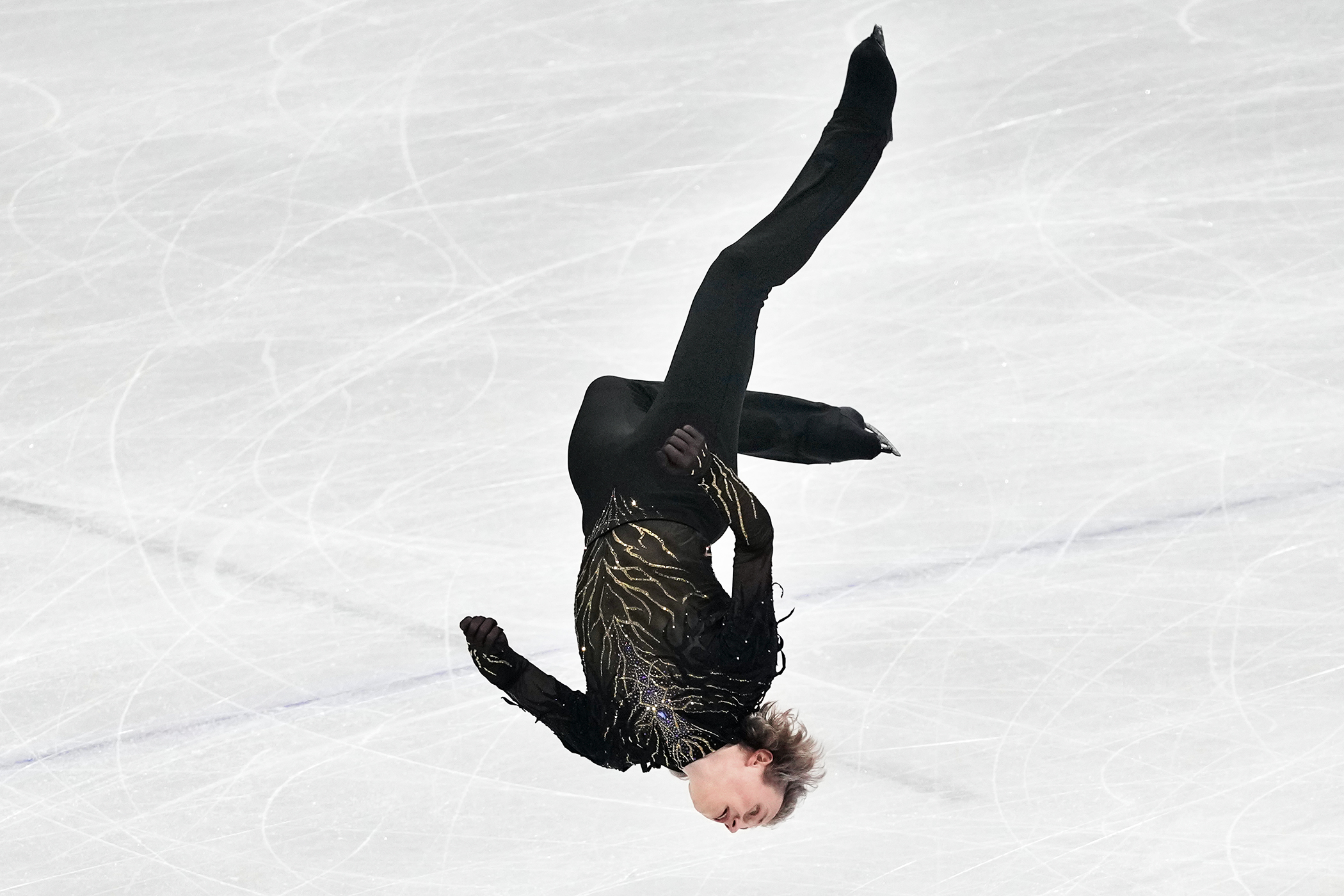
No one fits into the internet furore better than figure skating’s wunderkind Ilia Malinin, the 21-year-old “Quad God” – so-named as the first person ever to perform a quadruple axel in competition.
Malinin came here as favourite. He had not lost in competition for more than two years. The child of two Russian-Uzbek figure skaters who emigrated to the United States, his sallow complexion and feathered hair of a 1970s pop star give him an ethereal look. His popularity may have been helped by the fact his first name is the same as one of the protagonists of Heated Rivalry, the recent ice-adjacent TV show.
It is breathtaking to watch him. The eye is drawn to any skater, but Malinin is impossible to look away from. In the team event, he astounded the crowd with a backflip in his free dance, a routine which lifted the US into gold. On the internet, the argument rages about whether he is getting too much credit for a move that was allowed again in competition after it was executed by Adam Siao Him Fa, a French figure skater, or if Surya Bonaly is being erased as the black figure skater who did it in protest at the judges in 1998.
He is also divisive. He can appear arrogant. His early success and figure-skating nepo-baby credentials give off entitlement. He was previously sent on sensitivity training by US figure skating after he said as an 18-year-old on an Instagram Live that he would get more points from judges if he was gay. Naturally, he is now glibly referred to as homophobic.
Newsletters
Choose the newsletters you want to receive
View more
For information about how The Observer protects your data, read our Privacy Policy
As he walked out for his warm-up in the final, Malinin shaped up as if he was about to do one of his famous backflips before wagging his finger. It was the kind of cocksure behaviour that Malinin has developed a reputation for. Fifty minutes later, it would look foolish.
Malinin had a lead of five points from the short programme going into the free skate. Given his consistency, it looked unassailable. Victory looked only more certain as his rivals began to fall on the ice. It began with Siao Him Fa, who was in the bronze heading into the free skate. There were gasps as he hit the deck again and again. Then came Yuma Kagiyama, the Japanese skater who is Malinin’s closest competitor and whom he edged out in the team event. He fell multiple times, too.
It reached the point where it seemed that Malinin could just have skated round the edge of the rink and still won gold. Maybe the idea of being risk-averse – so unnatural to the way he performs – was in the back of his head as he came out and did just a single axel when there should have been a quadruple. Then a double loop instead of a quad. Then he began to fall, too.
As his routine came to an end, Malinin looked shell-shocked. So was everyone watching. Mikhail Shaidorov took a deserved gold medal with a stunning routine, yet even he admitted that he could not have anticipated what happened to the skaters who came after him. Malinin finished eighth.
It was either a crushing blow to an undeniable talent or an amusing outcome for someone who had underestimated the pressure of competing at the Olympics.
The tension between those two truths fuels the content machine further. Sports fans love a fallen angel as well as a villain and Malinin is compelling enough to be both. He is the perfect character for figure skating as the internet’s sport.
His father, who is his coach, had his head in his hands as they waited for the scores. Malinin sat stoically alongside, as he has for his entire life, the boy groomed for success. Peel back the internet’s noise, its caricatures and preconceptions, and there is still a man. The way that the internet loses sight of that is not limited to figure skating.
Photograph by Stephanie Scarborough/AP Photo