
Red cap pulled low over her eyes to keep out the sun, Faye admitted she did not know who she wanted to win. In a literal sense. “I don’t know who the other team is,” she said. New Zealand. “In that case I’ll support them.” She was much more certain about who she wanted to lose. The slogan on her hat made that perfectly clear. Make Iran Great Again, it read.
She had joined a few hundred members of Los Angeles’s Iranian community here – the closest possible point to the stadium without encroaching on what is, for the next month, effectively sovereign Fifa territory – a couple of hours before Iran made their fraught, freighted debut at the 2026 World Cup.
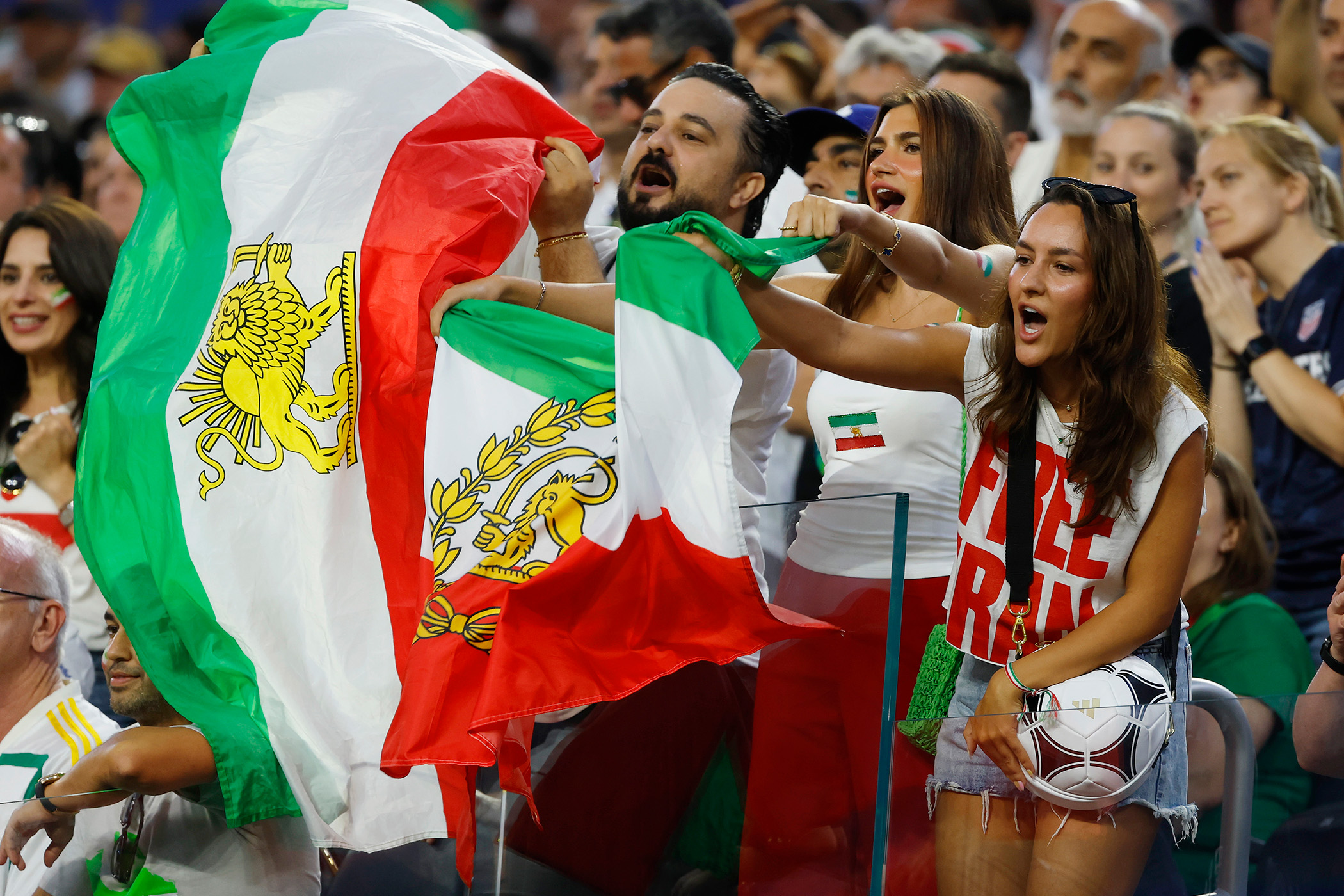
Many of them had come bearing the flag of pre-revolutionary Iran, either as a gold-fringed banner or in the form of a T-shirt. Others brandished the Stars and Stripes, or the flag of Israel. There were placards demanding regime change, and images of Benjamin Netanyahu, Donald Trump and both Reza Pahlavi, and his father, Mohamed Reza Pahlavi, the Shah deposed in 1979.
Politically, their views largely aligned with Faye’s: they want Trump, as she put it, to “finish the job.” Like many, she was reluctant to give her last name. The Iranian state, they fear, has eyes and ears among the diaspora in Los Angeles, a city with such a large Iranian population – many of them identifying as Jewish Persians – that one stretch, centred on Westwood Boulevard, is known as Tehrangeles.
The question of exactly where the Iranian football team fitted into that was a little more vexed. The conflict between the United States and Iran had made it unclear whether they would even be able to play at all. Weeks before the tournament, there had been few guarantees they would be allowed to take part. A World Cup host has, after all, never previously been at war with a participant.
Iran’s preparations had been derailed in innumerable ways. Several members of their backroom staff had been refused visas to the United States; the country’s football federation had been allowed by Fifa to move their training facility to the Mexican city of Tijuana. They would only enter the US to play their games, and perhaps not even that: some of their delegation were on day visas, and Fifa’s regulations state a team must arrive 48 hours before a game.
The team eventually landed in Los Angeles on Sunday. There were small protests at the airport and at the hotel, but it would be wrong to say there was a unanimous decision on how to respond to that. Most harbour some degree of sympathy for the players, acknowledging that they are in an impossible position. One of their number, Sardar Azmoun, had been omitted from the squad, apparently for posting a picture to social media that did not meet with governmental approval.
Beyond that, there is little consensus. Some, like Faye, see the team as representatives of the regime. On Sunday afternoon, as a peace deal to end the conflict was being agreed, activists had gathered not far from Westwood Boulevard to hand out T-shirts and flags to fans planning to attend the game. Fifa’s regulations proscribe the pre-revolutionary flag as a political symbol; fans were not, officially, allowed to bring it into the stadium.
“I think the idea is that we put the T-shirts on under our shirts,” said Justin, a Jewish Persian. He had paid $1,350 for three tickets; he would be at SoFi with his mother and brother. He was planning on taking a flag, too. “I have one at home. I’m going to take an Israeli one and an American one, too. That way, if they take it off me, I’ll still have them.”
But that stance was not universal. “You have to remember that this is Team Melli,” said Payam, a fan from London who had flown to the US for the game, using the Iranian national side’s nickname. “There is a difference between the country and the government. The team does not belong to them. It belongs to the country.”
Newsletters
Choose the newsletters you want to receive
View more
For information about how The Observer protects your data, read our Privacy Policy
He had the banned flag wrapped around his waist, an image of the Shah as the screensaver on his smartwatch, and the 2018 edition of the country’s national shirt on his chest. This was, he said proudly, the fifth time he has seen Iran at the World Cup. He seemed genuinely taken aback to be asked who he would be supporting. “Iran, of course,” he said.
That confusion, the sense that nobody was quite clear who to support, swirled around the vast bowl of SoFi all evening. The flag of the Islamic Republic was unveiled to no great reaction. The anthem, that other great flashpoint, was booed, by some. It was sung gustily by others. People are complicated.
Fifa’s prohibition on the flag had, very obviously, not worked. There were hundreds, possibly thousands, visible in the crowd. The rule had, as was always likely, proved unenforceable.
There had been stringent security measures outside, of course, but they are not designed to decipher symbols on clothing or detect concealed strips of material. Denying people entry for painting something on their faces was never going to be a practical option.
It was easy to suspect that the television crew broadcasting the game were under instructions not to show them on screen, but there were so many that it was impossible to avoid it. In the stands, there were occasional arguments, quarrels, but nothing more severe. From on high, the remnants of the protest were visible outside.
On both occasions that New Zealand took the lead, many of those flags flourished in delight. Rumbling chants of “Iran” rolled around the stadium as they sought to equalise. When they did so, the noise was ear-splitting. Iran seemed to have plenty of supporters wearing Mexican shirts. They had plenty wearing Iran shirts. Some of the flags fluttered, too, perhaps even the same ones. The game finished in a 2-2 draw; the abiding impression was that nobody won, in the end.
Photograph by K.C. Alfred / The San Diego Union-Tribune via Getty Images