Buried in a Surrey village, across the green and past the petrol station, is a portal to the past. All greys and beiges and burgundies, Lakeside first hosted the British Darts Organisation (BDO) World Championship in January 1986, and hasn’t changed since, without a lick of paint since Black Wednesday, an overwhelming aroma of fag smoke and stale racism.
Every available wall is littered with time-stained photos of the faded stars who populated its salad days – Tom Jones, Showaddywaddy, Jim Davidson, Michael Barrymore, a grinning Rolf Harris – while the entrance is marshalled by a woeful oil portrait of Margaret Thatcher. Sid Waddell wrote that Thatcher called Lakeside, the self-titled “home of world darts”, “one of her favourite places for Tory jollies”.
The World Darts Federation World Championship is the successor to the original championships, which ran until the BDO folded in September 2020, with the WDF, the sport’s official governing body, taking it over. It now vies for room as the sport’s premier open amateur event, well behind the Professional Darts Corporation’s (PDC) Christmas carnival at Alexandra Palace, with the Amateur Darts Circuit Global Championship running simultaneously and offering £60,000 to the winner, compared with the WDF’s £50,000. The women’s competition is considered the pinnacle of the female game.
This desolate December Thursday is midway through the 2025 event, the 39th Lakeside edition of a tournament once won by Phil Taylor and Eric Bristow. Lakeside is an attraction in itself, and players love coming here. “It still feels like the glory days,” one attender remarks. “Because they haven’t changed the carpets.” Everyone involved is aware that attempting modernisation would kill both Lakeside and the World Championships, breaking a spell already stretched to the limit of feasibility.
Bizarrely for a sport now defined by the PDC’s travelling circus of socially acceptable hedonism, the defining sound of a day at the WDF World Darts Championship is the eerily rhythmic thud of tungsten hitting sisal, every dart broadcast around a crumbling cabaret hall. A phone chimes during the first leg of the afternoon and it’s a surprise that the culprit is not stoned on the spot.
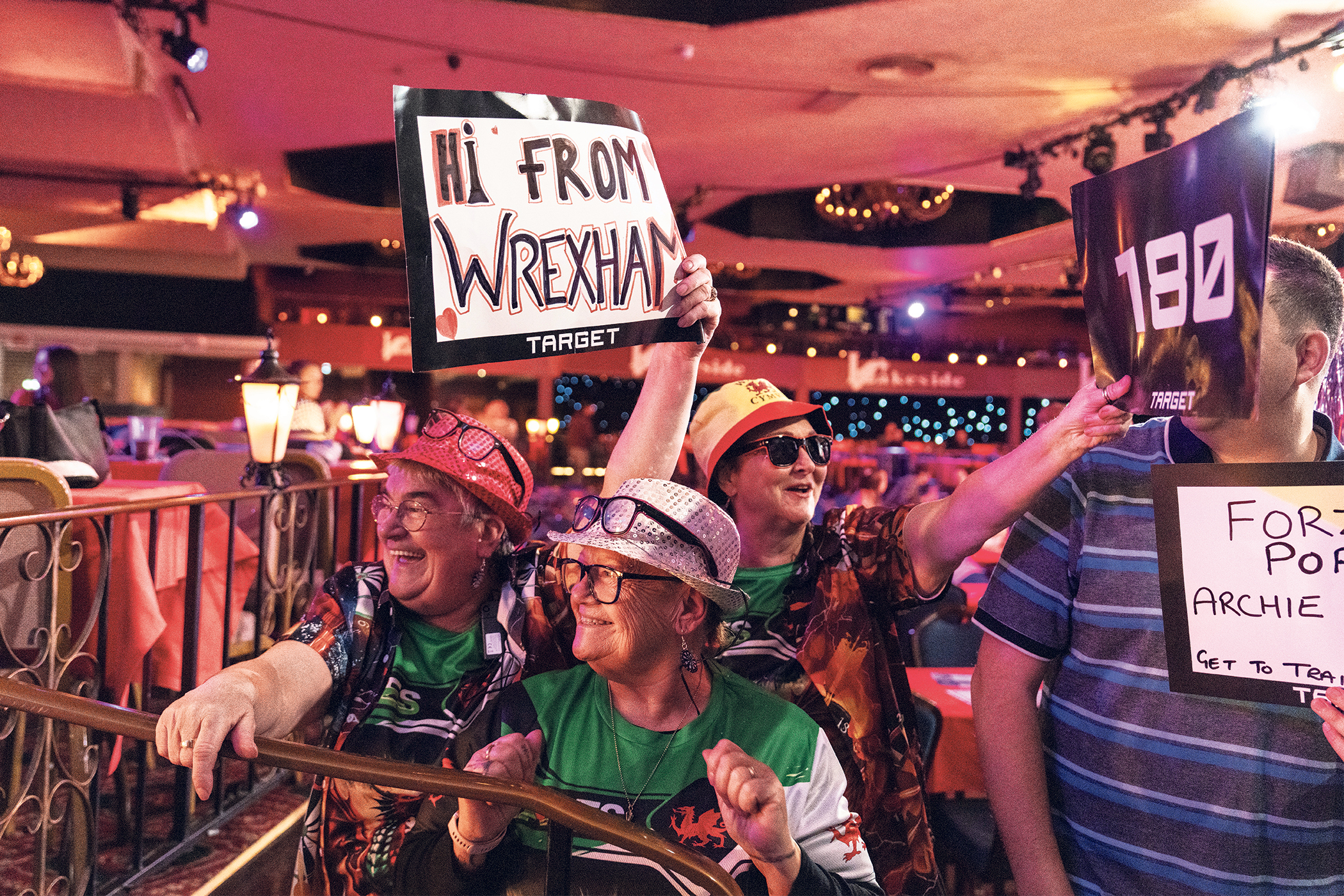
They drink – of course they drink – but this is respectful drinking, knowledgeable drinking from a knowledgeable crowd. As I repeatedly hear: “People who come here actually play darts.” Some have attended every year since the 1990s, often sitting at the same tables on the same days. A trio of middle-aged women in berets and feathered skirts – three French hens – have travelled from Whitby for the last 12 editions.
They much prefer their “Frimley Family”, the people they see here annually. They were pigs in blankets yesterday and have big plans for their Christmas tree get-up tomorrow. But while there are the odd bunch of bananas and a lifelike Dennis the Menace, less than half of the 100 or so attendees are in fancy dress. One couple look as though they have been dragged out of American Gothic and are really not happy about it, sat bolt upright with folded arms and pursed lips for 10 hours.
A quick glance around the cavernous cabaret hall locates a goth, a man in a three-piece suit and another in lederhosen. Women are in cocktail dresses and men their finest knitwear. None of this is to say that people aren’t enjoying themselves. They’re just not following the sport’s increasingly oppressive conventions.
Of course, some still don’t quite get the memo. A pallid Northern Irishman who “likes Nigel Farage” knocks his pint into his lap and barely flinches as lukewarm lager soaks into his trousers. “I will never regret anything,” his associate proclaims to no-one, moments before receiving his fifth and final warning from the admirably patient security, proudly downing his dregs before being escorted from the venue with the sombre deference of a man bound for the guillotine.
The smorgasbord of mankind on show is entertainment enough in itself, with this year’s Open field featuring 19 different nationalities. The youngest player in the senior category is 15-year-old Mitchell Lawrie, while 69-year-old American Paula Murphy was knocked out in the first round of the women’s event. Some are here in preparation for the big time, others comfortable in the knowledge that this is their peak.
Newsletters
Choose the newsletters you want to receive
View more
For information about how The Observer protects your data, read our Privacy Policy
At 6ft 9in, the No 1 seed Jimmy van Schie, “The Dutch Sequoia”, stoops forward when he throws like he’s trying to squeeze through a Hobbit’s doorway. At the WDF Six Nations earlier this year in Merthyr Tydfil, the stage had to be adjusted so his head didn’t hit the ceiling. German Paul Krohne turned down a PDC Tour Card to continue his engineering degree. Slovenian Benjamin Pratnemer, a licensed physiotherapist, has reverse-engineered his incredibly fluid if slow action to protect all the relevant muscle groups. Francois Scheyen always warms up in a coat with the exact same design as his playing shirt.
James Beeton, a 22-year-old former Chester FC academy product, was forced to remodel his throw entirely after a brush with dartitis, and he now performs a full practice throw before every dart – an arduous and unsustainable crutch for both him and the viewers. Having hit a televised nine-darter as a 16-year-old, his career has clearly not developed as he hoped, and playing is still difficult. Despite almost throwing away a two-set lead, he eventually makes it into the quarter-finals. His secret? “I get through it by…” he leans in, pausing for dramatic effect, “...alcohol.”
The PDC has spent much of the past 20 years attempting to free darts of its “double vodka” image, with the party line that alcohol plays no part in professional darts anymore. That might be true, but it certainly does here. The Players’ Bar doubles as a practice room, whiskeys and wines peppering the sparse tables, with Carlsberg and Angelo Poretti an underwhelming lager lineup.
Reigning champion Shane McGuirk is not scheduled to play until 3.30pm, but he’s halfway through a bottle of Magners well before midday. A Czech women’s player quietly spends her evening negotiating a four-pint jug of Guinness. Beeton began drinking at 7.45am for his midday match. Few players have not polished off at least five drinks pre-match. The uninitiated might call this unprofessional, but forcing down your third pint by 10am requires an unquestionably professional commitment.
“Big Rig” Ben Robb looked visibly tired and emotional as he beat Irishman Stephen Rosney 3-0 in their last 16 game. Tournaments in Germany and Sweden have attempted to ban alcohol from the premises entirely, but had to scrap their policy when averages plummeted.
And yet there remains hope that a fresh generation who learned to play in academies rather than pubs might finally change the sport’s relationship with alcohol. Luke Littler is the face of this, but the consensus is that Lawrie is destined to catch him in the near future. Having turned 15 in November, Renfrew’s “Wee Sox” beat American Jeff Springer Jr 3-0 to win his last 16 match, although his 93.06 average is down on his 97.21 from his previous victory over the No 2 seed.
Over 6ft, he looks his age in a way Littler never did, and calls comparisons to the world No 1 – whose record for youngest winner at Lakeside he broke last weekend – “absolutely class”. Replete with “the world hasn’t hurt me yet” swagger, he has won multiple senior events this year but still cannot compete for a PDC tour card until 2027. He is more confident than Littler was at 15, but similarly gilded.
He’s been working with a mental coach, focusing on “sacrificing stuff, like not going out with my friends,” he said.
“I do miss it sometimes, but when you’re here, you realise it’s all worth it. You still need to be a boy at the end of the day, enjoy yourself. I’m only 15, but if I want to be a professional darts player, I know what I have to do.”
On the oche, Van Schie’s 3-1 win over Krohne is a brilliant match by any standard, every set going to a deciding leg, all shadow-boxing and punished hubris. Lawrie is wreathed in the white light of possibility, in the joy of being at the start of something. Darts’ beautiful starkness, its ability to expose the full gamut of humanity, is universal. Under the fading chandeliers, there is the feeling you are tapping into something eternal.
“As long as we can have it here at the Lakeside, we don’t plan to go anywhere,” WDF president Buddy Bartoletta said. “It keeps the history of the game alive.”
Beyond that, it maintains a blissfully lost world of Tory jollies and sex offenders crooning cabaret. Lakeside is what darts once was. Maybe, beneath all the money and eyeballs and veneer of professionalism, it’s what it still is.
Photograph by Antonio Olmos/The Observer