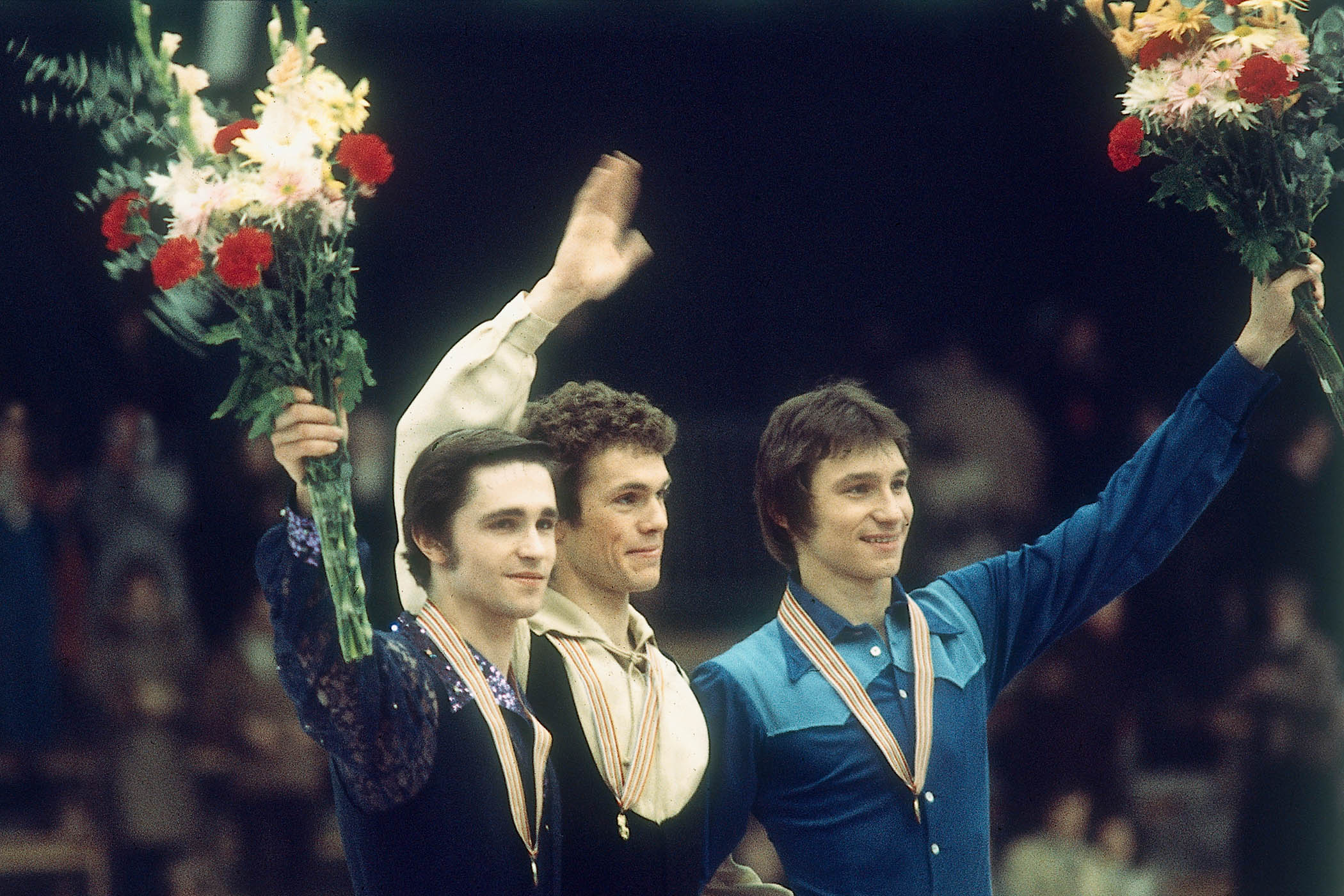


John Curry was by no means the first gay sportsperson. He was not even the first sportsperson to be publicly outed. But he holds an important place within gay sporting history.
At the 1976 Winter Olympics, Curry told a journalist that he was a “homosexual”. After winning gold in figure skating, the news was syndicated across the English speaking world. Curry’s life, already set to change drastically following his victory, would never be the same again.
Whether Curry had meant to do this continues to be debated. He insisted throughout his life that he had thought the conversation was off the record, but John Vinocur, the journalist, himself believed Curry knew exactly what he was doing. Certainly within his personal circle, the skater’s sexuality was no secret, and it had long been gossiped about in the wider world of figure skating.
There is often a well-meaning separation made between a gay athlete’s personal and sporting life. It is an attempt to see off negative prejudices that suggest their sexuality might affect their performance. Yet Curry’s relationship to his gender and sexuality were intertwined with the way he skated, which in turn revolutionised the sport for ever.
When Curry began skating, his balletic approach contrasted with the virile masculine expectations of the sport. Figure skating was not just about dancing on ice, but until 1990 involved “compulsory figures”, whereby skaters drew specific patterns into the ice. Curry’s onlookers, and occasionally his coaches, despaired at his insistence on using his whole body when he skated, considering it too feminine. But by the time he reached Innsbruck in 1976, no one could deny his sheer brilliance. That determination to push boundaries came from his own experiences of his gender and sexuality.
Curry came out at a unique time in British gay history. Homosexuality had been partially decriminalised in England and Wales in 1967 to permit sex in private between consenting men over the age of 21 (Scotland and Northern Ireland followed some years later). Lesbianism was never criminalised, mainly due to concerns in Parliament that it would only encourage it, while homosexuality was not fully decriminalised until 2000 when the age of consent was lowered to 16, in line with heterosexual sex.
Despite this, public attitudes to homosexuality were still conservative. As Christopher Brasher wrote in The Observer at the time of Curry’s coming out, following a press conference where the skater confirmed what had been written: “Opinion began to emerge that it was John who was normal and that it was we who were abnormal. By which we meant that he had spoken with the honesty of modern youth […] However much the law has changed, the minds of most of us are still full of taboos.”
Curry’s popularity in spite of his public proclamation of his sexuality can be seen in his victory at BBC Sports Personality of the Year in 1976, beating James Hunt, the Formula One driver who had won the world championship that year. Yet that did not mean he was free from barbs. At his entrance to the Sports Journalism Association awards, taking place at Christmas, the host joked that Curry was “the fairy for the tree”.
His work as a professional was unapologetically gay in its themes. His piece “Icarus”, which was performed at the London Palladium to rave reviews in 1977, involved Curry dressed in wings and shorts dancing with his lover at the time, Ron Alexander.
Yet as thousands of men across the world began to lose their lives to AIDS, some gay people were turned into pariahs, with the implication that they had brought the disease on themselves. Even today, commentary on Curry points to his experiences of casual sex and participation in the BDSM (which can include bondage, discipline, submission, masochism) community as evidence of a “darkness” within him.
Newsletters
Choose the newsletters you want to receive
View more
For information about how The Observer protects your data, read our Privacy Policy
AIDS robbed thousands of men, talented or not, famous or not, of the opportunity to have any kind of legacy.
Curry himself was diagnosed with HIV in 1987 and with AIDS four years later. After a number of years living in New York, he made his way back to England where he was nursed by his mother for the remaining three years of his life. The former champion skater slowly wasted away under the strain of the disease, often refusing to accept visitors for fear of how changed he had become.
Outspoken until the end, Curry was one of the few celebrities who publicly talked about his condition. In an interview with The Mirror, he said: “I have tried to see what’s good around me and to think back on my… unusually exciting life… I had everything and loved every moment of it.”
The interview ran under the headline: “All my friends died of AIDS. Now it’s my turn.”
His main concern was to raise money for his treatment and his mother, which culminated in the sale of his Olympic, world and European Championship medals. They were bought at Sotheby’s for £22,000 by a fan who returned them to his family.
Fifty years on from Curry’s victory, his life is a reminder that acceptance of LGBT+ people in sport and society is not a linear process. Curry’s coming out was not met with vitriol by the British public but he suffered from the homophobic culture that intensified during the 1980s and 1990s.
Equally while there have been hundreds of gay trailblazers across many sports throughout the years, homophobia and transphobia continues to be rife in the sporting world. Transgender and intersex people are increasingly limited in their ability to compete in sports, even at a grassroots level. The professionalisation and prevalence of women’s sport has pushed boundaries in terms of LGBT+ acceptance but it remains limited within men’s elite sport. There has never been an out footballer active in the Premier League, for example.
On the morning of 15 April 1994, John Curry’s mother Rita found he had fallen out of his bed during the night. His heart had simply stopped. He was 44 years old.
Photograph by Donald Stampfli/RDB/ullstein bild via Getty Images