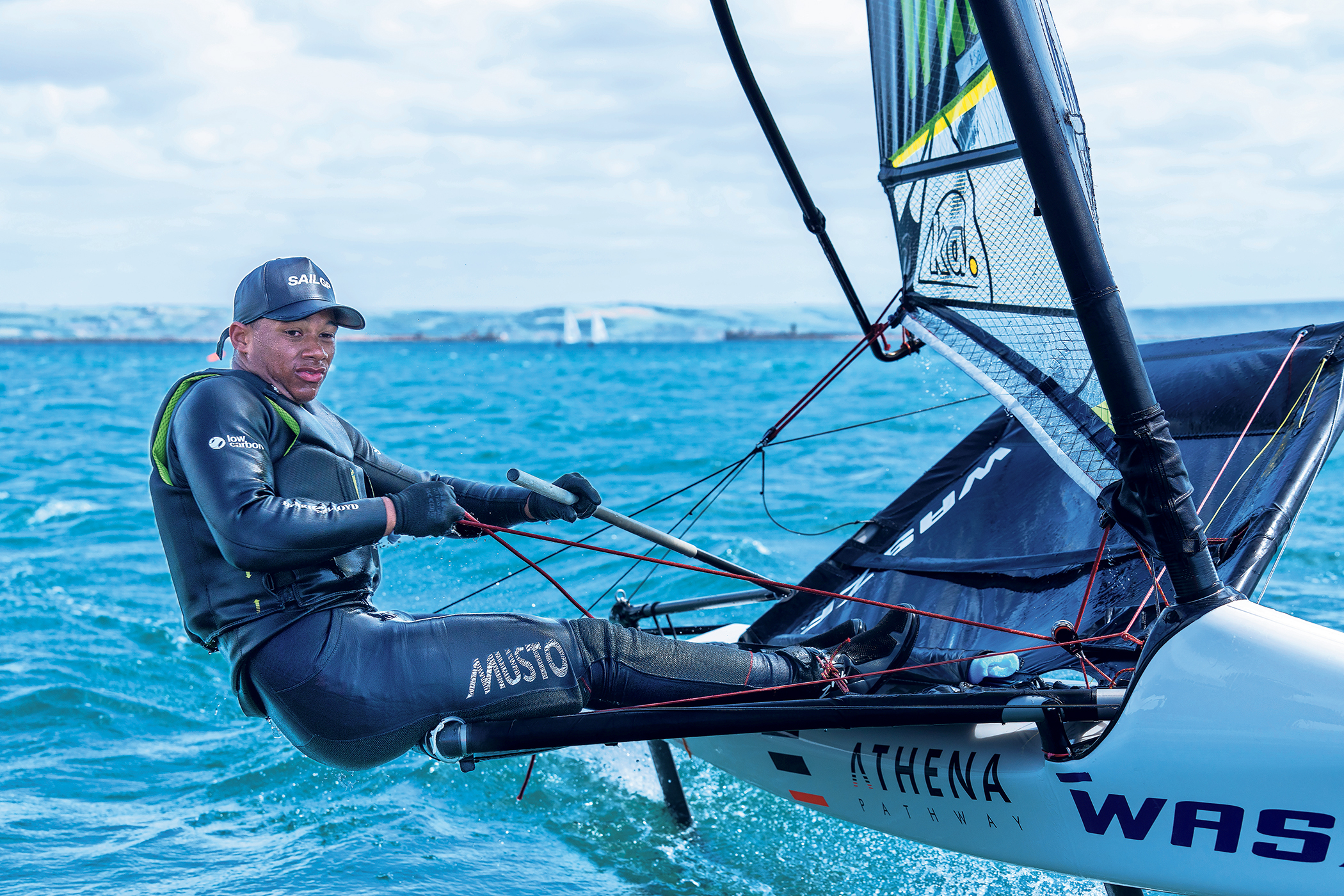


Top-level sailing is to diversity what an England Ashes tour is to national morale and Claudia Winkelman to the receding hairline.
The “three blondes in a boat” vibe of Britain’s gold medal winning trio of Shirley Robertson, Sarah Ayton and Sarah Webb at the 2004 Athens Olympics has not really moved on after 22 years. Every British competitor since then has been white.
Ineos Britannia, which became the first British boat to reach the America’s Cup match race in 2024, had an all-white crew. So too the Emirates Great Britain team that won the SailGP title last November. Kai Hockley, then, has some glass ceilings to smash.
In Australia this weekend with Sir Ben Ainslie’s Emirates Great Britain team as they begin their defence on the opening race weekend in Perth, the 20-year-old Londoner has his sledgehammer at the ready. He is the agent of change.
Hockley’s unlikely story began as a 12-year-old at Greig City Academy in Haringey. “I was playing football on a Saturday at the time, training during the week, doing what most kids would do,” he said. “Then the head of the sixth form gave this assembly to the Year 7s, talking about the sailing team that he had started. He wanted us to go to the reservoir to get the basics of sailing.
“Inner-city schools in north London are not very well known for sailing, but Mr Holt was very keen. We went out in the water, didn’t really know what we were doing but had a good time and it just progressed from there.”
Tuesday after-school club morphed into weekends on the road, overseen by his inspirational teacher, competing around the country with a handful of mates. The Tottenham kids stood out, it was fair to say.
“We would go to events and there would be five of us so we were never by ourselves, which was kind of nice,” he said. “But the sailing community is so welcoming we never felt out of place because everyone always wanted to teach us, help us, and further us in sailing.”
Sailing is not a cheap sport and to help fund the venture, the schoolboys would make pitches in person to local businesses for support. It turned out those who came on board were backing a winner in Hockley.
Within two years he had become the youngest competitor in the Fastnet Race. By 2023, he had been named Cowes Week Young Skipper of the Year. Still, though, a life on the ocean waves seemed a pipe dream.
Newsletters
Choose the newsletters you want to receive
View more
For information about how The Observer protects your data, read our Privacy Policy
“Throughout my time in school I didn’t really think of sailing as a possible career. I just competed. I just wanted to race against everyone,” he said. “I didn’t even know there was a pathway, not just because I was from the inner city but because the whole of sailing is kind of hard to navigate.
“To be honest, the first time I thought sailing could be a job was when Mr Holt got a message from Hannah and Ben asking whether I would like to come to Sydney for a trial. I was like: ‘Whoa! This could be a serious opportunity.’”
Hannah Mills, Britain’s greatest female Olympic sailor, and Ben Ainslie, her male equivalent, had just set up the Athena Pathway Programme to try to widen British sailing’s net. Hockley was their first intern.
Eighteen months on, he has been part of the British shore team at the America’s Cup in Barcelona and spent a season on the glamorous SailGP circuit where 13 teams face off at 12 grands prix around the world. Hockley is training up as a grinder, the power source for the F50 catamarans and the most punishing physical role on the boat.
‘If I do get on the boat, it’ll increase the number of people trying to get into the sport’
‘If I do get on the boat, it’ll increase the number of people trying to get into the sport’
Kai Hockley, Athena Racing
“When I went to the last America’s Cup with Ben’s team and saw the numbers the guys were putting up, that was a real eye-opener. I was like: ‘Jesus, it takes a lot to get here.’ But I’m putting in the work and hopefully I’ll get there,” he said.
“It’s not just the physical side but the mental and technical sides, too – SailGP is the same standard as F1.”
Each of the identical boats has 125 sensors on board which provide real-time information shared by the 13 competing teams so set-ups are constantly being tweaked. “There’s a lot to learn but knowing that you’ve got an opportunity that loads of people would want, I think that drives you to keep on going,” he says. “The goal is to get on an F50 racing regularly.”
He is learning his trade as a development sailor, eagerly awaiting his chance to race. Mills, the Emirates Great Britain on-board strategist, recognises his talent.
“It’s so hard to get on the boats in this league but we’ve really high hopes for Kai. I feel very confident we will see him on the boat in the future and that would be massive for him and the sport,” she said.
While Hockley is happy to embrace the role of trailblazer, talking in schools about sailing as a sport for all, he knows the overarching importance of making it on to the boat if his message is to land. “Obviously you have to work your way on to the boat but if I do get on and people see that then they can see that the pathway does work,” he said. “I’m really hoping that happens not just for me but because it will increase the amount of people trying to get into the sport.
“SailGP is really cool and it’s expanding at such a fast rate that I think more opportunities will start opening up for loads of people from loads of different backgrounds, which is the big thing sailing needs.”
Ainslie, the team CEO, agrees, although his motives are not entirely altruistic. “We want to create these opportunities, not just because it’s the right thing to do for the sport, but also commercially because as the sport grows, across SailGP and the America’s Cup, there’s going to be a shortage of these athletes that have the capability to sail these boats,” he said. “As we’ve seen in football, having an academy programme and that home-grown talent coming through is going to be both a competitive and a commercial benefit.”
Whatever the big-picture thinking, it feels like only a matter of time for Hockley.
Photograph by L Goldman/Ineos Britannia