

Joe’s Bar-B-Que does not really need to take requests. It is home to the actor Paul Rudd’s favourite sandwich. It once supplied Barack Obama and his staff with $1,400 worth of takeaway, duly inhaled on board Air Force One. Anthony Bourdain, no less, included it in his list of the 13 places to eat before you die, a few spots below El Bulli, which some say is the world’s best restaurant. It was home, he said, to “the best barbecue in the world”.
Still, over the last few months, every time Joe’s director of marketing, Eric Tadda, has found himself discussing the company’s preparations for the World Cup, he has made a point of soliciting whatever advice he can. What beers would Argentinian fans like to see on tap? What side dishes would the Dutch prefer? Will the English want Guinness, even though it’s Irish?
“We want people to come and have an authentic midwestern barbecue experience,” Tadda said. “We want them to have a taste of Kansas City, but if we can give them a bit of a taste of home, too, then we will try. We have a tradition of midwestern hospitality.” It is, clearly, something they take very seriously indeed.
Adjusting the menu so that visiting fans might be able to have a Stella Artois with their brisket and burnt ends – “Beef cubes,” Tadda said, and singled out in his review by Bourdain – is not the only provision Joe’s has made for the World Cup. It has had its menu translated into Spanish and, more impressively, Dutch; it is looking at reconfiguring its parking lots to suit the proclivities of European and South American visitors.
“We’re quite a touristy destination,” Tadda said. “People travel from all over to eat here. But most Americans will come for a few days and hire a car. We’re expecting this summer to be more third-party transit: public transportation, Ubers, that sort of thing.” There are plans for a drop-off and pick-up zone to prevent queues.
And then there is the thorny issue of tipping: implicit for Americans, but a source of bafflement (and stress) for everybody else. Circumventing that, Tadda knows, is a delicate matter. He has heard that some restaurants are considering including a service charge to avoid confusion, but he wonders whether the “extra business” the World Cup brings maybe should be considered reward enough.
That, of course, is no small part of the appeal of hosting the World Cup: sporting mega-events mean an instant, and substantial, economic uplift; it is why cities compete so ferociously to hold them. As the smallest – by most measures – of this summer’s 16 host cities, that will be especially pronounced in Kansas City.
They are anticipating somewhere between 650,000 and a million supporters to arrive over the course of five weeks or so: a boon not only for the city’s hospitality sector, but for all of those industries that supply them. It is, as Tadda pointed out, quite a good time to be in the napkin business in the midwest. “Plates, cups, napkins: all the restaurants get them from the same one or two suppliers,” he said.
‘We’re not going to minimise what this event is. We want it to be organic, and maybe a little bit raucous’
‘We’re not going to minimise what this event is. We want it to be organic, and maybe a little bit raucous’
Mayor Quinton Lucas
In Kansas City’s case, though, the belief is that the impact will last longer than one glorious, money-spinning summer. Hosting the World Cup, the city’s powerbrokers feel, could do for Kansas City what holding the 1996 Olympics did for Atlanta. Not only in the form of an upgraded airport and expanded tourist infrastructure, but reputation.
“We’re already a great national city,” said Tracey Lewis, President and CEO of the Economic Development Corporation of Kansas City. “But this puts us on the world stage.”
The city already knows the power of the spotlight that sport can cast. As Quinton Lucas, the city’s 41-year-old mayor, said, Kansas City has at various times been known for “farmland, the Wizard of Oz, and Taylor Swift’s fiancé”. Its most potent international brand, though, is its American football team, winners of three and runners-up in two of the last seven Super Bowls. Outside of the United States, there is a very good chance that when people think of Kansas City, they think first of Patrick Mahomes and the Chiefs.
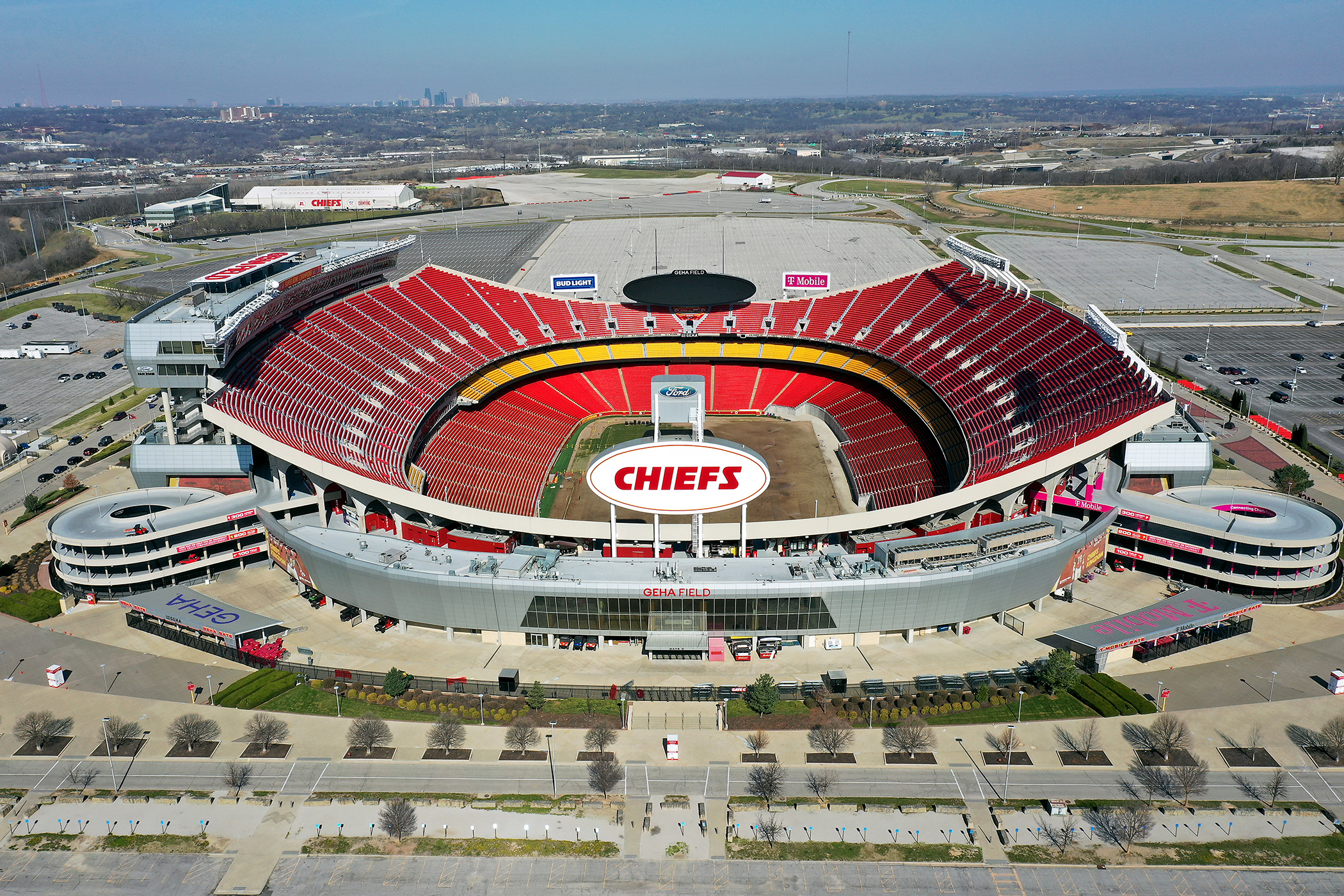
The plan, then, is for the World Cup to follow much the same playbook, just on a much grander scale. Arrowhead Stadium, the home of the Chiefs, will host six games across the first month of the tournament, starting with visits from Argentina and the Netherlands in the group phase, including a knockout game that might feature Portugal, and culminating in a quarter-final that might involve either the current holders or, at a push, the tournament’s principle hosts.
But Kansas City has successfully pitched itself as an ideal base for teams, too. Four competing nations have chosen their training facilities here, attracted primarily by its location: in a tournament of vast distances and inordinately complicated logistics, Kansas City is slap-bang in the middle.
Argentina, the Netherlands and Algeria will all be based in the area; so, too, will England, staying at the boutique Inn at Meadowbrook in Kansas, with Thomas Tuchel’s players training at Swope Soccer Village, just on the other side of the state line in Missouri. “We chose a hotel where you can open the window, where it’s an intimate and small place,” Tuchel said. England will, he promised, “try to be in Kansas City as often as possible”.
The effect, the city hopes, will be to turn the one heartland outpost of the World Cup into the diffuse tournament’s de facto heart. “If you land at JFK this summer and head into Manhattan, New York is so big that you could go about your business and not know there’s a World Cup happening,” said Mayor Lucas. “That will not be the situation here.”
A few weeks ago, when the mayor’s office received a call from the KNVB – the Dutch football federation – suggesting that they would like to close down at least one city street so that their fans could march to their game, he leapt at the chance; they have all seen the Naar Links, Naar Rechts videos – the viral bouncing from left to right dance – from Germany in the summer of 2024.
That enthusiasm has not been dimmed by the spiralling complications presented both by Fifa and by the political landscape in the United States. Mayor Lucas said he was “confident” that the presence of Immigration and Customs Enforcement officers – previously deployed to nationwide horror in Minneapolis and Los Angeles, and currently stationed in considerable numbers in the country’s airports – would not be a “complicating factor” once the tournament starts.
Unlike several host cities, meanwhile, Kansas City has not scaled back its commitments to fan parks and viewing experiences because of the difficulties presented by Fifa’s strict commercial arrangements. In New York and Boston, among others, plans have been changed or abandoned altogether when organising committees discovered that Fifa’s conditions made it all but impossible to secure sponsorship.
“With apologies for the language, we’re not going to half-ass it,” said Mayor Lucas. There are plans in place already for Kansas City to bid for games at the Women’s World Cup and the Men’s Rugby World Cup, both slated for 2031. This is its chance, he said, to prove that it can stage these events, and stage them well.
“We’re not going to minimise what this event is,” he said. “We want it to be organic, and maybe a little bit raucous, because we know that is when it is most interesting. We want people to come – Americans of all stripes, as well as fans of the competing nations – to come and experience it. We want to share ourselves on the world stage.”
Photograph by Jamie Squire/Getty Images
Newsletters
Choose the newsletters you want to receive
View more
For information about how The Observer protects your data, read our Privacy Policy