
David Beckham had a choice to make. In the summer of 2003, with the terms of his multi-million pound contract at Real Madrid agreed, the club felt confident enough to bring up the slightly awkward question of shirt numbers. The midfielder had worn seven at Manchester United, but that was already assigned to Real’s homegrown icon Raúl. Beckham would have to find an alternative.
He had a couple of options available to him. “We spoke to him about the numbers four and 23,” Jorge Valdano, then the club’s sporting director, would later recall. Beckham wanted to make the decision quickly, so as to be ready for his glitzy unveiling in the Spanish capital. “Finally, his wife intervened,” Valdano said. “She said something like: ‘The number 23 didn’t do Jordan any harm.”
Beckham’s account differed slightly in the details – his version, relayed to ESPN, did not feature a spousal intervention – but not in the general gist. “I’d always been a huge fan of Michael Jordan,” he said. “Everything he represented, everything he did in his career. I was a huge fan, so yeah: it was a no-brainer.”
Until that point, there had been scant evidence that either Beckham took a vast amount of interest in basketball. The sport was popular enough in Britain – it remains one of the largest participation sports in the country – but both the NBA and its domestic equivalent, the British Basketball League, had struggled for television coverage.
Occasionally, in the 1980s, brief highlights of the NBA Finals would be shown on World of Sport, ITV’s equivalent to Grandstand. There were spells on Screensport and Eurosport. Coverage bounced around Sky Sports, Channel 5, ITV Digital before landing, just before Beckham moved to Spain, on what would eventually become ESPN. If he was watching it, he was putting in the effort.
Being interested in basketball and being interested in Jordan, though, were two different things. Few people in Britain in the 1990s and early 2000s would have seen the six titles Jordan won with the Chicago Bulls in any detail. But everyone knew him as a commercial and a cultural phenomenon. He was on magazine covers. Thanks to his Jumpman logo, he was cast in silhouette on his eponymous, and desirable, trainers. Other apparel lines would follow. He was the face of video games. He was in movies.
He was a byword for excellence, for greatness, for what we would now call being the GOAT, the greatest of all time (although probably not in the movies). He was a name that anyone with even a passing interest in sports – or, later, fashion – would know instantly. Basketball made him famous, but it could not contain his fame. His number, 23, really did not do him any harm.
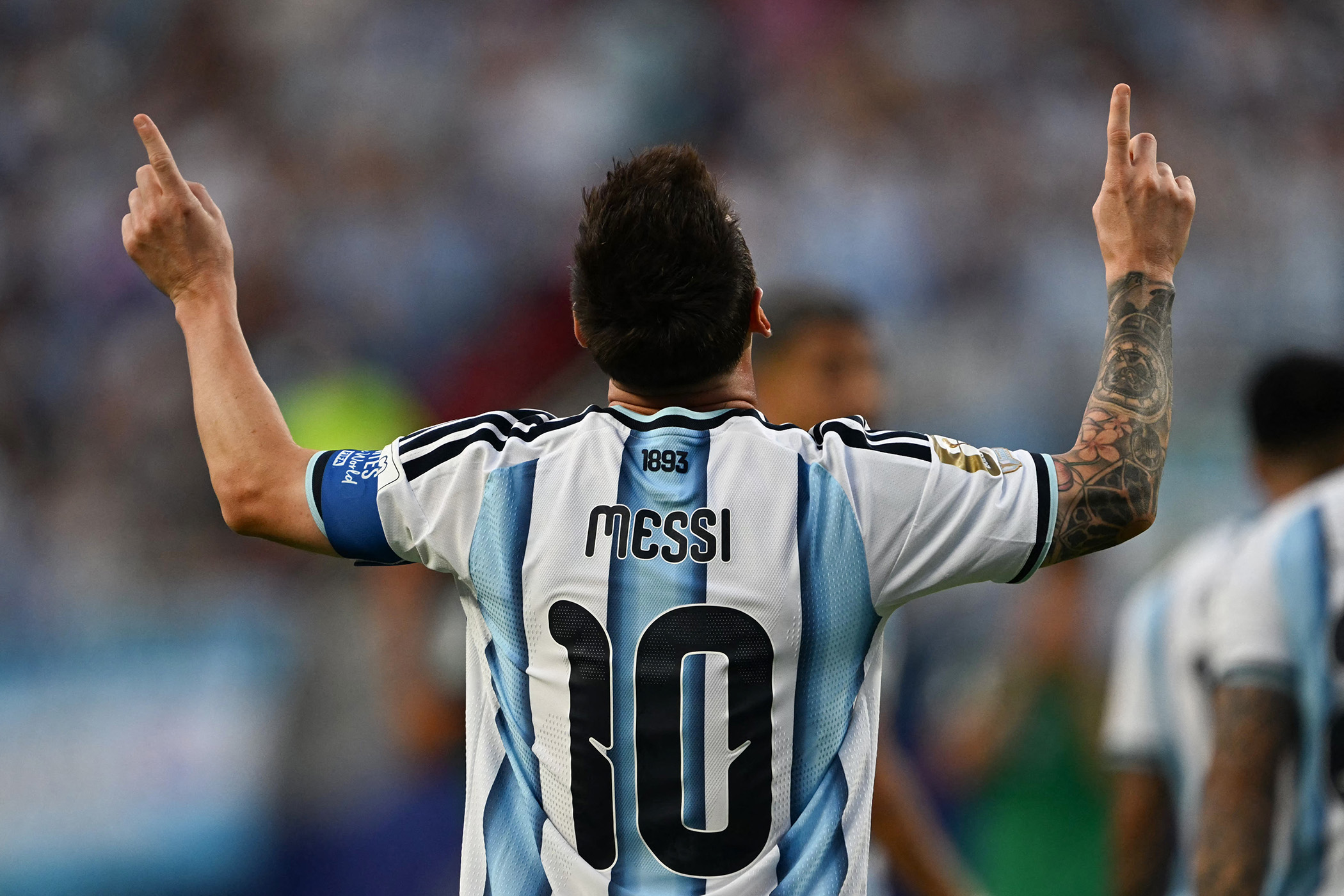
There is more than an echo of Jordan’s worldwide fame, 30 years ago, in the effect that Lionel Messi has had on the United States. Whether or not this is a football country might still, despite overwhelming evidence that it is, be open to debate. Whether it is a Messi country is very much an open and shut case.
He is a fixture in the cultural landscape, a synonym for greatness
He is a fixture in the cultural landscape, a synonym for greatness
Messi is everywhere in the US. He is, as has been noted, in more than a quarter of the adverts that have been commissioned here for this World Cup: he is never off the television, shilling for beers and crisps and batteries and sports apparel. A player who may have earned a billion dollars in career earnings has endorsed a special edition burger at the Hard Rock Café. It is, apparently, legendary.
His shirts are omnipresent. Inter Miami experienced such a rush when he first joined that Adidas had to reconfigure its whole global supply chain in order to get enough fabric in the club’s bespoke soft pink colour. There have been Argentina shirts in every city hosting World Cup games, regardless of whether Argentina are playing there or not. A conservative estimate would say that 95% of them bear Messi’s name.
Newsletters
Choose the newsletters you want to receive
View more
For information about how The Observer protects your data, read our Privacy Policy
But more importantly, he has not so much as cut through with a non-football audience but – just as Jordan did – transcended the bounds of sport altogether. He has won the admiration of other athletes; he has been described as the “GOAT” by Patrick Mahomes, and won praise from everyone from LeBron James to Marshawn Lynch.
In a country where everything is mediated through its effect on the famous, he has acquired a not inconsiderable army of devoted celebrities, too. Camila Cabello told The Today Show last month that she was travelling to Alabama to watch him play a friendly for Argentina; he has won over Reese Witherspoon, Owen Wilson and at least one Kardashian, maybe more.
In 2024, only 18 months after he moved to Major League Soccer, he became both the first footballer and the first foreign-born athlete to be named as the most popular athlete in the United States in the annual SSRS poll. He has been such a draw to the league’s games that there has been at least one class-action lawsuit filed over a heavily-advertised fixture that he missed.
His case is not an absolute parallel to Jordan’s, of course. Messi is present in the United States. He is someone that fans can go and see in the first person, in real life. Even before he moved here, nobody could claim that his career has been difficult to follow: Messi has been on television in the US, as he has everywhere else in the world, twice a week for the last 20 years.
He might be just as happy to endorse products – Republicans buy batteries too, it turns out – but his voice is much less familiar than his face; we have now reached the point where there is something quite endearing about the fact that Messi has become quite so famous without actually ever saying anything. In the social media age, where everyone exists as their own main character, his silence reads less as truculence and increasingly as an act of rebellion.
But even allowing for those differences, Jordan’s experiences outside the US remains the best model by which we might understand the nature and extent of Messi’s fame here. Messi is more than just the public face of his sport. He is a fixture in the cultural landscape, a synonym for greatness. Football has taken decades to win over the United States. Messi did it in a few months.
Photograph by Roberto Schmidt/ AFP via Getty Images