
If you could sneak past the security guard on the road to the stables at Badminton House in the next few days, you would find a grand courtyard, painted apricot. There are 45 stables in closed arcades that line the yard like shops around the Piazza San Marco in Venice. They have built-in mangers and 19th-century brass door fittings: stables that befit the Duke of Beaufort’s hunters, and the equine athletes that are set to compete in the most-prestigious horse trials in the world.
Most of the top horses will be living in those stables from Wednesday onwards, being massaged, groomed, eating feeds prescribed and mixed by nutritionists. But if you could walk on through the grand arch into an old farmyard, you would come to a row of three smaller stables. And at the end, you would find a tall, dark bay horse gazing over the stable door at the birds roosting in the clock tower.
This is Walter – or Lordships Graffalo as he is formally known – and this is his preferred box. “The other stables have bars across the doors,” his rider, Ros Canter, says, “but that’s not for Walter. At Badminton, he likes sticking his head in the air and watching the birds. He’s been in the same box every year.”
He must be happy there. Walter is one of only six horses to have won Badminton twice (he also came second at his first attempt, in 2022, when he was only 10 years old). This year, he could win for an unprecedented third time. He is already the horse of a generation: if he wins next week, he will be a legend for all time, the Usain Bolt or Muhammad Ali of the equine world.
‘He was a thug when he was younger, he pushed us around, treated us like toys’
‘He was a thug when he was younger, he pushed us around, treated us like toys’
Ros Canter
It takes a certain equine athlete to excel at the top level of eventing. They have to be excellent in all three stages: the balletic dressage, which is about accuracy and elegance; showjumping, which requires power and precision; and the cross-country test.
At Badminton, this involves galloping for 11 and a half minutes over large and imposing fixed jumps: hedges, tables, huge logs, into the lake, combinations of fences that demand quick thinking, bravery and, above all else, absolute trust between horse and rider.
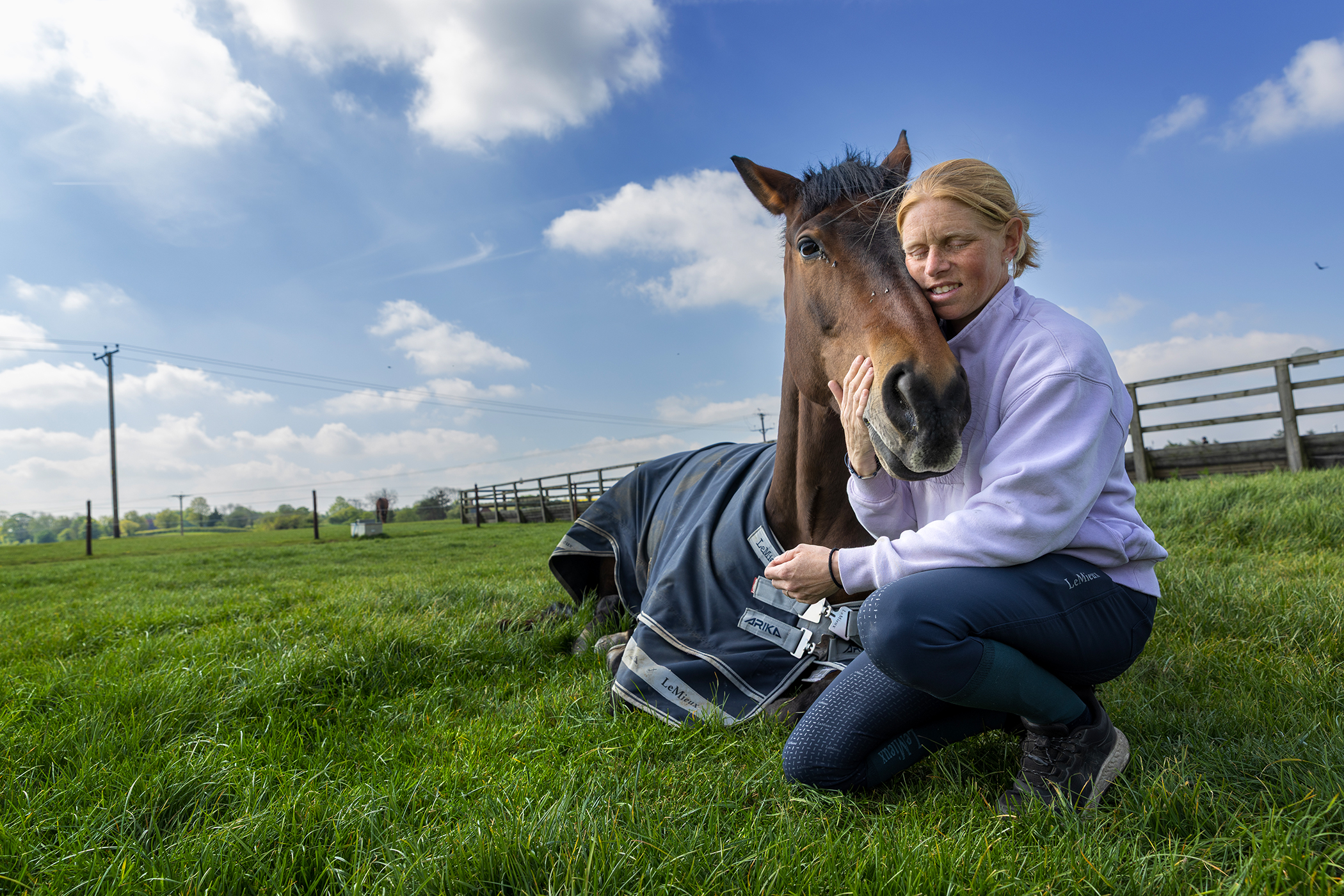
In no partnership is that more apparent than with Walter and Canter. He is 17 hands high (1.73metres), she’s 5ft 2in (1.57m); he weighs roughly 700kg (110st), she’s about 50kg. Last year, she was four and a half months pregnant when they won their second Burghley Horse Trials (another of the world’s toughest five-star competitions). No horse had previously won both Badminton and Burghley twice. “Competing while pregnant wasn’t a decision I took lightly,” she says, “but the relationship I have with Walter is special.”
They first met in 2015, when he was three and known as Hermes. He was taken to Canter to be “broken in”, trained to saddle and bridle. “He had great balance,” she says. “At that stage I was still not very confident about jumping at speed. I’d never been round a five-star, so I couldn’t have known then that he was going to turn into what he has. I just quite liked him.” The feeling, presumably, was reciprocated.
She persuaded Michelle Saul to buy him for her to ride and compete. They rechristened him Walter (which gives the lie to the superstition that it’s bad luck to change a horse’s name), and Canter set about teaching him his trade. “Initially, he was quite lazy to ride,” she says.
“Then, when he was a five-year-old, he became quite sharp for a while. He was always fine if you gave him a job to do, but if you got on him and didn’t set him to work, he’d make up his own games.” She’s too discreet to say exactly what that involved.
Newsletters
Choose the newsletters you want to receive
View more
For information about how The Observer protects your data, read our Privacy Policy
Walter only really started coming into his own when he turned 10. “ He’s quite a blood [thoroughbred] horse and he’s big,” Canter says, “so he took a bit of time to be able to control his body in a way that made him a true winner.”
He was never – and still isn’t – a pushover on the ground. Canter describes him as “a bit of a lad, really. He was a thug when he was younger. He didn’t have a lot of respect for humans; he pushed us around and treated us like toys basically.”
According to Sarah Charnley, his groom at the big events, he’s still playful. “When you’re plaiting him, you have to put something in his mouth for him to fiddle with, otherwise you’ll find his big flobbering lips all over you,” she says. “But once Ros is on him, he’s the consummate professional.”
He is also a showman. The bigger the atmosphere and the tougher the conditions, the better he performs. According to Sam Watson, an Irish Olympian and co-founder of Equiratings, the analytics company that helps to manage and promote equestrian sport, he is “one of the most exceptional horses we’ve ever analysed. He’s responsible for the highest ever HPR [high performance rating] in our database, for his win at the 2023 European Championships.
“His top performances were achieved on softer ground [when other horses struggled], and are characterised by his ability to defeat very strong fields by wide margins.”
Walter, at 14 years old, is in his prime. This summer, if all goes to plan, he will head to the World Championships in Aachen. In 2028, there’s the LA Olympics. In between, there are a few more Badminton and Burghley crowns to collect.
Canter isn’t looking any further ahead than trials in the next few days. Walter is the favourite to win – Equiratings give him a 34% win chance, in a field of 69 – as well as the crowd’s darling.
“He has such a following that the noise of the cheering is loud all the way around,” says Canter. “You can hear people saying, ‘Go Walter!’. He’s convinced that everyone is there to see him. I just feel so privileged to live in Walter’s world.”
And when he’s finished his cross-country round on Saturday, hopefully without penalties, he will head back to his stable in the old farmyard and resume birdwatching, at least until the showjumping on the final day.
Photograph by Gary Calton for The Observer