
The dignity of the FA Cup final as a global spectacle and English folk tradition was rescued by a single skilful act. Beyond Antoine Semenyo’s beautiful back-heeled goal, Chelsea versus Manchester City will already have been forgotten by the time you read these words.
Except of course in the half of Manchester made into a trophy warehouse by Pep Guardiola – 20 now, in 10 years, and perhaps the last for City, if he leaves this summer with a year left on his contract. While Guardiola deliberates, Chelsea have reached an agreement with Xabi Alonso to become their new manager. After a sterile display by their team here, Chelsea fans could go to bed feeling more optimistic.
“Manchesterism” remains the strongest force in football as well as Labour leadership politics, but a change may be coming. Guardiola remains coy about his plans but has behaved since the turn of the year in a way you could only describe as demob happy.
When Blue Moon rang round Wembley, City’s fans went through the motions of celebrating an FA and Carabao Cup double. They rejoiced, then settled into the satisfied state of London theatregoers after another agreeable visit to the capital.
Risk-aversion, end-of-term fatigue, the distractions caused by challenges still to come and big-money structural caution all conspired to make this a flatliner of a final: more a piece of a business that needed to be wrapped up than the thrilling Wembley showdown we always hope FA Cup finals are going to be.
City had four shots on target. Chelsea had one. But rather than waste anyone’s time chuntering on about anti-climaxes there is a need to ask why a game that might have rescued Chelsea’s trainwreck of a season and given City an insurance policy against losing the title to Arsenal mostly proceeded without spirit or imagination.
First, the FA Cup final used to be a ritual last-rocket burst for the English campaign. But then they shifted it to the season’s penultimate weekend, rendering Chelsea versus City a mere respite from the struggle between Arsenal and City to be Premier League champions.
Under a six-year deal between the Football Association and Premier League, the FA Cup final gets a whole Saturday to itself. Fourth, fifth and sixth round games are not in competition with Premier League fixtures. The downside is that the final is quickly swallowed up by the return of Premier League issues: Spurs or West Ham going down, Arsenal or City being crowned champions, and European qualifying spots – that overblown race within a race.
That marathon resumes on Monday when Arsenal face Burnley at home, and 24 hours later when City travel to Bournemouth. England’s domestic league campaign meanwhile has been elongated by play-off ties that have been hyped into games of thrones. Each of the three European finals has an English contestant. Then comes a World Cup of 48 teams. With all that going on, is it any wonder that a final between one broken club (Chelsea) and a distracted one (City) might lack a bit of death-or-glory?
The comparative paucity of interest in this 145th final among people not identifying as Chelsea or Manchester City fans demonstrated the collateral damage caused by skulduggery, alleged or proven.
Newsletters
Choose the newsletters you want to receive
View more
For information about how The Observer protects your data, read our Privacy Policy
In City’s case, the unresolved 115 charges of breaching Financial Fair Play regulations are a cloud that can’t be shifted by their side’s excellence. Bottomless gulf state funding isn’t the only foundation for their success; the other has been Pep Guardiola’s brilliant coaching, which isn’t just about trophy-farming. From David Silva through Kevin De Bruyne and on to Bernardo Silva, a parade of stars have had their talents maximised, their limelight dialled up to radiant.
At the Chelsea end sits the £10m fine for secret payments totalling £47m during the Roman Abramovich era, and the £262m pre-tax operating loss for 2024-25 – the largest in Premier League history.
It would be silly to think football fans wander through their days with extreme moral purpose. Equally, they never miss a chance to wallow in a rival’s ethical discomfort. Piety is a handy disguise for tribalism.
Chelsea versus Manchester City was set up to be reviled or just plain ignored by rival supporters. Lacking the universal magic of FA Cup finals that can be enjoyed by curious neutrals, it was a private duel between the unloved on a very public stage.
It wasn’t a patch on Celtic versus Hearts. It featured a managerial mismatch between the Chelsea caretaker Calum McFarlane, who was assistant manager of Croydon FC eight years ago, and Guardiola, whose Surrey stockbroker Sunday wardrobe (camel jumper, brown slacks) did nothing to soften his fearsome aura.
Even people who view City as a cautionary tale about allowing nation states to own football clubs would have to concede the Premier League will be poorer without Guardiola’s touchline charisma. A side hustle is trying to work out when he will burst in a game from passive observation to frantic intervention, with gestures that transmit intolerance of mediocrity as much as they do instruction.
Sometimes they convey empathy, solidarity. After 10 finals, including Community Shields, Erling Haaland has yet to score at Wembley. He has 111 goals in 134 Premier League appearances and 37 in 51 games for City this season. But he still can’t land the big tuna of a Wembley goal. After a swiped shot across the goal went out for a throw-in, Haaland joined a 23rd minute drinks break and felt a slap of encouragement on his chest from Guardiola.
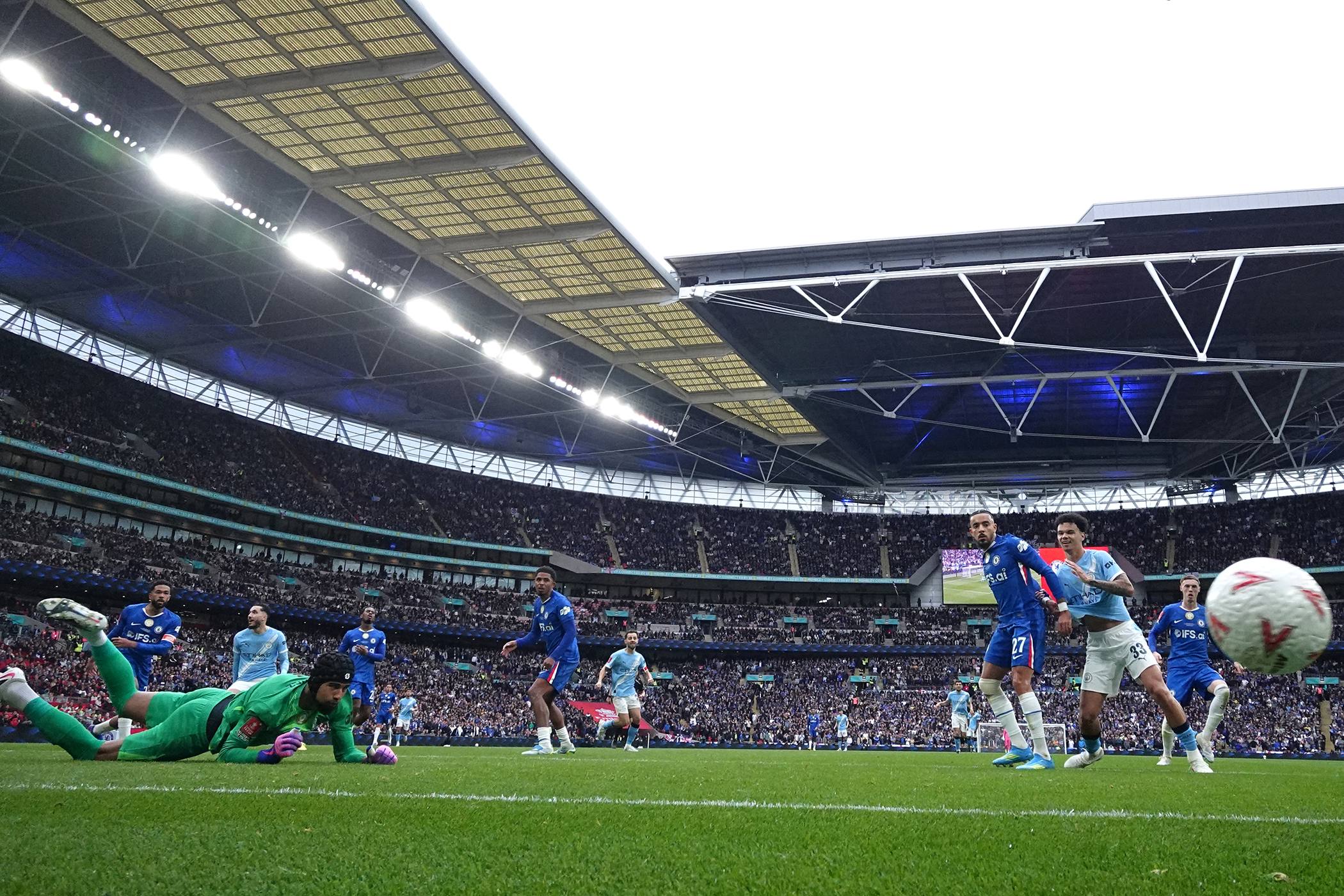
No goal, but an “assist”. Nineteen minutes from the end of a game that revived the old German metaphor of two bald men fighting over a comb, Haaland freewheeled down the left-hand side of Chelsea’s penalty box and cut the ball back for Semenyo to perform a shuffle that bamboozled Chelsea’s goalkeeper Robert Sanchez.
It was a goal made partly in Bournemouth, from where Semenyo joined for £62.5m in January, and where City will go on Tuesday night needing to win to keep the title race breathing. Semenyo is held up by City’s enemies as a classic example of vulgar problem-solving by a club that can always spend its way out of trouble. That overlooks Semenyo’s personal achievement in stepping up from Bournemouth to City halfway through a season and making himself an automatic starter.
Chelsea go trawling too, for young talent and for managers. Alonso is ready to gamble with his reputation by taking command of a Chelsea side devoid of identity and hindered by a spluttering business model. He’s entitled to hope Guardiola will be gone by the time it all starts up again in August.
Photograph by Richard Pelham/AP