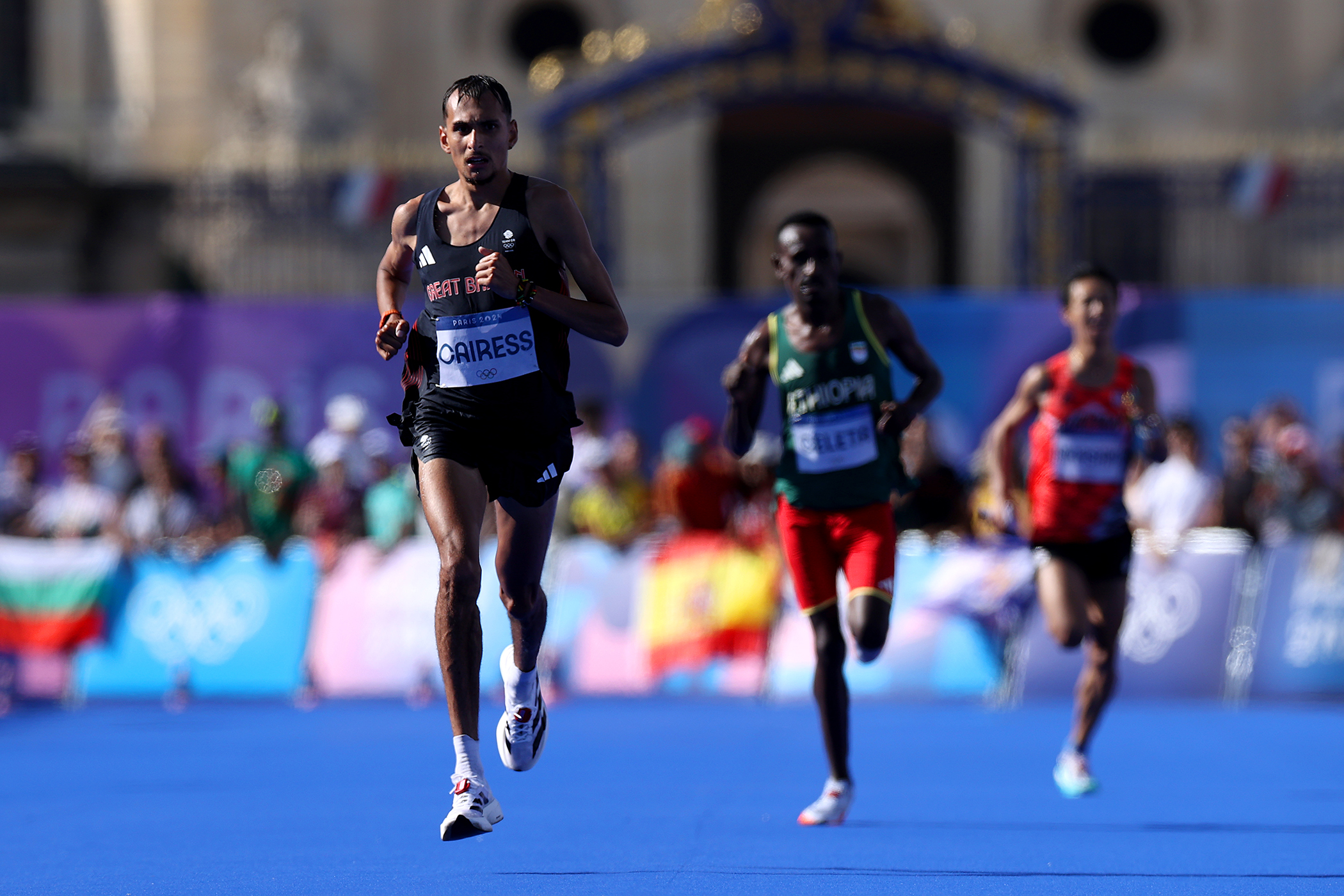
Emile Cairess will attempt to break Sir Mo Farah’s marathon record and become the fastest British man over the distance when he competes in April’s London Marathon.
Cairess, who finished fourth with a heroic run at the Olympic games in 2024, currently has a personal best of 2:06:46. That puts him third on the British all-time list, after triathlete Alex Yee ran 2:06:38 at Valencia Marathon in December to go second. Farah’s record is 2:05:11, which he set at the Chicago Marathon in 2018, whilst his 2019 mark of 2:05:39 is the fastest British time at a London marathon.
Cairess paced Yee in Valencia, as well as his training partner Phil Sesemann who ran 2:07:11. There has been a notable increase in competition at the fast end of British marathon running. Yee, who won gold in the men’s triathlon at the 2024 Olympics, has been a surprise addition to the mix, having made his marathon debut at London last year.
“It’s nice to see that we’re getting to a much better standard than five or six years ago in British running,” the 28-year-old told The Observer.
“The fastest British people run, the better for everyone.“But then with regards to the competition, I’m always keeping my eyes forward to compete with the top Ethiopians and Kenyans. That’s where I’m looking. I’m not really focused on being the best British runner. That kind of mentality leads to performances on a bigger scale.”
East African runners have dominated marathon running in the 21st century but Olympic medals in recent years for Belgium’s Bashir Abdi as well as Netherlands’ Sifan Hassan and Abdi Nageeye have demonstrated a resurgence in European long-distance running.
“It feels like maybe Europeans didn’t believe in themselves as much and didn’t invest themselves as much into training,” Cairess said.
“It just takes one or two athletes to see that things are possible and change people’s minds. Then it’s a snowball in terms of more athletes doing well and then there’s more belief.”
Cairess will be joined by Sesemann, Mahamed Mahamed and Patrick Dever as part of the British elite pool at London. Dever will be of particular interest having made his marathon debut on the notoriously difficult New York City course last October and running 2:08:58. It was the fastest time an Englishman had ever run at the event.
Dever and Cairess have competed against each other for years and memorably were separated by just one-thousandth of a second at the 2019 British University Cross Country Championships. Cairess came out on top that day but their rivalry could be renewed over the longer distance this April.
Newsletters
Choose the newsletters you want to receive
View more
For information about how The Observer protects your data, read our Privacy Policy
On the women’s side, Eilish McColgan will return to the course where she made her marathon debut last year, running 2:24:25. Charlotte Purdue, the third fastest British woman ever with a PB of 2:22:17, will also be running. Purdue has had a torrid time with injury that means she has not completed a marathon since 2023, and not ran at London since 2021.
The toll that marathons take on the body limits the number a professional athlete can complete in a year which means injuries can be very disruptive. That is something Cairess had to deal with last year after pulling out of last year’s London Marathon due to an ankle tendon issue.
“It’s difficult when you miss a big event and then it’s a year for it to come round again,” he said.
“But I’m always focused on improving and every day thinking about what I can do better.
“When you have a good year like 2024, people naturally expect that things will keep progressing, but it doesn’t always work like that. It’s part and parcel of being an athlete. If you can’t deal with setbacks then usually you don’t get to a good level.”
To rehabilitate from his injury, Cairess was in the gym five times a week doing specific exercises for his ankles and calves. He also had a platelet-rich plasma injection as he returned to running to help continue the healing process. He has been training in Kenya with his coach Renato Canova who is well-known for his focus on high volume low intensity mileage, but also spent time in Sierra Nevada with the Ingebrigtsens, the Norwegian middle- and long-distance runners.
“It’s a slow process of getting better at running,” Cairess said. “It’s not something that happens overnight.
“From the outside, when people have a really good performance, it looks like it did happen overnight, that they made this massive improvement. But there’s always a story behind that. It’s about patience, and doing all the training. That’s the way to bridge the gap and just letting it happen as it needs to happen.”
Photograph by Michael Steele/Getty Images