


Home advantage is a natural feature of World Cups. Six countries have won on their own soil and only twice in history has a host failed to get out of their group. But an altitude boost is of a different order.
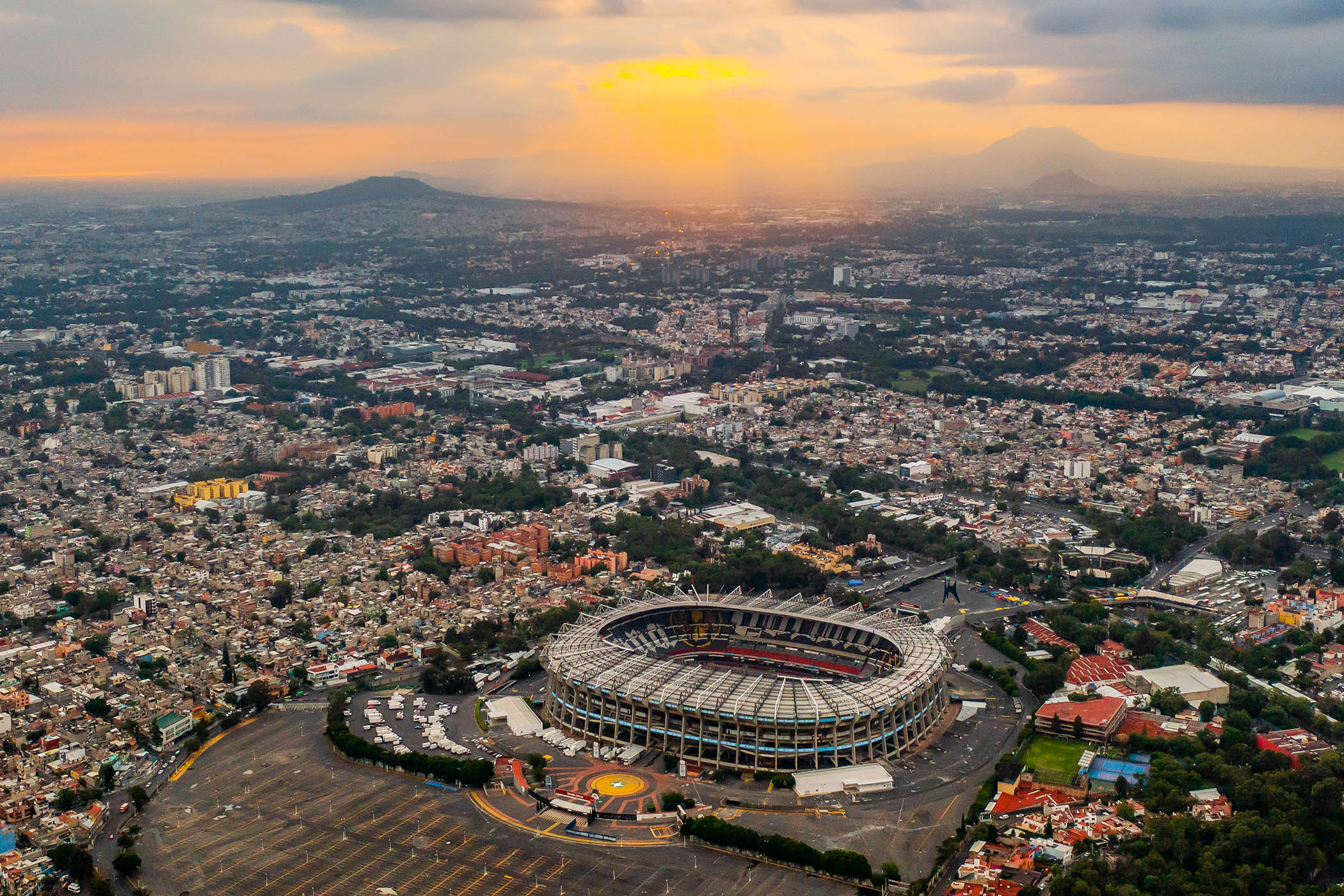
Mexico City’s Estadio Azteca, at 7,350ft above sea level, sits at an elevation that significantly affects performance. When Mexico play England at the stadium in the early hours of tomorrow, the home team will have a major advantage. However you cut it, this isn’t fair.
Players will take to a field that is twice as high up as Snowdon, or Yr Wyddfa, and five times as high up as the Empire State Building. A commercial aircraft’s effective cabin altitude is about 7,000ft.
Although the percentage of oxygen in the atmosphere is constant whatever the altitude, the drop in barometric pressure at greater heights pushes molecules further apart, which means every breath at the Azteca will take in roughly 23% less oxygen than at sea level.
The greatest athletic impact is on VO2 max, which measures the maximum amount of oxygen the body can convert into fuel. VO2 max levels at 7,000ft tend to fall by 10%, meaning more fatigue and less distance covered. While sprints theoretically become easier because the air is thinner, recovery is harder. Data suggests there could be a 21% decrease in high-velocity running in the game as a result.
Lower air density also means a football moves faster and truer. None of Mexico’s eight goals in this World Cup have come from outside the box. But there is a benefit to keepers being accustomed to how the ball will behave. Mexico are yet to concede a goal in this year’s tournament.
Results prove that elevation matters.
Statistical analysis has found that every 1,000m (3,280ft) altitude difference gives the home team an advantage of roughly half a goal, which may have brought about some unlikely victories. In the Estadio Hernando Siles, at nearly 12,000ft, Bolivia handed Argentina their heaviest defeat in more than 60 years in 2009. Lionel Messi said playing at that altitude was “impossible”. The Azteca is at a lower elevation than Estadio Hernando Siles, but Mexico have only lost two of 89 competitive matches at their national stadium, and none since 2013. They beat a formidable Brazil team in 1999 and 2003.
The particular unfairness that England faces relates to scheduling. The key to playing at altitude is the production of more red blood cells, but this process takes more than a week. This year’s bumper World Cup, which features more teams and more games, means that England will have had four days between their victory against DR Congo in Atlanta and their game in Mexico City.
England are further disadvantaged by a Fifa rule that requires them to train in the stadium the day before the game. The Football Association typically adopts a “fly in, fly out” strategy to minimise the time spent at altitude. But England arrived on Friday, two days before kick-off, which will run them close to the “dead zone” of three to nine days when the effects of altitude are at their most severe.
Newsletters
Choose the newsletters you want to receive
View more
For information about how The Observer protects your data, read our Privacy Policy
Mexico, by contrast, have been able to enjoy a near perfect acclimatisation period. They have been playing in the capital for nearly a month, leaving once for a game in Guadalajara.
Some may cry that these are preemptive excuses and that these are not new problems. But if you look at the 1986 World Cup as a comparison, the fixture list was far less packed and the tournament took place in Mexico alone. Before that World Cup, the England squad were able to spend weeks acclimatising. They still lost to Argentina in the quarter-final.
Thomas Tuchel is correct to say that England’s current bunch have a “huge” disadvantage ahead of the game against Mexico. Their mission will be to acknowledge and adapt to the limits imposed by altitude, hope they can do enough to win, and then worry about Brazil or Norway six days later.
Photograph by Hector Vivas/Getty Images