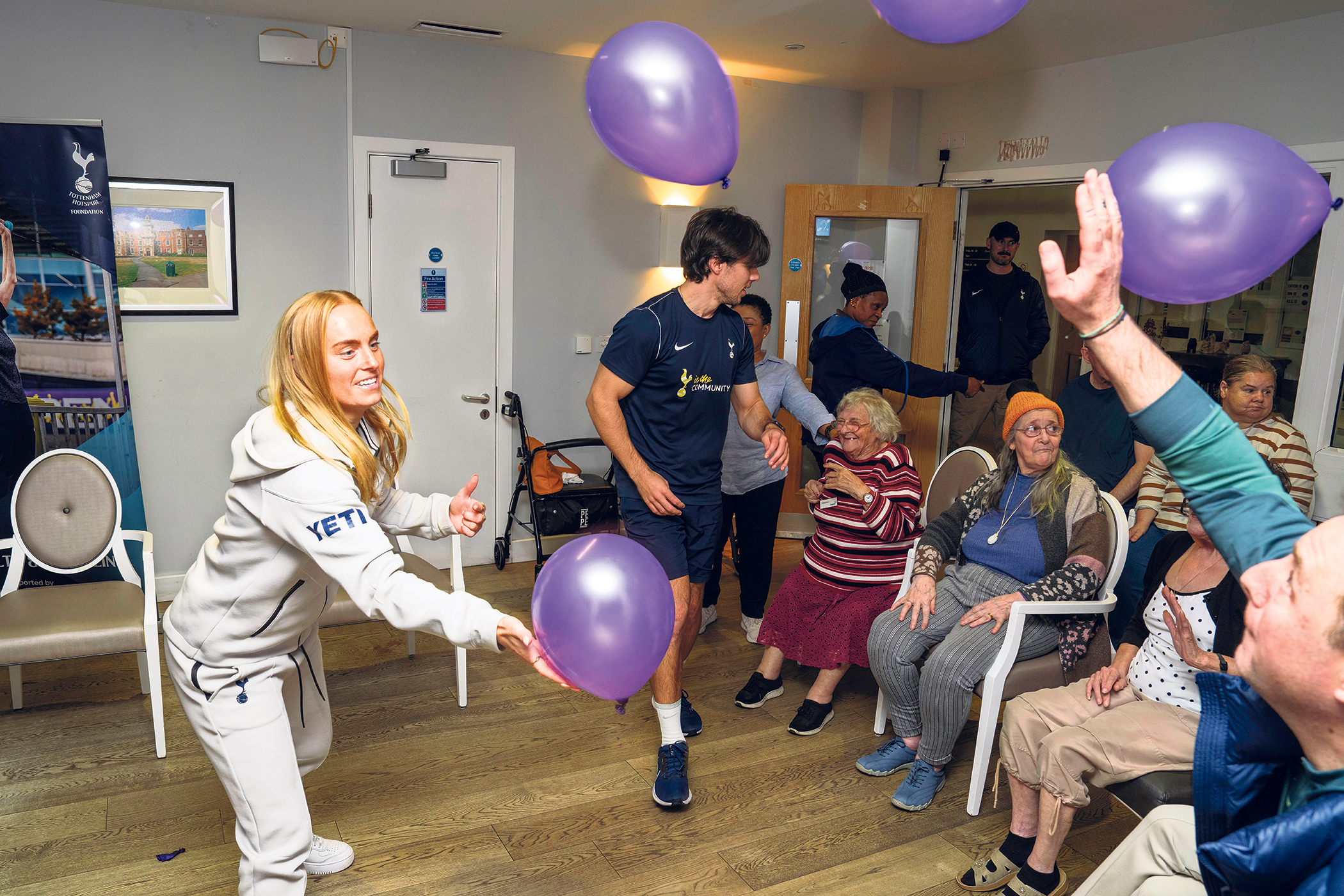

It is a Friday afternoon in the international break and Molly Bartrip is practising keepie-uppies with a purple balloon. Alongside, her Tottenham team-mate Bethany England has opted to use her head to keep the balloon in the air.
This is not an esoteric training routine but part of a session run by the Tottenham Hotspur Foundation. The players are at Lorenco House, a care home a stone’s throw from the Tottenham Hotspur Stadium. The session helps older people get active. It is also an opportunity to meet the players.
“Honestly, my first team is Manchester United,” confides one woman as she chats to Bartrip before quickly clarifying that she does love the Lionesses. Another grills her about how many goals she has scored in her career. Bartrip sidesteps the question by pleading that she is a centre-back (the answer is two).
Bartrip has recently set up her own charitable foundation, MindBall, with one eye on the future. While she is not planning on calling quits on her career just yet, she knows “there’s a shorter distance to the end than there is from the beginning”. The 29-year-old is a mainstay of the Women’s Super League, with 138 appearances for Reading and Tottenham Hotspur.
“My mum always asked me what I wanted to do when I’m older,” Bartrip says, “and I’ve always said I just want to help people.”
MindBall focuses on mental health inspired by the “battles” Bartrip went through early in her career. As a 14-year-old in the Arsenal academy, she was hospitalised with anorexia. She had lost so much weight that her liver was beginning to fail.
“The reason why I became anorexic was my own self-doubt, my own fear of rejection,” she says, stressing that Arsenal were very supportive. “If I had been taught how to cope with that at a younger age, maybe I wouldn’t have gone that way. When I was 21, I was diagnosed with severe depression and anxiety. I was suicidal.”
Bartrip was at Reading by that point and felt that talking about mental health was taboo. “It was like the forbidden subject,” she says. “No one really spoke about mental health. I didn’t feel like there was the right education to protect the person.”
‘Women grew up with men as role models, I don’t see why it can’t shift the other way’
‘Women grew up with men as role models, I don’t see why it can’t shift the other way’
Molly Bartrip
Bartrip has gone through her own challenges this year as she has struggled for minutes after four seasons of playing almost every game. She says that when you are fighting to get on the pitch, it poses a challenge to your “identity”.
“You put so much pressure on yourself as a footballer. I’ve played a lot of games throughout my career, and I’ve been very fortunate to do so. When times like this happen, it’s about getting the right support about you.
Newsletters
Choose the newsletters you want to receive
View more
For information about how The Observer protects your data, read our Privacy Policy
“There’s so much more to us than just Molly, the footballer. I’m a partner, I’m a daughter, I’m a sister. I love baking cakes. I watch Love Island. Sometimes you forget that and lose yourself in football.”
Tottenham have been the surprise success story of this season’s WSL. The side who finished second bottom last year are only four points off the Champions League spots.
“The girls have been brilliant,” says Bartrip. “It’s absolutely credit to them how well we’ve been doing. Everyone’s looked at Spurs as a completely different team this year. It’s a team culture. Everyone is playing a part in that. I’m not going to sit here and say it’s easy [not to be playing] because it’s not. But it’s part of football.
“That is the importance of educating the next generation. Because not everything is plain sailing. Not everything can be perfect.
“I felt like I couldn’t battle anything when I was growing up. I didn’t know who I was or who I wanted to be. You’re at such a fragile age. It’s about making sure you’ve got the right things around you to help you grow as a person, on and off the field.”
As to what clubs can do, Bartrip thinks having a psychologist available is the biggest change that more clubs could make. She is effusive about the “amazing connection” she has with Tottenham’s.
“It’s massive not just for the players, but for the staff,” she says. “Sometimes you forget that it’s a whole club. There needs to be more education and knowledge around the area [of mental health]. I think it is getting there.”
The emotional toll of being a footballer is hard to ignore at Tottenham right now, with the men’s side at risk of relegation. Bartrip admits that with TV coverage and social media it is hard to avoid the narrative around the side, although the women’s team are focused on their own season. She hopes that players are emboldened to speak out about mental health within the men’s game as well as the women’s, but also that younger boys can be inspired by women speaking out, too.
“In the men’s game, you don’t hear many men talking about it, but why? When they’re in it, they know it’s tough. Fans outside don’t see how tough the game is. They don’t see how tough sport is to compete at, especially professional levels. Naturally as competitors, we go through ups and downs. It’s an absolute rollercoaster of emotions.
“People sometimes do differentiate the women’s game from the men’s game, but I don’t think they should. We are all role models and we all have a role to play in creating success for the future. It’s really good for girls to be role models for boys and for boys to be role models for girls.
“Realistically [women’s footballers] have grown up with men being our role models. I don’t see why it couldn’t shift the other way. You don’t see many male players talking openly about the mental side of the game. It’s not as common as it is in the women’s game. So I think boys could understand women as well. One young boy might read my story and be like ‘I get that’. It doesn’t matter if I’m female or male. I think there’s definitely room for that.”
In the UK and Ireland, Samaritans can be contacted on freephone 116 123, or email jo@samaritans.org or jo@samaritans.ie. Other international helplines at befrienders.org
Photography by Antonio Olmos for The Observer