


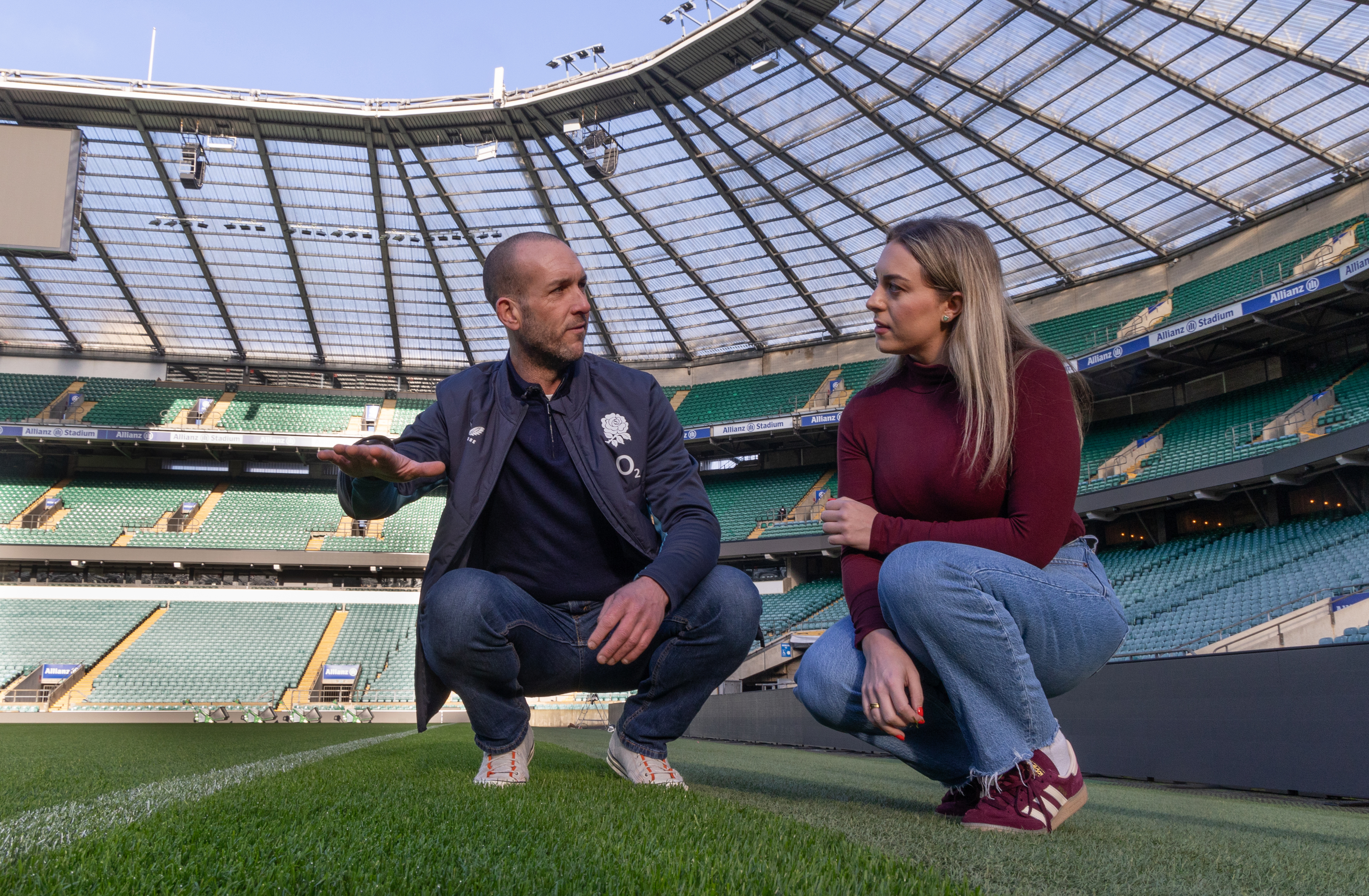
It’s early Wednesday morning and the vast bowl of the Allianz Stadium in Twickenham is almost silent. In three days, this stadium will be full of 82,000 fans passionately singing the English and Welsh national anthems, and the pitch will be the stage for rugby’s fiercest rivalry. But for now the only sounds are the low hum of strimmers and the soft choreography of groundspeople floating across the pitch, pushing lawnmowers in perfect unison.
Without the fans and grunting rugby players, it is impossible not to marvel at the pitch’s perfection. “I call the pitch the 16th player,” says Jim Buttar, the head of grounds and technical operations at the RFU, as we walk across the pitch he has nurtured since 2019. Just as every detail of an international player’s preparation is obsessively controlled, from nutrition to strength and conditioning, the surface beneath their boots is treated with the same attention. Buttar knows every inch of this pitch, and monitors it with a myriad of data points including temperature and moisture, all with the aim of making sure the pitch remains perfect. He has a tracker set up at his home, so he can keep an eye on his pride and joy at all times of the day or night.

It turns out that pushing a lawnmower in a perfectly straight line is harder than it looks, but Ian Ayling, the Allianz Stadium grounds manager, trusts me with the job. Ayling watches as I attempt my first straight line. At that moment, I was grateful that I have never been asked to walk in a straight line by a police officer because I would fail any sobriety test. My first wonky attempt stands out like a sore thumb against the groundspeoples’ ruler-sharp work. But with Ayling’s encouragement I keep going, and soon my mowing is good enough for me to be trusted with painting the white lines that mark out the pitch.
If the touchline looked a bit odd on Saturday, well, it’s my fault. As I spray the paint between my feet, waddling over the freshly painted touchline so as not to stain my shoes, I reach the end of the touchline and continue far down the side of the pitch, too focused on keeping a straight line to notice where I am. When I finish, I find I have left what can only be described as a metre-long white skid mark in my wake. Ayling comes to the rescue with a hose.
“All this grows all year round,” says Buttar, who is also a Board Member of the Grounds Management Association, as we inspect the grass. “We create an environment where grass will always grow. Doesn’t matter what time of the year it is.”
His staff form a well-oiled machine; some have been tending to the same pitch for decades. Each groundsperson can rack up 35,000 steps a day as they mow the pitch lengthways first before a second widthways cut, every day, 365 days a year. Over a year, they might walk 2,500 miles, roughly the length of Route 66 across America, just on the pitch here in Twickenham.
It feels like being backstage at a West End show. In the shadows, never the spotlight, the crew are focused on the technical details that make the production run smoothly, and people only ever talk about their performance when something goes wrong.
And when it goes wrong, the impact can be huge. During this winter’s Ashes, the pitch at the Melbourne Cricket Ground was classed as “unsatisfactory” after 36 wickets fell in six sessions, thanks to excessive seam movement. The length of the grass was 10mm, about 3mm longer than usual. Those extra 3mm cost Cricket Australia an estimated A$10m (£4.97m) in lost revenue when the Test finished in only two days.
Recognising the role grass can play in performances, some managers make demands of their groundspeople. In football, Manchester City manager Pep Guardiola asked for a new pitch on his arrival at the Etihad in 2016, insisting it must be no longer than 19mm in the warmer months or 23mm in the winter (shorter than the average Premier League grass length of 26mm). At the Allianz Stadium, demands about the pitch rarely come from coaches.
Newsletters
Choose the newsletters you want to receive
View more
For information about how The Observer protects your data, read our Privacy Policy
“That’s only happened once, when Steve [Borthwick, the current England coach] first came in,” says Buttar. “He wanted to change the size of the dead-ball area, but it didn’t last long. I never question why, it’s down to the game and the tactics, and that’s beyond me.”
Rugby pitches vary in size, and the dead-ball area (the area behind the posts where tries are scored) can be 6-22 metres long, often decided by the head coach. In 2018, a year before Buttar arrived at the Allianz Stadium, the former England head coach Eddie Jones extended the Twickenham pitch’s dead-ball area before facing Ireland at home. A try scored by Irish winger Jacob Stockdale that day would not have counted using the pitch’s usual dimensions.
However, the surface of the Allianz pitch cannot be changed on a whim, says Buttar. It should remain consistent, so that Saturday’s surface feels exactly like the one the players remember. In that sense, the pitch does its job best when no one notices it at all.
The pitch is a hybrid surface installed in 2012 and was meant to last 10 years, but 16 years later it is still in great condition. Built on sand, with 19 miles of pipes underneath for under-pitch heating, it is mostly real grass but about 3% is synthetic fibres, stitched down to about 180 millimetres, of which roughly 25mm are exposed at the top. Natural grass wraps itself around those fibres to create traction, but over time, that structure degrades and performance begins to tail off. A full reconstruction of the pitch is now scheduled for this summer, and some of Buttar’s team will travel to the Johan Cruyff Stadium in Amsterdam soon to learn about a similar pitch there.
While the plans for the new pitch have only just recently been signed off, Buttar says it will be state of the art. The plans include a reservoir beneath the pitch, creating a closed loop water system fed by rainfall, rather than the hard water available in Twickenham. Irrigation will come from underneath rather than from sprinklers above, meaning the grass on the surface will be drier on matchdays, which in turn means the ball will be less slippery. The water can be UV treated, and nutrients can be injected hydroponically to keep it in perfect condition. It is a complex and ambitious project, untested in the UK at this scale.
By the time the light fades, the pitch is green, striped and looking every bit the stage for elite sport. The job demands focus, but it is also, unmistakably, fun. My efforts are insignificant contributions in the grand scheme, but enough to feel momentarily inducted into the rituals that turn a field into a Test match surface. And if journalism doesn’t work out for me, Ayling offered me a shift when the Red Roses host Ireland on this hallowed turf in April. I just need to work on my straight lines.
Photography by Andy Hall