
The bus arrived trailing a plume of red smoke. Flanked by fans four or five deep, the coach carrying Liverpool’s players to their last stand crawled along Anfield Road, a police outrider acting as pacesetter. Flares crackled into life. Fists punched the air. Mostly in defiance. A little bit in desperation.
On an evening of spitting rain and filthy cold, it was not a bad attempt at performing what has become the opening rite of Anfield’s European liturgy. The bus welcome is part ritual, part communion, part cri de cœur. It has become a key part of the stadium’s mythology, a harbinger of what is to come.
Tuesday’s iteration did not live up to the visit of Manchester City in 2018 or Barcelona in 2019 or Real Madrid, seemingly every year nowadays. The noise was a little dulled, the frenzy slightly diluted. It was not so much a spontaneous outburst of passion so much as a duty being fulfilled, a tradition being maintained, of everyone going through the motions.
With good reason, as it turned out. Liverpool released a stirring video on Tuesday morning splicing together highlights of all Anfield’s great miracles: St Etienne, Olympiacos, Chelsea, Dortmund, Barcelona. It felt like a prayer. So comprehensively had Arne Slot’s team lost in Paris a week earlier that this was all they had left; not faith, but superstition. Liverpool were left to hope that magic might prove to be real.
It didn’t work. Luis Enrique, the PSG manager, acknowledged after the game that Slot’s team “deserved to score”. They had shown “what sort of team they are”. For a while, Anfield had flickered with possibility. Liverpool had the reigning European champions penned in, pinned back. And then the spell broke, Ousmane Dembélé scored, and it was over. Liverpool might have gone out on their shields, but they still went out.
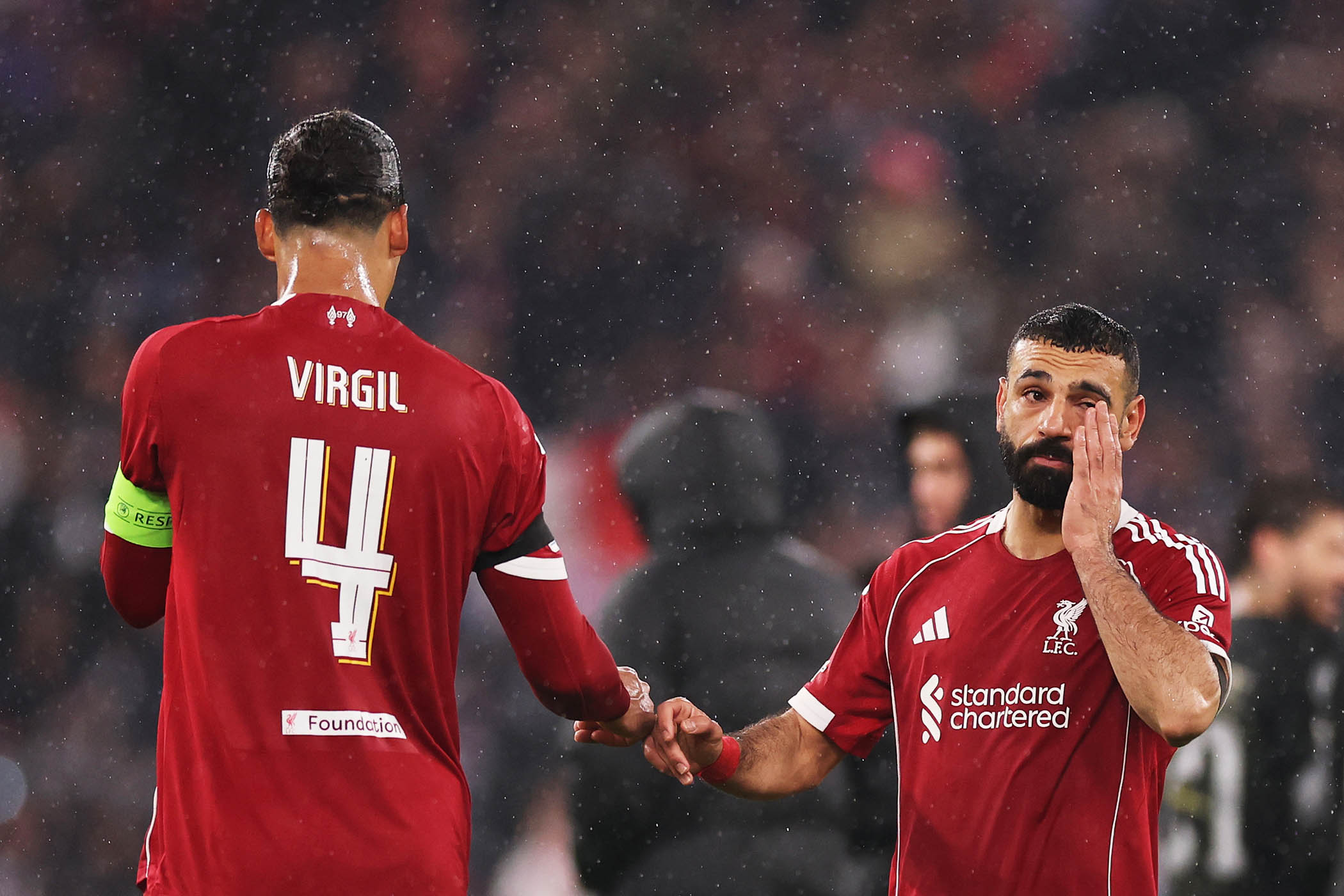
Elimination felt like an end to more than the club’s one distant hope of lifting silverware this season. After the final whistle, Mohamed Salah lingered in front of the Kop, as has become customary, as though trying to wring every last memory from the moment.
Those fans who remained sang Andy Robertson’s name, too. Both have now played their final European game for Liverpool. They are in their valedictory period, their days of lasts. Neither will have the glorious farewell they might have anticipated. Despite a summer of eye-watering spending – £450m gross, £220m or so net, sliced either way the most lavish in the club’s history – Liverpool’s season has been one of desperate disappointment and mounting dissatisfaction. All that can be salvaged from the campaign, now, is a return to the Champions League for next year. Given they have won just once in the Premier League since February, and a run-in that includes Sunday’s Merseyside derby, visits to Old Trafford and Villa Park and a meeting with Chelsea, even that consolation prize may prove to be beyond them.
FSG has built one great version of Liverpool. The challenge for it now is to prove it can build another
FSG has built one great version of Liverpool. The challenge for it now is to prove it can build another
The club might not have expected this season to be quite such a struggle, but they knew that some pain was inevitable, sooner or later.
When Salah and Robertson walk away this summer, they will leave behind a squad that has undergone a more drastic, more violent transformation in the last couple of years than has perhaps been appreciated.
Their impending departures will mean only five of the players from the most successful period in Liverpool’s modern history – the spell between the 2018 and 2022 Champions League finals – remain in place.
Newsletters
Choose the newsletters you want to receive
View more
For information about how The Observer protects your data, read our Privacy Policy
The few that do can also feel the clock ticking: captain Virgil van Dijk has seemed diminished for much of this season; goalkeeper Alisson Becker is increasingly hampered by injury. Both are out of contract in 2027. So are Joe Gomez and Curtis Jones. Ibrahima Konaté can leave for free this summer.
The shift has been no less pronounced off the pitch. Ian Graham, the head of the club’s research department, stepped away in search of a new challenge in 2023. The following year, with rather more fanfare, Jürgen Klopp announced his own departure. Most of his closest lieutenants went with him. A few months later, Dave Fallows, the club’s chief scout for 12 years, stepped down, too.
The response of Liverpool’s owners, Fenway Sports Group, was to hand control of the club’s front office to Michael Edwards, the sporting director credited with overseeing Liverpool’s return to prominence. He became FSG’s chief executive of football. Richard Hughes was plucked from Bournemouth to do Edwards’ old job, but other faces – Julian Ward, David Woodfine – were more familiar.
FSG’s plan appeared to be that it might be able to recapture lightning in a bottle.
Barely a couple of years on, there are doubts there, too. Edwards has been frustrated by FSG’s failure to start to build a multi-club model. Hughes has been persistently linked with an appointment in Saudi Arabia. Both of their contracts expire next year. The same is true of Slot.
Much of the focus, as Liverpool have lurched from one defeat to another this season, has been on the Dutch manager’s future, on whether he will stay or go, on what his employers must do right now to satiate the baying discourse. It has always been a slightly odd fixation. Liverpool’s view has been consistent: Slot has not become a bad coach overnight; even disregarding the grief over the death of Diogo Jota, his task this year has been much more complex than assumed; history, as one of the club’s executives said privately, will look kindly on him.
The identity of the head coach, though, is not the most pressing question facing Liverpool. The impression at all levels is of a club waiting: for one era to end and another to begin, for yesterday to become tomorrow and, above all, to find out who is going to make that happen.
FSG has not been a perfect owner – as the roiling dispute over ticket prices at Anfield illustrates – but it has restored the club to the front rank of teams in England and Europe. It has built one great version of Liverpool. The challenge for it now is to prove it can build another.
Photograph by Carl Recine/Getty