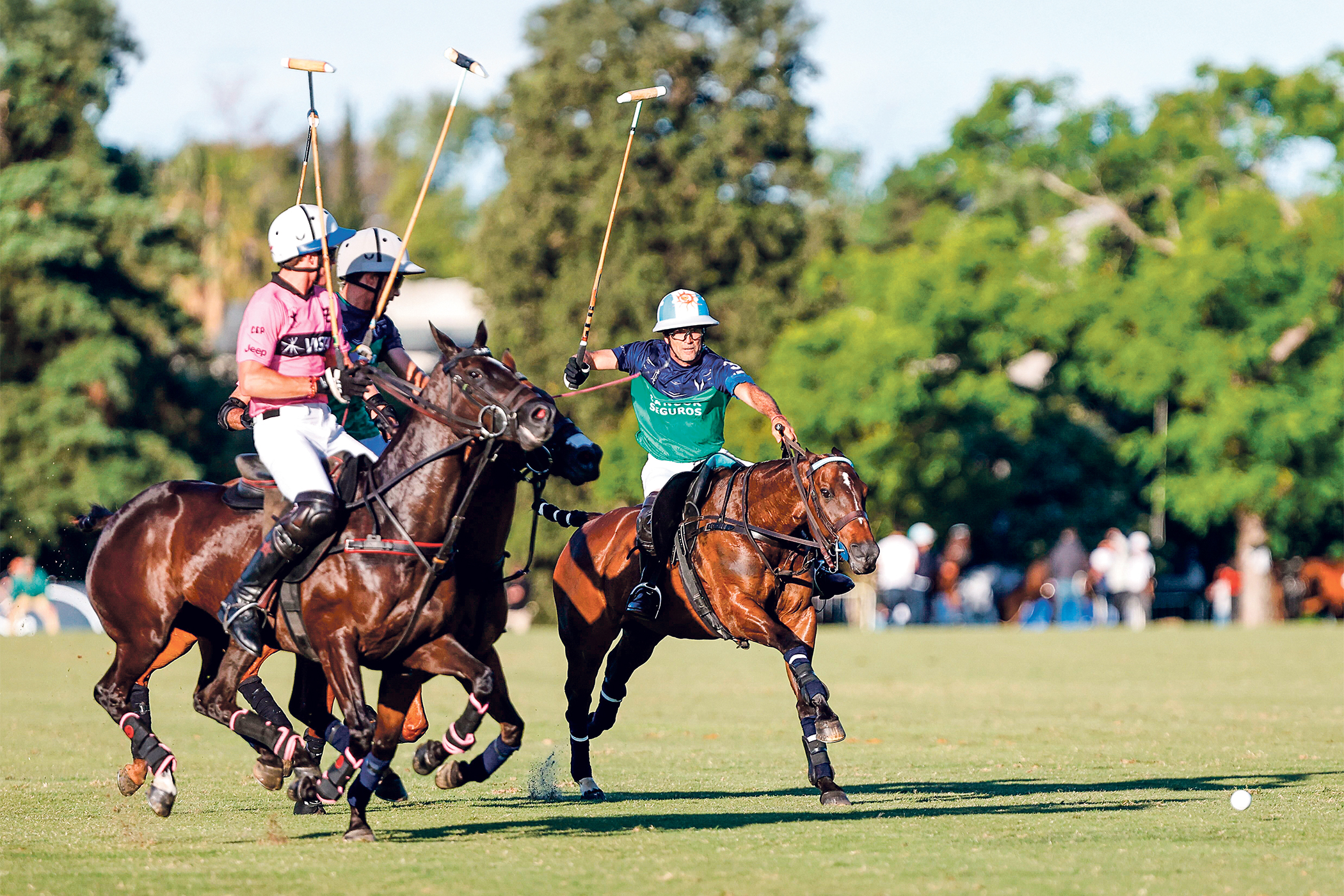

Nothing was going to spoil Adolfo Cambiaso’s day. As the world’s No 1 polo player, he was going to lead his team, La Natividad-La Dolfina, to the final of the prestigious “Abierto”, the Argentine Open Polo Cup, by crushing their opponents UAE.
The stars were aligned. The sun shone bright in a sky of Argentine blue. Flags fluttered above the jacaranda trees that line Avenida del Libertador, the grand thoroughfare that borders one side of the polo grounds in uptown Buenos Aires. A marching band oompahed beside the Christmas tree, decorated with the signature red and gold of the society designer, Carolina Herrera. In the stands, President Javier Milei of Argentina, channelling Elvis in his bloated years, sat watching as Cambiaso’s team took an early lead, and – seemingly cruising – maintained a comfortable buffer over UAE through the first seven chukkas (a chukka is seven minutes of playing time).
Then the match veered off script. At the end of the seventh chukka, UAE scored two fast goals, and Cambiaso fluffed a penalty. At the beginning of the eighth – and final – chukka, the UAE No 3, Tomás Panelo, streaked down the pitch to put his team ahead, with less than five minutes to play. There was an audible gasp. The UAE fanbase, swathed in hot pink, started thumping drums and blowing trumpets. This wasn’t what was meant to happen.
With his chiselled jaw, lean athlete’s physique and unquestioned genius on a horse, Cambiaso could have stepped out of the pages of Jilly Cooper’s 1991 bonkbuster, Polo. He is something of a superhero in Argentina, among the small elite with the money to indulge in what is a very expensive pastime. In the wider polo world, he is regarded as the GOAT, the Greatest Of All Time.
He has won every polo major, numerous times; he has scored nearly twice as many goals in the Open as anyone else. In 2010, he introduced polo to a brave new world, when he cloned his favourite mare, Cuartetera; seven years later, he won the Open riding six of her clones. Their progeny regularly go for over half a million dollars.
In April 2025, Cambiaso turned 50, a rare age for someone at the top of such a physical sport. Over the years, there have been rumours of his retirement. But there is something a bit different in the air this year, something that smells a little like a final victory tour.
There was the three-episode documentary on his life (in Spanish), released on Disney Plus; the interviews with him and his family, which were possibly the only watchable bits of the Netflix series Polo, produced by Prince Harry and Meghan’s Archewell Productions. And then, the Open.
Arguably, Cambiaso had been preparing for this tournament since his sister, Camila, started going out with his childhood polo team-mate and one-time best friend, Bartolomé “Lolo” Castagnola. The two men climbed the polo ladder together, earning the maximum 10 handicap at a startlingly early age – before falling out when Cambiaso sacked his brother-in-law from his team.
This year, however, they have reconciled. The result is a marriage between Cambiaso’s La Dolfina team – the GOAT and his kid, Adolfo Jr, known as “Poroto” (Spanish for “bean”) – and the Castagnola family’s La Natividad.
Professionals, largely Argentinian, are paid to play for – and with – a “patron”, who funds a team and gets their kicks from clashing sticks at the top level (or, realistically, floating around the margins while the others play). Cambiaso reputedly earns a couple of million dollars playing in America in the spring, before moving to the UK, for similar pay, in the summer.
Newsletters
Choose the newsletters you want to receive
View more
For information about how The Observer protects your data, read our Privacy Policy
That money is ploughed back into his polo set-up in Argentina. His ultimate aim: to win the Argentine Triple Crown, the only tournaments which have no handicap limit, and which culminate in the Open. His team have gone unbeaten in the first two legs of the Triple Crown, and this may be his last Open.
The first half of the semi-final went with form: Cambiaso’s team, in emerald green and royal blue, played with verve. The 64 mounts – each player is allowed eight per match, which they hop between, to conserve their energy – included a handful of Cuartetera clones, genetically identical dark bay mares.
The skill of the players, who galloped along the pitch, bouncing the hard ball on the spindly shaft of their stick before pelting it 100 yards towards the goal, is breathtaking. The watching crowds, as sleek as the ponies, appeared to be evenly split in their allegiances to Cambiaso’s team and to the underdogs, UAE, funded by the oil millions of Sheikha Maitha bint Mohammed Al Maktoum, daughter of the ruler of Dubai.
But, as the game neared its end, the UAE players, with little to lose, picked up pace and inched ahead.
Adolfo Cambiaso started the final chukka riding a pony named Grumpy. He would have been if his team had lost. But with minutes remaining, Poroto scored a penalty. There was another collective intake of breath. As the drums of both teams started thumping louder, Camilo Castagnola streaked away and, with a scorching angled shot, took his team to 15-14. In the dying seconds, he scored again: 16-14 to La Natividad-La Dolfina.
President Milei, with his signature sideburns, descended onto the pitch and hugged Cambiaso. Jilly would have relished every minute. Now for Sunday’s final against Ellerstina, and the chance of glory.
Photograph by Rodrigo Néspolo/AP