


The numbers will have made pleasant reading for the army of executives at the Premier League and its constituent clubs. They awoke on Thursday morning to a world in perfect order: English teams occupying five of the top eight slots in the Champions League; all six of the league’s representatives in contention to qualify automatically for the last 16.
More gratifying still, they will have been able to see the latest Deloitte Football Money League, an annual report by the accountancy firm which seeks to measure what really matters: which clubs make the most money. As always, the answer was: the English ones. Nine of the 20 richest teams in the world come from the Premier League. One of them, extraordinarily, is West Ham United.
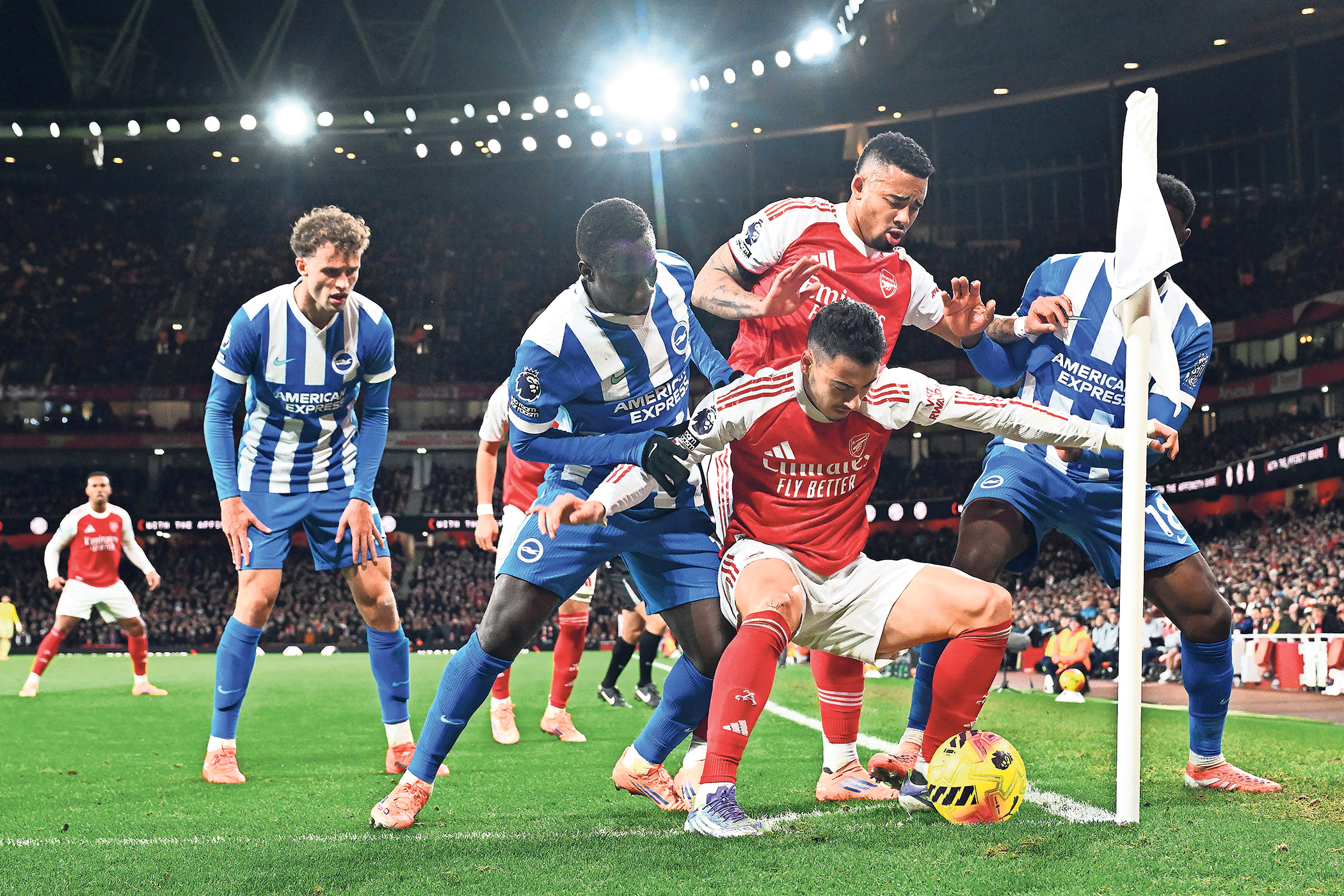
Together, they form a portrait of the Premier League as a picture of moneyed good health, the strongest and wealthiest and best domestic competition on the planet, a super league in all but name. There is just one slight caveat: watching it, for much of this season, has not always quite lived up to that billing.
There are numbers here, too, ones that are not nearly so welcome. Prior to this weekend’s action, the number of goals in the Premier League is down, to 2.7 per game. The number of goals from open play, too. And the number of shots, which is currently tracking to be the second-lowest on record.
The number of goalless draws, meanwhile, is up to its highest since 2020-21 (17 so far before yesterday, compared with 16 in the whole of last season). Until Marcus Tavernier scored a penalty for Bournemouth at Brighton last Monday, it was on course to be the lowest scoring weekend in the competition’s history.
A handful of caveats are necessary: the sample size remains relatively small; it is entirely possible there is a correction in the coming months; the past two seasons, fresh in our collective memories, were the highest scoring in the Premier League’s history (a record 3.3 per game in 2023-24 and 2.9 per game last season), at least in part because of a considerable increase in the amount of injury time being played.
But those numbers, that apparent slide into deadlock, does seem to encapsulate the lived experience of watching this iteration of the Premier League. It is too simplistic to say that the league is dull; nothing which inspires such emotional investment can be truly boring. But it does quite often seem as though the league has played itself into a stalemate.
Within football, the accepted explanation for that is largely tactical: the massed defences, the direct attacks and the set pieces that characterise most Premier League games are simply a new front in the battle of ideas endlessly being waged by the league’s galaxy-brained coaches.
“It is a consequence of how it is changing tactically overall in football,” Unai Emery told Sky Sports a few months ago. We have, in this telling, moved beyond the intricate, possession-focused style preached by Pep Guardiola – the one seen as the game in its platonic form – and its antidote, the blitzkrieg ballet of Jürgen Klopp, to something that draws on and advances both: a style so hegemonic that it has turned the league into a monoculture.
To use the appropriate and not-at-all recherché jargon: every team, or almost every team, presses high and then sinks back into the fabled low block, waiting for moments to pounce in transition. Possession is used as rest defence. Most sides, as Emery said, go “man-to-man all over the pitch”. The speed of the shift is impressive: when Marcelo Bielsa’s Leeds did that, five years ago, it was greeted as alien technology.
Newsletters
Choose the newsletters you want to receive
View more
For information about how The Observer protects your data, read our Privacy Policy
In the absence of meaningful stylistic or strategic differences, then, the focus has shifted on to playing the margins: the resurgence in long balls, long throws and set pieces is not so much English football reverting to type as the league’s great minds seeking to find an advantage wherever they can.
The consequence has been, over the first half of the season, not just a reduction in goals and shots (the 24.4 shots per game so far this season is the second lowest since 2003-04 after the Covid-hit 2020-21 season’s 24.2) but in something much more subjective: aesthetic enjoyment. Games not only now involve less actual football – the amount of time the ball was in play dipped across the campaign’s early months – but seem to follow broadly the same pattern.
“If you face a low block, you don’t have a meeting to tell the players how they have to bring the ball out from the back, because you already have the ball within 25 yards of the goal,” Arne Slot, the Liverpool manager, said this week. After that, he said, it is a matter of “standing on the line, just having ball possession, hoping something happens”.
Slot has attracted considerable criticism for repeatedly bemoaning how many “low blocks” his side has faced – Steven Gerrard, no less, said on TNT Sports this week that he should probably stop talking about them – but he is not alone. Plenty of fans would suggest his description of the average Liverpool game echoes their own memories of this campaign. So would many of his peers.
Eddie Howe acknowledged that his Newcastle team had to do better against massed defences after their goalless draw with relegation-threatened Wolves last week. Enzo Maresca, before he parted ways with Chelsea, admitted that his side were struggling to unpick opponents arranged in an unmoving phalanx, too. “It is more complicated,” he said in October.
This interpretation – that the league’s stasis is effectively a marker of tactical sophistication – is tempting. Football has always tended towards the Great Man Theory of History, believing that it is shaped more than anything else by the brilliance and the insight of its most charismatic, compelling figures, that it is players and managers (and sometimes executives) who drive change.
The resurgence of massed defences lays bare the problem with this. The Premier League has André Villas-Boas to thank for the term “low block”. The Portuguese did not invent the phrase, but he was the first to popularise it during his brief, and not especially defensive, spell at Chelsea.
The idea, though, is nothing new. Gerrard – a veteran of the Premier League’s last great ice age, in the mid-2000s, the era of José Mourinho and Rafa Benítez and “parking the bus” – noted that “low blocks have been happening against Liverpool ever since I played, and many years before me”.
That is putting it mildly. Gipo Viani, another of football’s great men, invented what came to be known as “catenaccio” at Salernitana in 1946. The name and the approach might be different, but the abiding principle is exactly the same. The knowledge that the best way to neutralise an opponent, or shut a game down entirely, is to flood the centre of the pitch and to sit in unmoving ranks on the edge of your own penalty area has been around, at the risk of exaggeration, for ever.
What is striking, now, is that such an ancient technique should be so effective not just in the modern game, but in the richest league the game has ever seen. (That Liverpool, Newcastle and Tottenham have all looked much more fluent in the Champions League is not a coincidence.)
It may be that this is football in its ultimate form: a war of attrition in which everyone is so good that nothing happens at all
It may be that this is football in its ultimate form: a war of attrition in which everyone is so good that nothing happens at all
Tactics are a contributory factor to that – thanks to the advanced pressing strategies of its coaches – but they are no more than that. The Great Man Theory, after all, has long since been rendered obsolete. Individual genius is not what drives history; material, structural and technological factors all play much more significant roles.
It is highly likely, for example, that teams could not defend nearly so obdurately if they did not have access to five substitutions in every game, enabling managers to re-energise their teams before they start to wilt. Liam Rosenior, the new Chelsea head coach, has said that the key to breaking down a low block is to “keep banging at the door”. It is harder when the door can be continually reinforced.
Likewise, it probably helps that the league’s teams are largely stocked, now, with full internationals. As the consultancy group TFG told The Observer earlier this season, the average quality of player in the Premier League has never been higher. Better players are, of course, less likely to make mistakes.
And then there is the amount of knowledge available to every side: not just in terms of data to show them what their opponents are likely to do and how they might be stopped, but the ever-growing expertise in sports science. The game’s elite might be at risk of considerable fatigue, thanks to an ever-expanding schedule. Everyone else, even in the Premier League’s middle order, has never been in better shape.
It is not, in other words, that the Premier League’s coaches have hit on a brilliant new strategy; it is that factors beyond their control have combined to breathe new life into an old idea. It may be, in fact, that this is football in its ultimate form: a war of attrition in which everyone is so fit, so smart and so good that nothing happens at all.
Photograph by Stuart MacFarlane/Arsenal FC via Getty Images