

We are rapidly approaching the point at which everyone decides that Something Must Be Done. The managers of the Premier League are starting to express their disapproval. A handful of club executives are starting to fret about what might be called English football’s artistic direction.
Most worrying of all, we appear to have lost Ruud Gullit. The former Chelsea manager, one of the game’s great aesthetes, told Dutch television last week that he was going to stop watching football.
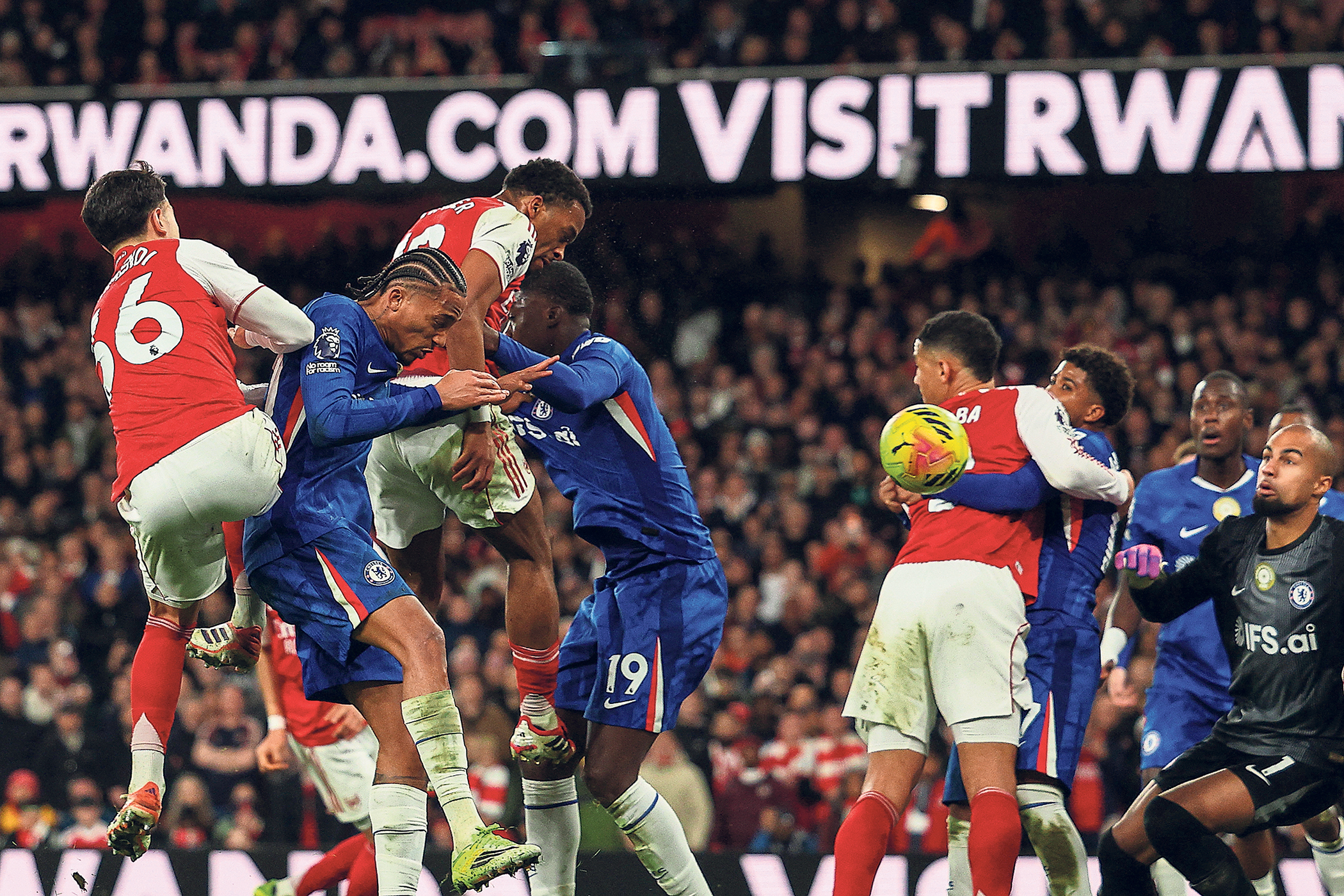
The experience, he said, had become “absolutely horrible”, thanks to “players just trying to create corner kicks, trying to create throw-ins”. It was leading to games that were “absolute garbage”.
The question of whether the primacy of set pieces has become a problem for the Premier League has come to dominate the sporadic meetings of managers, sporting directors and captains that the league holds across the course of the season to discuss how the game is being played.
The growing consensus, among those who have taken part, is that the “product” is suffering.
That does feel ever so slightly overblown. Contrary to popular perception, the vast majority of goals still come from open play. Corners account for just 18 per cent of all the goals scored in the Premier League this season.
Set-pieces as a whole – free-kicks, goal kicks, throw-ins launched like trebuchets – have provided somewhere between a quarter and a third.
More importantly, while those figures do represent a notable increase, they are not wildly out of line with the norm. More than a quarter of goals came from set pieces almost as standard between 2007 and 2011, according to data from Opta.
Even in the 2020-21 season, when the proportion dipped to its lowest point in recent years, it still fell to only 19 per cent.
The difference between set pieces being old-fashioned and set pieces being the cutting edge of the modern game is somewhere in the region of 100 goals across the season: it may not feel like it, at times, but that boils down to an extra goal from a dead ball about once every three or four games.
It should be remembered, too, that many fans will regard that as no bad thing.
Arne Slot, the Liverpool manager, might have suggested that his “football heart” breaks a little every time someone scores from a corner; Gullit might be about to switch off for good. But these are, ultimately, subjective judgments.
The patient, intricate mandala football that Pep Guardiola played at Barcelona – the approach that would turn Spain into world and European champions – left plenty of people cold: Javier Clemente, the agricultural former Spain coach, originally coined tiki taka as an insult; the Italians came to know it as passenaccio. Gullit also complained about teams “passing, passing, passing, passing. Where are the dribblers?” It is, famously, a game of opinions; people like different things.
There is one very obvious – and inarguable – drawback to the renewed focus on set pieces. “For me, the main topic is to make a clear rule on how much time you can waste for a corner, for a throw-in, for a free-kick,” said the Brighton manager Fabian Hürzeler after defeat by Arsenal.
“When Arsenal have a corner, and they are leading, sometimes they spend over one minute just to take [it]. I have the opinion that every supporter who pays a lot of money to go to the stadium and watch our game should see the same game time. They want to see a football event, not … 40 minutes where the game is not running.”
The British-dominated body that governs the game’s laws, the International Football Association Board, clearly shares that concern. At the organisation’s congress in Cardiff last month, it elected to introduce countdown clocks on throw-ins and goal-kicks. The rules will be introduced at the World Cup this summer; they will arrive in England next season.
There are some within the Premier League who would go further still. The amount of time lost to the theatre that accompanies each set-piece has not been the only objection to this season’s dominant style. The league encouraged its referees to penalise what it calls “non-footballing actions” – holding or blocking players in the box – more harshly this season; they have obliged, awarding seven penalties for those offences this year, rather than four in 2024-25.
But that is only half of the problem. When Gianluca Rocchi, Italy’s equivalent to Howard Webb, explained this week that he did not want Serie A to witness “the situations that I see in other leagues”, in which “up to five players [are] just standing still inside the six-yard box” in order to prevent goalkeepers claiming crosses, it did not take a vast amount of calculation to work out which league he meant.
Every corner, every free-kick, now seems to reduce the goalmouth to a pitched battle; whether they lead to a goal or not is not the only relevant factor. There may be no right or wrong way to play football, but there is something jarring about seeing some of the most expensive squads ever assembled – playing in front of fans paying premium prices for both tickets and television packages – contriving to compete to see who can push each other the most at corners. The concern, for those on the Premier League’s stylistic working group, essentially boils down to whether that is enough to engage the audience; some, certainly, believe that failing to redress the balance – most immediately by remembering that attacking players can commit fouls, too – will damage the league’s image, and eventually its popularity.
It is, though, not quite as simple as that. The Premier League’s appeal does not reside solely in its aesthetic value; its competitive balance has always been a key selling point, too, and it is hard to argue that this season has not been competitive. In the space of three weeks, a Wolves team who had been on course to be the worst in the division’s history have beaten Aston Villa and Liverpool and drawn with Arsenal. Brentford are currently seventh. Tottenham might get relegated. Barely anyone can string two wins together.
Newsletters
Choose the newsletters you want to receive
View more
For information about how The Observer protects your data, read our Privacy Policy
That is not the only consideration. There has always been a tension between what the people playing the game want to achieve and what the people watching it want it to deliver. For them, entertainment is a by-product; for us, it is the purpose of the endeavour. Its nature, though, is chimerical. Tastes vary; so do priorities. Most fans will, ultimately, find enjoyment in any sort of football that leads to glory.
It is that, more than anything, which might make concerns over the nature of the “product” a little unnecessary. Neutrals might not find much of the football on display in the Premier League these days admirable, but then most people aren’t neutrals. They are fans. They will watch their team regardless, whether it is in person, or on television.
Everything else they will likely consume in highlight form, whether that is on Match of the Day or on TikTok. When the action is cut quickly enough, the nature of the goals does not particularly matter; the 89 minutes of stalemate, like the half hour of waiting for people to take throw-ins, ultimately do not happen at all.
The Premier League’s participants are probably right to be worried about the competition’s dwindling aestheticism. The drift into a special teams approach has created a spectacle that is attritional, reductive, devoid of recognisable artistry. That is a problem if you are selling a sport. But they are not. They are selling content, and story, and emotion. That is the Premier League’s great blessing: it is a product, one that everyone will buy, regardless of quality.
Photography by Adrian Dennis / AFP via Getty Images