

In those last few minutes, as the clock ticked and Real Sociedad counted down the seconds until they could take their place in the Copa del Rey final, the Reale Arena was a blur of movement. Scarves whirled and flags waved and the club’s ultras bounced, their shirts discarded and their fists clenched. The stadium turned, as one, for a celebratory Poznan.
Well, almost as one. Not everyone was quite so happy. In theory, Athletic Club’s allocation for the second leg of the semi-final stretched to a thousand or so tickets in a corner section of the stadium, up in the second tier, ringed by a plexiglass fence. In practice, there were visiting fans dotted throughout the stands, hundreds of red islands in a jubilant blue-and-white sea.
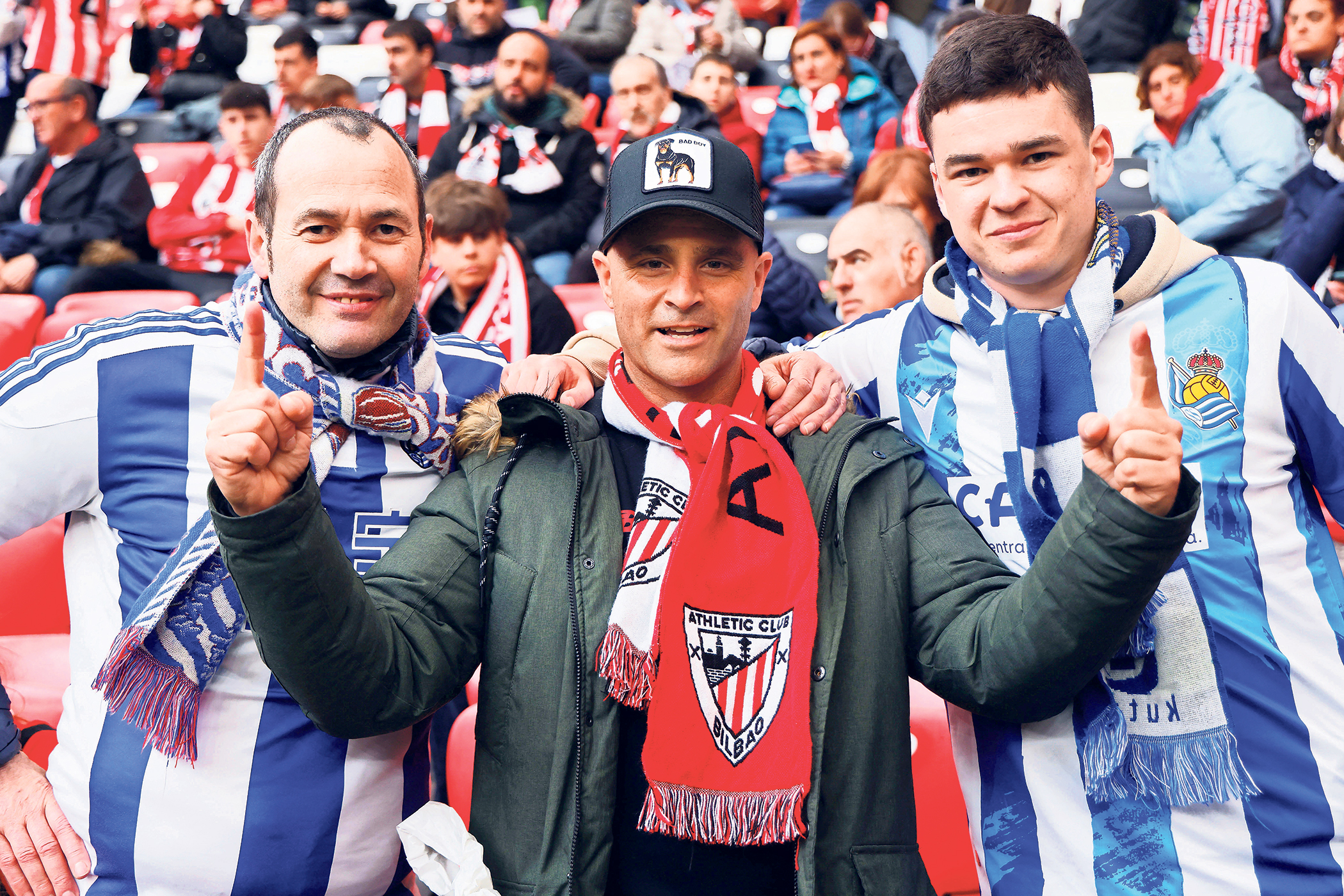
They had not sneaked in, poker-faced, colours hidden, hoping to avoid detection. The Basque derby is a rarity: a fierce, deep-rooted and keenly felt rivalry that takes place with little or no segregation between supporters. Everyone knew Athletic fans had tickets in home sections. Nobody would expect anything else. This is, after all, Europe’s friendliest derby.
It had been like that all day. As the sun strained to break through the Wednesday morning cloud over San Sebastian, fans strolled along the promenade on Playa de la Concha. There were groups in La Real shirts and groups in Athletic’s and, often, a little bit of both: families with one stray sheep; sets of friends with divided loyalties; couples proudly displaying their marital differences.
Snatches of song drifted through the shaded streets of the old town as fans cloistered outside sagardotegi, Basque cider bars, and lingered over pintxos. Some corners had been colonised by the visitors, but there was no sense of territory being claimed. Colours blended, groups mingled. That is unusual, but not unheard of: it is not said often enough that the vast majority of football fans are disinclined to fight.
What sets the Basque derby apart, though, is just how far that harmony extends. “You wait and see,” Iker Goni, the president of the Basque football federation, had told me. “The fans will walk to the game together. They will sit together. And afterwards they will leave together.”
If that sounds a little saccharine, it is not. Tens of thousands of Real Sociedad fans had greeted the team’s buses when they arrived, a couple of hours before kick-off; a few minutes later, the area where they had done so was covered in hundreds of spent flare cartridges. Athletic’s players were met with whistles for having the temerity to come on to the pitch and warm up.
Half an hour before kick-off, the noise was incessant, percussive; the game that followed was muscular, bristling. Ander Barrenetxea, the Real Sociedad midfielder, made sure his first tackle left a mark. His captain, Mikel Oyarzabal, bodychecked Alex Padilla, Athletic’s goalkeeper. Dani Vivian, Athletic’s grizzled centre-back, spent much of the second half in a state of permanent snarl.
Cordiality does not come at the expense of passion. The stakes, naturally, heightened the atmosphere; for both sides, a shot at a trophy has been a relative rarity since their halcyon days of the 1980s. But the Basque derby is never an etiolated sort of experience, a game played out in the spirit of a half-and-half scarf.
That raises two questions. Or perhaps it raises one question, framed two ways. What is it about this game that makes it different from almost every other derby in world football? Or, why aren’t more games like this?
‘I’ve never really understood neighbours hating neighbours – in football or anything else’
‘I’ve never really understood neighbours hating neighbours – in football or anything else’
Juan Irizar
Juan Irizar calls his wayward children over, beaming with pride. “Listen to this, you two,” he says. He has a Real Sociedad scarf draped over his shoulders. His son, also Juan, and his daughter, Alejandra, very much do not. Both have Athletic shirts under their jackets, a choice made for them – much to their father’s chagrin – by their maternal grandfather.
“What you can see here,” Juan says, gesturing across the plaza outside the Reale Arena, “is unique in the whole of Europe. The reality that you’re living, that you’re seeing, here in THE BASQUE COUNTRY” – he contrives to say those three words in capital letters – “where we can all be together, does not exist anywhere else.”
Once the parental lecture is over, his mood becomes more ruminative. “I’ve never really understood neighbours hating neighbours,” he says. “Whether in football or anything else. If that’s right, that this is the only place this happens, then I think that’s quite sad.”
Every derby has its own particular enmity, its own origin story. Some of them are true, or contain at least some truth, rather than being reverse engineered to add an explanatory veneer to good old-fashioned dislike.
Celtic against Rangers is rooted in religious differences. Boca Juniors against River Plate is about wealth and class. Real Madrid and Barcelona is, or has been made to be, a proxy battle for nationhood. Most, though, are a little less intractable. “Fan-related rivalries tend to emerge when there’s a conflict or history of resource competition,” said Martha Newson, an associate professor of psychology at the University of Greenwich who specialises in fandom. “They developed when clubs represented parts of towns or regions that competed with others when there wasn’t enough to go around.”
Until relatively recently, that did not always result in outright antipathy. The Merseyside derby was, for a while, England’s very own “friendly” derby. Further back, and the game’s tribal boundaries were not quite so calcified. Speak to Arsenal fans of a certain vintage and they will admit – perhaps quite quietly – they sometimes went to watch Tottenham when their team were away, and vice versa. The same principle applied elsewhere.
That idea has been wholly alien for some time. Loathing is now seen as an intrinsic condition of any rivalry; if a game is not full of spite and bile, it does not feel like a derby. This is not just how it is so much as how it should be. We actively celebrate that reflex hostility as an expression of authenticity, of meaning. If it was diluted or softened, then the effect would be to reduce the experience. Except, in the Basque country, it doesn’t.
Newsletters
Choose the newsletters you want to receive
View more
For information about how The Observer protects your data, read our Privacy Policy
There is no great mystery to anyone why the Basque derby is an exception. A few fringe theories float around, private thoughts and personal hypotheses: Irizar wonders if it might be because the games, for so long, have rarely had much at stake; his daughter, Alejandra, speculates that it may be because life in this part of Spain is “generally pretty good”; there isn’t much resource conflict here.
Nahia López, a Real Sociedad fan sitting with Athletic-supporting friends outside the stadium, thinks it might be because “we all live together”. José Luis, browsing a retro football store in the old town, takes the contradictory view. “Sometimes it helps that we are separated by 90 kilometers,” he said. In general, anyway: his wife is an Athletic fan, he explains. They all know, though, that all of that is secondary.
“It’s a brotherly rivalry,” said Iker Goni. “The games are intense. Everyone wants to win. But we are all Basque.”
Although the cause of Basque separatism has drifted from international – and to some extent national – view in recent years, overshadowed by calls for Catalan independence, the region’s sense of self remains as strong as ever. It has its own autonomous government. Public signs are in Euskera first, Spanish second. The ikurriña, the Basque flag, is ubiquitous across both San Sebastián and Bilbao.
That identity takes precedence over club loyalty. “What’s important in fandom is the layer of identity you’re tapping into,” said Newson. “In the Basque region, the unifying identity is perhaps so strong that it isn’t broken for the smaller matter of club identities. They’re all representations of the same Basque identity.”
Occasionally, that is made manifest. Earlier this year, a Basque national side played a friendly at San Mámes, Athletic’s stadium, against Palestine. “The most fanatical supporters from all of the Basque teams marched together to the game,” Goni said. “Not just La Real and Athletic, but Eibar, Alaves and Osasuna, which is from Navarra but is culturally Basque, too.”
That is not to say there is no tension in the relationship. There is a little resentment in Gipuzkoa, the province around San Sebastián, at Athletic’s tendency to present themselves as a symbol of Basqueness. “Real Sociedad is a sports team,” as Ekain Arregi, an Athletic fan, put it. “Athletic is a cultural institution.”
The Bilbao side’s youth policy – which permits only players with Basque roots to play for the team – creates tension, too. The other clubs in the region tend to see Athletic as a predator. “They don’t like losing players to us,” said Arregi’s friend, Nikola Almagro. “Even when they sell players to another team, they put anti-Athletic clauses in the contract, so we have to pay more to sign them.”
There have been signs of increasing strain in recent years, a division they suspect has been stoked a little by the toxicity of social media. It would be a shame if that changed the dynamic, they said. “More than Athletic fans or La Real fans, more than anything we’re all Euskoneras,” Arregi said, using the Basque term for Basques.
Still, there are limits. A few hours later, Real Sociedad are awarded a late (and somewhat soft) penalty. Oyarzabal converts it, sealing their place in the Copa del Rey final. Outside, two fireworks scream into the sky, a longstanding tradition designed to keep fishermen, out in the Bay, up to date with the score.
In the stands, the pockets of red and white start to disperse, their heads bowed as they scurry up the stairs, trying not to look at the exultant home fans. The rivalry might be friendly. Everyone might be Basque. But that doesn’t mean it hurts any the less.
Photography by D .Nakashima/AFLO/Alamy Live News