
Late in his first-round match at the 2014 Australian Open, Frank Dancevic realised something was not quite right. Snoopy was standing on the other side of the net. “Wow, Snoopy,” he thought. “That’s weird.” Shortly afterwards he fainted for almost a minute, before recovering enough to endure a straight-sets loss.
Dancevic would later call playing in the 42C heat “inhumane”, and if Jannik Sinner was not seeing Snoopy across Rod Laver Arena yesterday afternoon, there is little doubt he was close. Sinner looked seasick; the green of his face clashing with the grim yellow of his shirt. Cramp began in one leg before migrating to the other, then moved up to his arms. His opponent, 24-year-old University of Texas grad Eliot Spizzirri, appeared built for 40C temperatures, winning the first set before going a break ahead in the third.
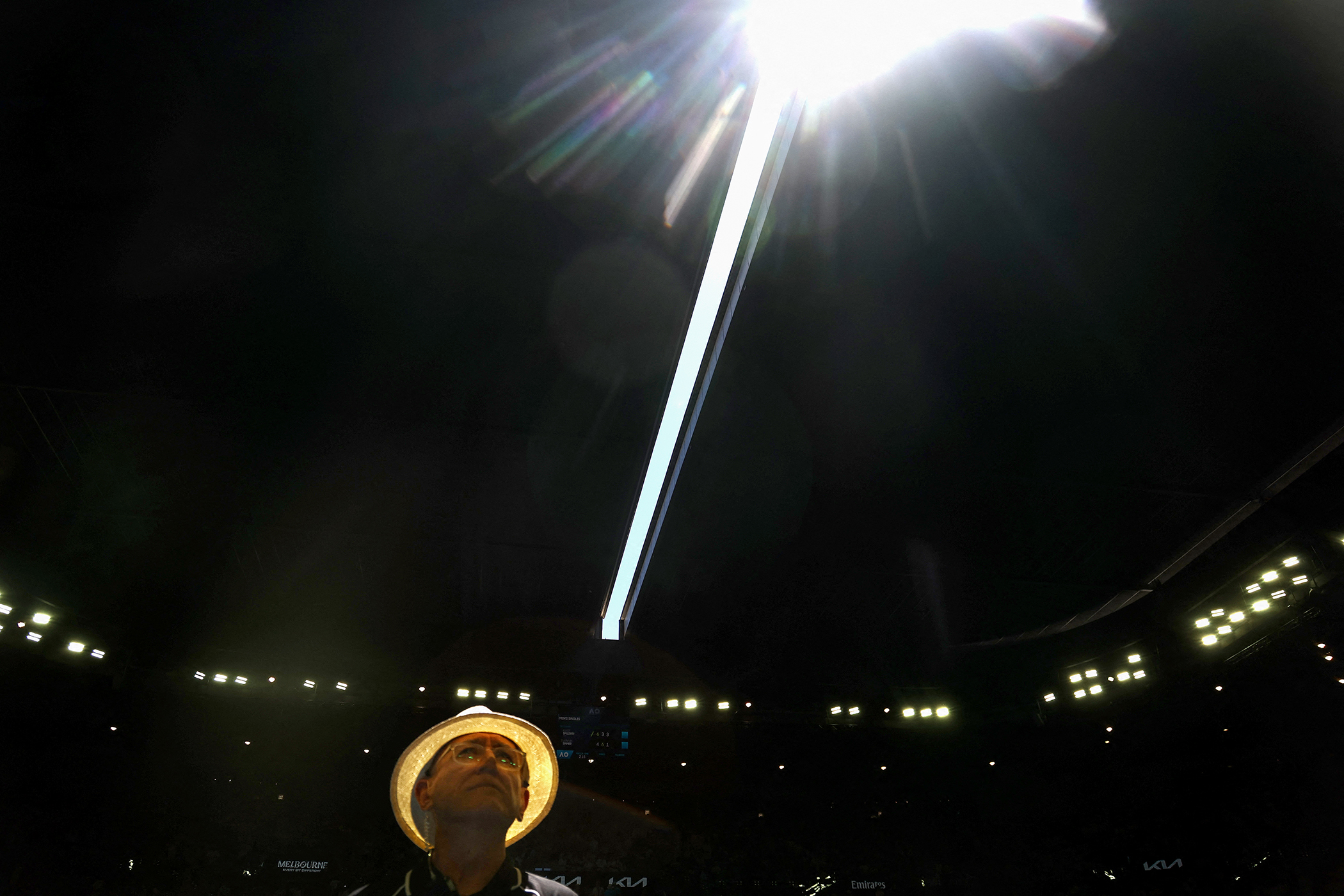
It was when the tournament’s heat stress scale hit five for the second time in three years that the roof closed and play was halted on all roofless courts for the rest of the afternoon – one of a range of player protections introduced since Dancevic’s dream. Sinner would later say he “got lucky with the heat rule” as he endured to win 4-6, 6-3, 6-4, 6-4. Ben Shelton, playing on Margaret Court Arena, said: “If the roof was open today, I don’t know if I’d be able to go the distance.”
The unofficial motto of this year’s Happy Slam has been that bigger is always better, a bombardment of record attendances and viewerships broadcast twice daily. The Opening Week, their ingenious attempt to rebrand the qualifiers, had been an unadulterated success, led by both the 1 Point Slam and an opening ceremony featuring a doubles match including Roger Federer and Andre Agassi. Revamped fan spaces like Top Court and Grand Slam Oval provide much-needed seating and relaxation areas that Wimbledon would kill for.
But attempts to continue pushing limits have still left the heart of Melbourne Park feeling overcrowded, a smorgasbord of snaking queues and constant traffic for every court.
More than 60,000 people attended every afternoon throughout the first week and yesterday was predicted to break all records, but the usual email from Tennis Australia was late and understated. A little more than 50,000 braved the heat, and a tournament that has been all about bigger was deprived of its statement figure by weather that made trudging from court to court feel like a marathon. A thousand or so remained in Rod Laver Arena in search of shade despite no play scheduled for nearly three hours.
The worsening heat has been a defining feature of the Australian summer for almost two decades. The Tour Down Under cycling has been repeatedly compromised by the weather – last week’s Queen stage of the men’s race was shortened, losing its signature climb, because the bushfire risk was considered extreme.
And while Melbourne has always had the odd day which topped 40C, they have become ever more regular. The city now averages 11 summer days over 35C and the Australian Climate Council predicts that will double by 2050.
That this will limit play once again is a real shame, because desiccating heat aside, the Australian Open is among the most joyous and relaxed elite sporting events, far less self-conscious and nakedly exploitative than its peers. Players are happy and hopeful because their seasons have only just begun; fans bathe in summer sun. But producing the world’s best tennis tournament is irrelevant when the extreme consequences of climate change threaten to make even spending an hour outside untenable.
Photograph by David Gray/AFP via Getty Images
Newsletters
Choose the newsletters you want to receive
View more
For information about how The Observer protects your data, read our Privacy Policy