

As the historian Tom Holland has said, elite football is now the most popular pastime the world has ever known. The game has become not just a boom industry but a cultural form that consumes people from Manchester to Manila and London to Lima. Rory Smith On Football is a guide to that world, a way to cut through the deafening noise, the claim and counterclaim, to help understand what is happening on the pitch, off the pitch, and why all of it matters. Sign up here.
Not quite a week on, it is the moment of perfect stillness that remains. Federico Valverde is a player composed entirely of hustle and bustle. In the flesh, the Real Madrid midfielder – or right-back, or right-winger, or whatever else is required – appears to exist in a state of constant motion, a player with the same attitude to running as a springer spaniel and the same approach to fatigue as a cyborg.
At times, it has felt as though his willing industriousness has typecast him just a little. We do not, as a rule, expect to see our superstars doing quite so much dirty work. If the Uruguayan were that good, would he not be loitering on the halfway line, waiting for one of his lackeys to give him the ball? His workrate, one some level, gives him the air of a water-carrier.
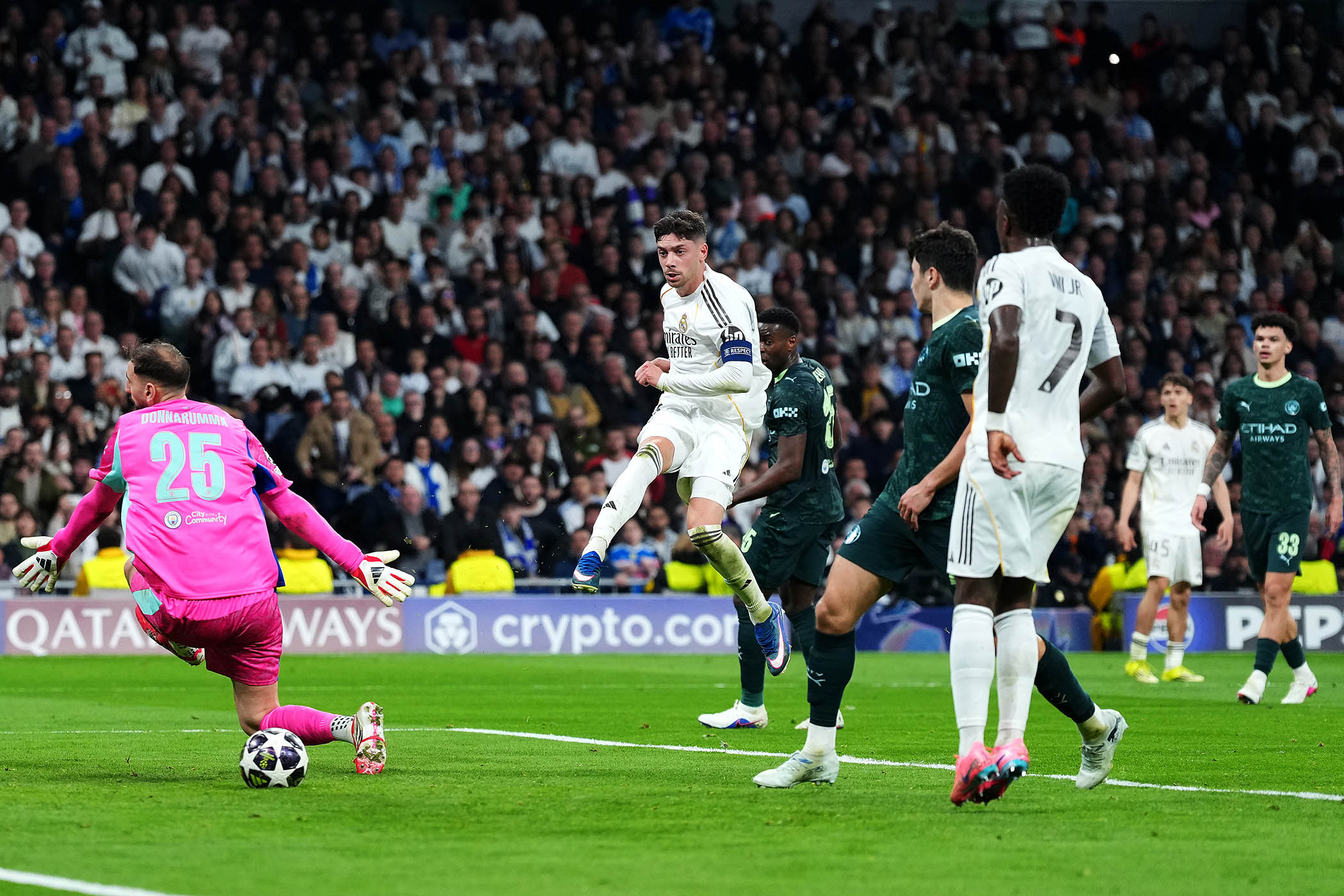
His first two goals in Real’s 3-0 demolition of Manchester City last week fitted those preconceptions perfectly: the first a sprint from the halfway line before dodging Gianluigi Donnarumma; the second a sudden charge into the penalty area that left Nico O’Reilly, City’s left-back, looking like a man waiting on the wrong platform for a train.
The third, though, was quite different: a goal defined not by speed and movement but by its absence, its opposite. Brahim Díaz lofted a pass, ingeniously, over four City players. Valverde saw it, read it, sprinted on to it. And then he slowed everything down, clipping the ball over Marc Guéhi’s head with the deftest touch. Everything seemed to pause: attacker, defender and ball caught in a perfect tableau. It lasted no more than a heartbeat, and then colour, and noise, and time rushed back in.
The power of the Champions League has always been its ability to produce these moments with startling regularity. Compelling games and high drama are baked into the model, of course, an almost inevitable outcome when both the quality and the stakes are so high. But the competition’s mythology is rooted as much in its capacity to transform a mere game into something much closer to art, to generate a stream of instances that evoke such awe and wonder and delight and despair that they enter into a sort of shared folklore. The Champions League has always acted as a forge of memory.
Valverde’s third goal, then, ought to belong to a line that includes – but absolutely is not limited to – Fernando Redondo’s turn at Old Trafford, Ronaldinho’s improvised toe-poke at Stamford Bridge, Lionel Messi’s bedazzling of Jerome Boateng and Cristiano Ronaldo’s overhead kick for Juventus.
Which others you might add to that list, and in which order you would place them, will depend a little on your age, your tribal affiliation and your level of engagement with European football. That none of them came in finals is kind of the point. These are incidents that have entered the collective consciousness not because of what they meant, but because of what they were: a shared, universal timeline of modern football in its highest form.
It is intriguing to wonder whether Valverde’s goal will have the same collective half-life. Not because it was in any way lacking in spectacle or élan or even iconography – that image of Guéhi, entirely confounded by his opponent, captures perfectly the impact of genius – but because of the cultural and technological landscape in which it was produced.
It is no great insight to say that our algorithmic age has served to shatter almost every aspect of our shared culture. As the author Derek Thompson has observed, we have replaced a form of monoculture with a series of “mini-realities,” ones which more closely resembles “cults, all stacked on top of each other.” We no longer have much of a shared experience of the world; everything is fragmented, atomised, bespoke.
Newsletters
Choose the newsletters you want to receive
View more
For information about how The Observer protects your data, read our Privacy Policy
The impact of filter bubbles and echo chambers and social media micro-targeting has been most pernicious on politics, where we can all now retreat into a world where everyone shares our views, but it has been no less profound on other aspects of culture.
The 2023 finale of Succession, for example, was a generational television event for the 2.9 million people in the United States who watched it. With delayed consumption, it might be that nine or ten million eventually took in the denouement to the Waystar/Royco power struggle (no spoilers). In 1983, 83 million people watched the end of M*A*S*H. In the late 1990s, 76 million Americans tuned in to see what happened to Seinfeld. In 2004, 52 million watched the end of Friends. There are, as several cultural theorists have observed, no more watercooler moments.
With only occasional exceptions – Taylor Swift’s Eras tour, say, or the Oasis reunion last summer – the same has happened in music and in film and every other branch of the arts we might care to name. What we consume is tailored to what we have previously consumed. It is to culture what Alan Partridge was to regional detective dramas: “People like them, let’s make more of them.”
Sport in general, and football in particular, has long been the last bulwark against that tide, something that still largely has to be experienced communally – either in real life or digitally. Whether that can hold or not is a different matter.
Fans are increasingly encouraged to absorb football entirely through the lens of their own club; younger viewers more and more prefer it to be mediated through the reactions of their preferred streamer, the game itself rendered secondary to watching the emotions it generates. And then there is the pressure created by the sheer volume of football to watch; the surfeit might, in time, dilute the meaning of any individual moment. It is harder to enter the collective consciousness when the collective consciousness is so easily distracted.
For the Champions League, one fuelled by its own folklore, that is a genuine threat. It is one Uefa is clearly conscious of, hence the fact that the competition’s highlights are now on the BBC, its finals have been shown on YouTube and its goals are posted onto social media by the very television networks who have paid princely sums to ringfence that very content. Money from those broadcast deals is vital, of course. But so too is that sense that the Champions League is still something we can all experience together.
Photograph by Angel Martinez/Getty Images