Maro Itoje’s 100th cap and Henry Pollock’s first start for England were the preview-meat for this crowd. Two fine stats, worthy of build-up analysis and reflection. Then the whistle blew and it all fell apart.
England’s captain Itoje left the field after 54 minutes with some of his country’s fans questioning his leadership in consecutive calamities – first in Edinburgh against Scotland and here in a record 42-21 defeat by Ireland. A minute into the second half Pollock was trudging to the sin-bin for an infringement on England’s tryline. Enjoy your special day.
Pollock is 21, Itoje 10 years his senior. The illustrious captain became a centurion with few doubting his contribution through many false dawns in his decade of national service. Meanwhile, Pollock is the closest English men’s rugby has produced in a generation to a crossover star capable of catching youth’s eye. English rugby churns out yeomen, not exhibitionists.
But for the leader and the prodigy, landmark achievements died on the page. England were a rabble, schooled by Ireland in the basics of international rugby. Their 12-match winning run before Edinburgh felt like a printing error as Ireland destroyed them with discipline, game awareness and execution.
The greater shame is that England’s Six Nations campaign has imploded. But it would take a hard heart not to feel sympathy for Itoje, who jogged out alone to receive the crowd’s adulation, but then had the party cake thrown in his face. Or for Pollock, whose work in the pack was less than convincing when England needed hard yards and ballast, but who excelled in flashes in his favourite fun zone as a wide attacker.
Pollock said before the game he was asked by head coach Steve Borthwick only “to be myself”. And that’s what he tried to be, except Ireland rendered his free-flowing talent irrelevant by dominating the contest. Pollock was left to decorate in tiny bursts a game he was unable to shape. Itoje, the heart of England’s pack, and a veteran of every conceivable rugby-ing experience, was also marginalised by Irish precision and efficiency in set piece and open play.
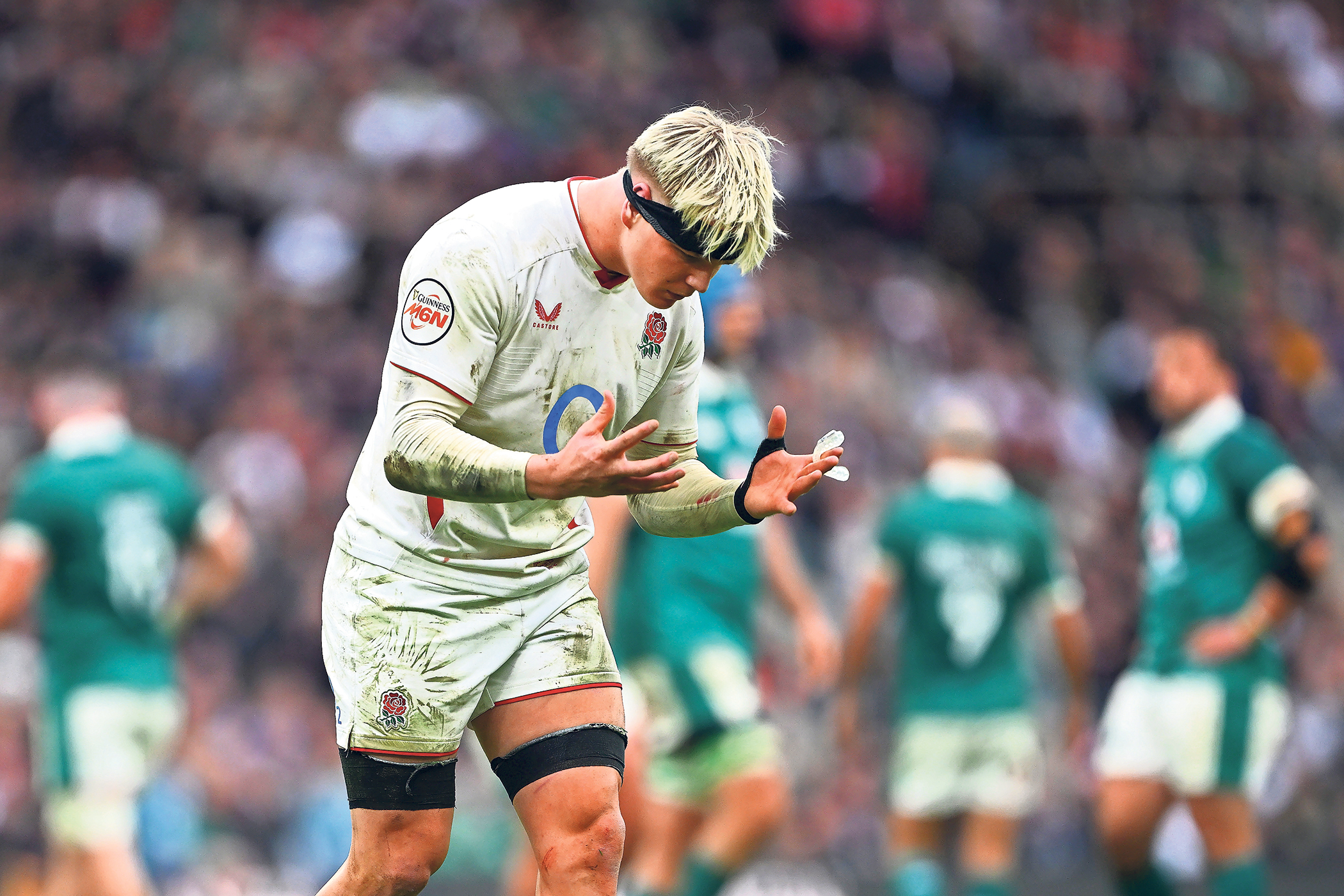
The landmark men, then, were spectators – quite literally when Pollock had to watch 10 minutes of the game from the holding pen for a desperate, last-ditch offence, and when Itoje gave way to Alex Coles, with his family applauding him off the pitch.
At least that image alleviated the gloom of his red-letter day. Itoje has given too much of himself to be blamed as the sole culprit for England’s lack of direction. The failure of leadership is collective: Ellis Genge, for example, trying to stop an Irish attacker with a meek shoulder brush, while his arms stayed down by his side.
It’s not hard to imagine Pollock’s flamboyance counting against him while he waited for his full England debut
It’s not hard to imagine Pollock’s flamboyance counting against him while he waited for his full England debut
A British and Irish Lions tryscorer before he was an England starter, Pollock applied himself from minute one, chatting, cajoling and gesticulating his way across the pitch in a positional role that could be described only as: free spirit.
Almost 10 minutes had passed before he added ball carrier and forager to the tasks he had given himself as an auxiliary back, poised to attack as a centre or even winger. Anyone seeing him for the first time might think he had overdone the versatility bit. But it would be a mistake to think he does whatever he likes.
Newsletters
Choose the newsletters you want to receive
View more
For information about how The Observer protects your data, read our Privacy Policy
He was England captain, at Under-18 level. His reading of the game may be unconventional but it’s also intuitive.
With England 15-0 down in less than half an hour it was Pollock who sprinted back to foil an Ireland counterattack, pulling down Jamison Gibson-Park before he could surge into open space. It’s not hard to imagine Pollock’s flamboyance counting against him while he waited for his full England debut. Mavericks have to work extra hard to persuade head coaches to pick them.
Before this laudable Irish win, Itoje looked back on his previous 99 appearances and said: “You must navigate yourself through the years and hurdles.”
How true that felt when England traipsed off. Yet Itoje remains the lamplighter for Pollock as he “navigates” a course from object of curiosity to indispensable England starter.
Speaking to the BBC’s Rugby Union Weekly podcast, Itoje said: “It goes back to – what is the type of career that I want to have? Do I want to have the type of career that I win a couple of trophies over a three-, four-, five-year period, then I’m nowhere to be seen?
“No, the type of careers that always interested me and the ones that I’ve always admired were the ones of consistently competing at the top level over a period of time.”
The timing was cruel for him to be so ineffective in a game, but respect for his record will survive England’s woeful experience at Ireland’s hands.
Pollock now knows how wonderboy trajectories work. They aren’t linear and the external world sometimes has other ideas – as Ireland did, on a shattering day for England.
Photography by Shaun Botterill/Getty Images