
Scotland spent the week hoping for an England assist, but ultimately it was the failure to help themselves that punctured their dream of finally clinching a maiden Six Nations title after losing 43-21 to Ireland.
After allowing France to score four late tries last weekend to claim a bonus point at Murrayfield, Scotland knew that their quest for a first championship since 1999 was no longer in their hands.
It was a two-part puzzle: they had to beat Ireland for the first time in nine years and then hope England could somehow clamber back off the canvas to land a knockout blow on France in Saturday’s final game.
Scotland, though, couldn’t overturn their terrible record against Ireland, who won comfortably to claim the Triple Crown and give themselves a sniff of the overall title.
Gregor Townsend has not beaten Ireland in 12 attempts, a winless streak that stretches back to 2018. Scotland still haven’t won in Dublin since 2010, when they triumphed at Croke Park, and are yet to savour victory inside the Aviva Stadium. Scotland’s last win on this site came back in 1998 when it was still known as Lansdowne Road, an entire generation of travelling fans still to see their team prosper at the home of Irish rugby.
What makes this latest defeat so galling was that, for once, there was so much at stake for Scotland heading into Super Saturday. A victory would have seen them finish no worse than second in the table, which would have been their best final position in the Six Nations. It would also have delivered the Triple Crown back into Scottish hands for the first time since 1990, the last time any Scotland team won four championship matches on the bounce.
That earned Ian McGeechan’s side the Grand Slam that year and, although that particular prize wasn’t on offer here, an overdue Dublin triumph would have sent Scotland to the top of the Six Nations table, temporarily at least, ahead of that denouement in Paris later in the evening. Given all of that, it was hard to escape the feeling of what might have been when the final whistle sounded and Scotland had been bested by Ireland once again.
Their end-of-campaign post-mortem would have begun the moment that they arrived back at their team hotel and must have been a painful process. Had they won, the squad would have gathered in a private room, most hoping for an England victory for the first time in their lives, to boost their own chances.
Now it was just an occasion to reflect on a tournament that started and finished with defeats but included a run of three victories in the middle that gave renewed hope, even if that was once again dashed by the Irish. Townsend tends to lean towards the positive, but it wasn’t difficult to detect the sadness in his voice as he summed up a tumultuous campaign for his team.
“The performances we’ve delivered, especially those key victories, are some of the best rugby I’ve ever seen this team play,” he said. “Obviously, the France game stands out, the England game and a lot of the Welsh game, particularly the second half.
Newsletters
Choose the newsletters you want to receive
View more
For information about how The Observer protects your data, read our Privacy Policy
“But today is a reminder and a lesson. The reminder is this is what we need to do to play our best. And when we do that, we can go up against any of the best teams in the world. But the lesson is that it has to be for a longer period. No-one can play 80 minutes when they’ve got no possession. But we’ve got to be better when we do have those opportunities.”
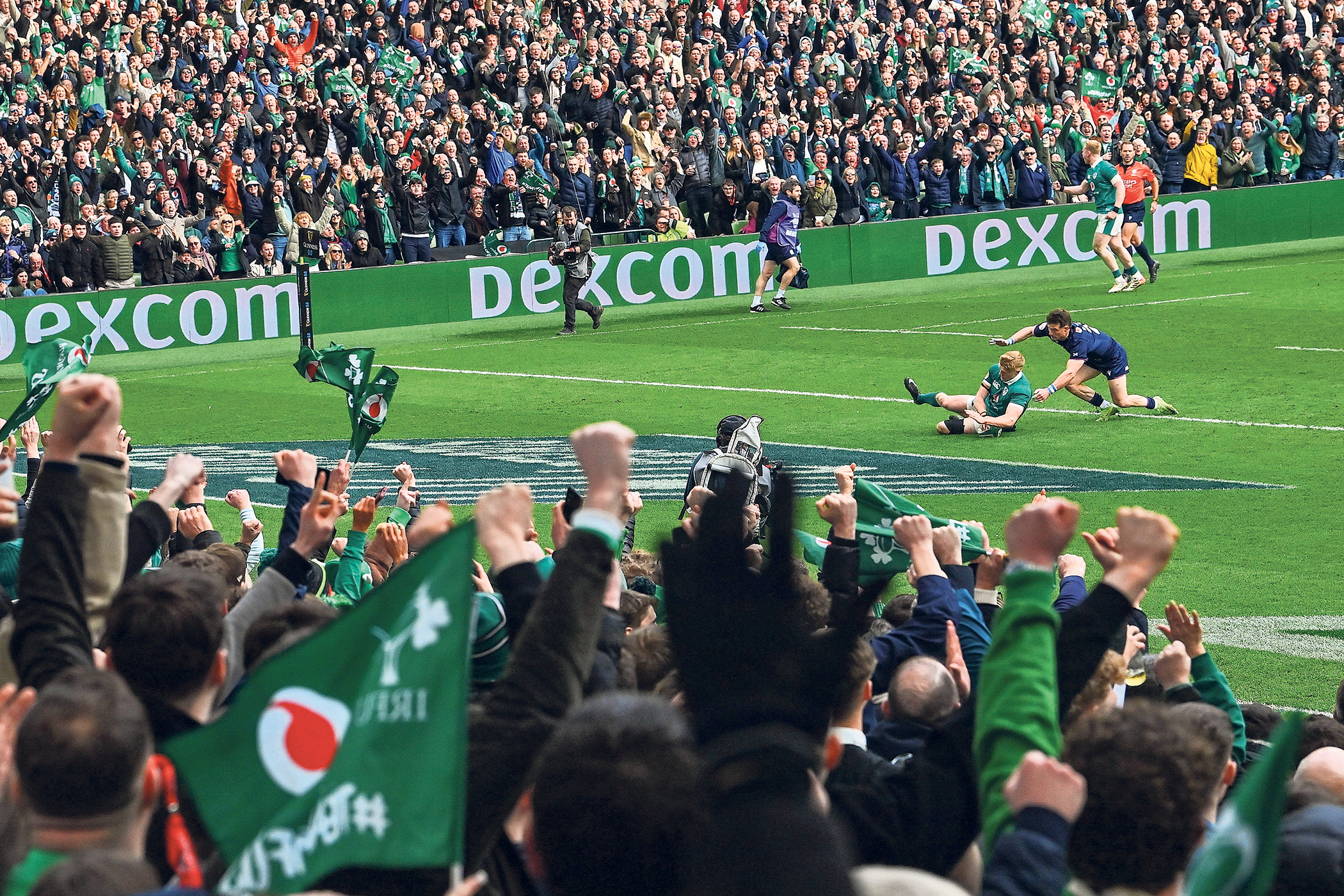
It was almost impossible to escape the tension and sense of occasion from early in the day as supporters from both sides began to gather in the pubs and bars from Temple Bar all the way to Lansdowne Road. Both sides took to the field knowing that the victor would have a shot, no matter how slim, at the championship, and it was Ireland who took it.
They scored the first of their six tries as early as the third minute and, although Scotland responded right away through a Darcy Graham score and kept fighting until midway through the second half when they trailed by only five points, it was the home side who looked more purposeful and aggressive throughout.
Ireland were the deserved victors. And as the fireworks exploded and the Cranberries’ Zombie – the unofficial national anthem – boomed out over the Aviva speakers, the Scotland players stood motionless, their heads bowed in contemplation and frustration.
“We crawled back to 26-21 but I think Ireland deserved to win,” admitted captain Sione Tuipulotu. “I’m really proud of the boys, how they rallied in this championship. And we definitely made progress, there’s no doubt about that. But yeah, my goal was to lift that Triple Crown and we did not get there. That will probably [sink in] later on after letting my emotions brew a little bit.
“[Collisions] are where it was won and lost. I’m proud of the way we stuck in it, but we can’t make the errors we did. We’ve made progression, but we want to be where these guys are with a trophy.”
There will be questions again about Townsend’s future following this latest setback, although the wins over England and France, in particular, should remove any possibility of him vacating his post ahead of the Nations Championship in the summer.
Another loss to Ireland will sting but the three results that preceded it at least partly answered doubts over whether he had taken the team as far as he could. The poverty of most of last year’s performances, especially in the bigger matches, and then the loss to Italy to start this campaign did not suggest that this was a squad that had more to give. We know now that they did, even if Ireland remain the great obstacle that Scotland simply cannot overcome.
Photograph by Seb Daley/Sportsfile via Getty Images