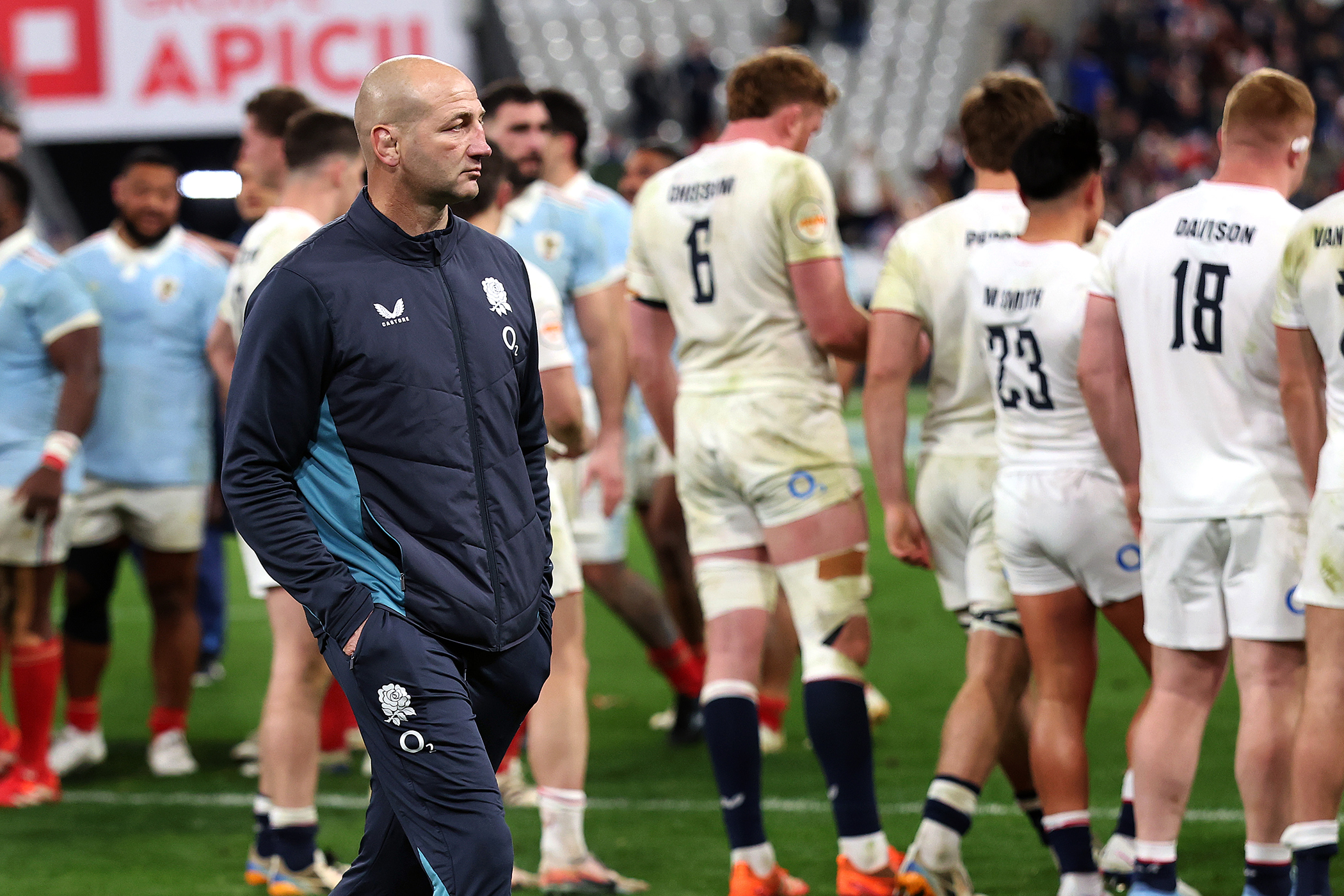

It was actually something that Bill Sweeney did not say, during a briefing into England’s disastrous Six Nations on Thursday, which felt the most significant. Asked for his initial reflections on the tournament, Sweeney used “disappointed” twice before saying: “We still have absolute confidence in the squad we have got and the talent in there.” Notably, there was no mention of the coaching staff.
A review into England’s campaign is ongoing, “a deeper dive” than normal, which is not expected to wrap up until a month’s time.
After England’s first defeat by Italy less than three weeks ago, Sweeney released a statement suggesting that the RFU remained “fully committed to supporting [Borthwick and his coaching team] and the players as they face France this weekend and then look ahead to the Nations Championship”, with the insinuation being that Borthwick would be in place for the summer itinerary of playing away to South Africa and Argentina either side of a Test against Fiji in Liverpool.
Sweeney’s remarks on Thursday, when asked if Borthwick would be in place this July regardless, certainly felt more measured.
“The primary focus is to get to the bottom of the issues,” he said. “What are the issues? And clearly, there's some, and we're getting to them already. So we've got a sense of some of the areas that need addressing. And I see the outcome of that being for us to make sure we've got the right support mechanisms in place to address that and support Steve to get that right going forward.”
There is a recent precedent here. New Zealand returned home from a reasonable autumn tour – three wins, one loss against England at Allianz Stadium – and launched their own end-of-year review. The feedback from players about head coach Scott Robertson, around the team’s environment and coaching, was so scathing that he had to go after only two years at the helm. Robertson’s All Blacks repeatedly seemed to fade in the second half.
Publicly there is no suggestion that England are at that point. Elliot Daly gave his “full backing” to Borthwick after the loss to Italy and suggested England “probably should” havereached the World Cup final in 2023. Ben Earl was similarly effusive. “Steve gives us a game plan where I honestly have complete, supreme confidence that we'll win every game.” And here’s Jamie George in Paris. “Steve is one of the best coaches I’ve ever worked under. Under Steve, I think we will be right up there with the favourites to win the World Cup in 2027.”
England in this Six Nations had their own repetitive issue, mainly around ill-discipline, with yellow cards in every match and nine overall. “The excellent thing about Steve is that we will have answers, we will have clarity to make sure it doesn’t happen again,” George added in Paris. No doubt that will be the focus of this deep-dive review.
The reason these reviews matter so much, even if they can seem drawn out, is that they offer those players who might not quite be singing from the same hymn sheet as those public messages the anonymity to speak freely.
What is clear is that the glow around England’s performance in Paris, the optimism that created at the time – ‘Why can’t they always play like that?’ – has faded pretty quickly.
Newsletters
Choose the newsletters you want to receive
View more
For information about how The Observer protects your data, read our Privacy Policy
Sam Vesty, the Northampton Saints head coach who works closely with a number of England’s backs in Alex Mitchell, Fin Smith and Tommy Freeman, publicly questioned the team’s identity this week on BBC Radio Northampton's The Saints Show.
"Scotland move the ball. Italy move the ball… all those teams that we have just mentioned - if I asked you what their identity was, you could pretty clearly say something, couldn't you?” said Vesty. “I'm not sure you can say that with England at the moment."
As Vesty added, it’s easy to play with the handbrake off, to be “a free rugby team”, when there is nothing on the line. So how much can you really take from that performance? Sweeney suggested the display in Paris showed “a style of play there that has been developing going back to 2024, that New Zealand series in Dunedin and Auckland… a style of rugby that builds on traditional blends of the English set piece but is more expansive, more open, more running”.
That might be true, but England did not play that way against Ireland, and certainly not in Rome. Too often in this year’s Six Nations there was a disconnect between what is being said and what is happening on the field. And the speed at which that goodwill created by England’s 12-match winning run disappeared has been striking.
Failing to live up to expectations will make that happen, which has certainly not been an issue in recent years for the Red Roses, world champions again and with 73,000 tickets sold for their women’s Six Nations opener at home to Ireland next month. The impact of their success is extending far beyond the professional game.
“When you go into the community game and talk to clubs and you see the numbers, and you see the number of women and girls coming into the sport for the first time, and what that does for the community game in total, then it's a real positive,” said Sweeney.
There was a notable contrast between the RFU’s (understandably) cautious approach towards Borthwick’s future and the review process, compared with the plans for the Prem over the next decade, which were also announced on Thursday.
Those initiatives – a salary cap floor of £5.4m which all teams must spend to, fines for not hitting marketing budgets as part of new minimum standards criteria, more “Big Games” across the country – created the impression that the Prem is growing up a bit, intent on driving higher standards.
The Observer understands that two clubs, Newcastle Red Bulls and one other, currently fall short of that salary cap threshold but will meet that £5.4m figure by the time the rules come into effect. Newcastle, gradually increasing their spending, were taken over by Red Bull last summer. “We need improved standards across the league, and to make sure clubs aren’t making up the numbers and taking their position for granted,” said Simon Massie-Taylor, the Prem Rugby chief executive.
Two expansion teams will also join the competition for the 2029-30 season, with expressions of interest required next season before prospective franchises spending the 2028-29 campaign in the second division Champ to be put through their paces operationally. The end goal is to have 20 clubs by 2040, ideally filling the gaps currently vacant for a top-flight rugby union operation in Yorkshire, Birmingham, Norfolk and the south-east.
Closing the door on promotion and relegation between the top two divisions is a shame, but had felt inevitable for years until it was formally recognised that the Prem would move to a franchise model at February's RFU council vote.
The direction of travel for the Prem is now clear. For England under Borthwick? Not so much.
Photo by David Rogers/Getty Images