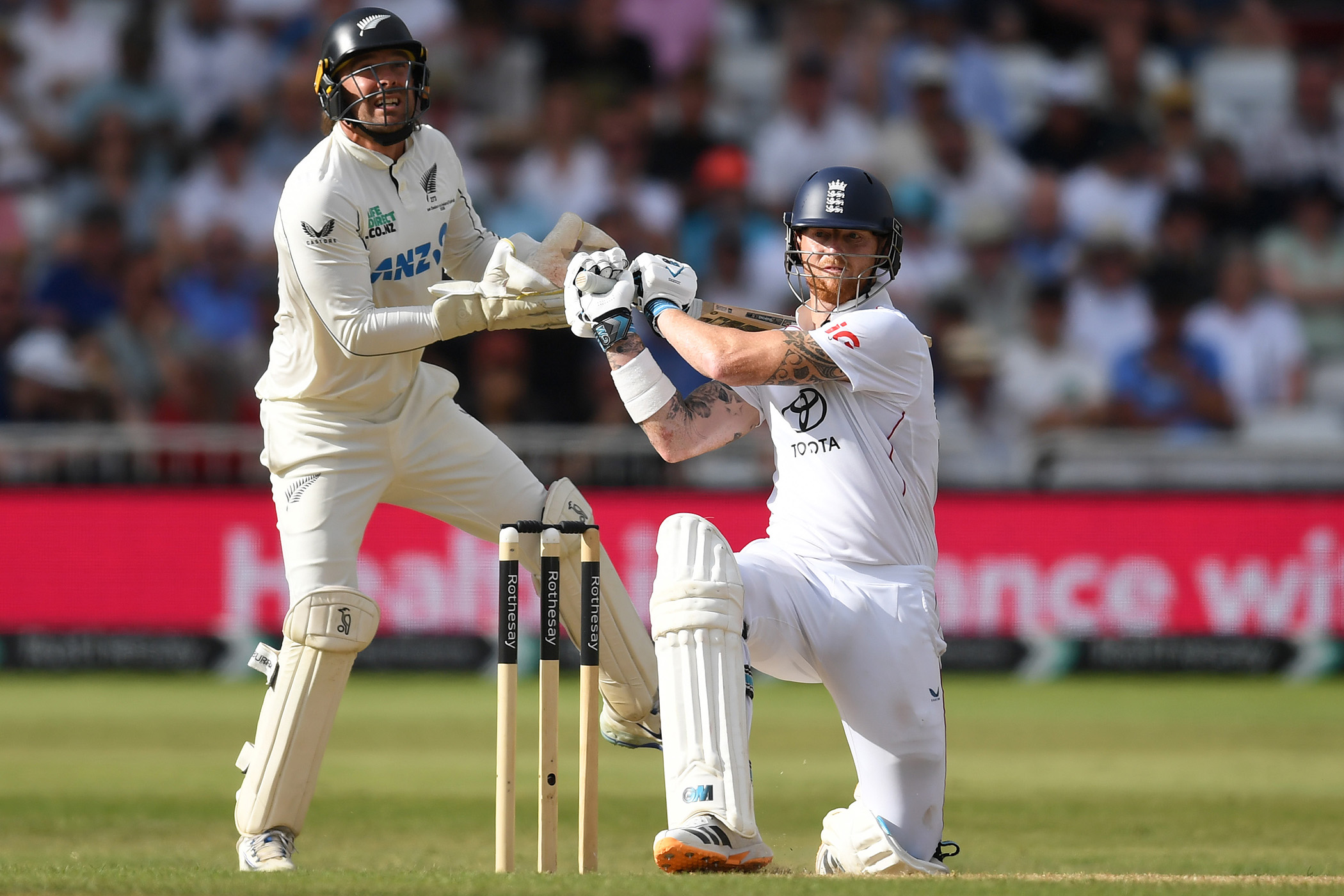


The Weekly Stat: In England’s 49 Test matches from the start of Ben Stokes’s captaincy in 2022 to its end in Nottingham last Monday, they scored at 4.44 runs per over. No team have ever scored at a faster rate over a 49-Test sequence – the next highest figure was Australia, who scored at 3.86 per over from July 2001 to March 2005. With the ball, Stokes-era England conceded 3.58 runs per over. No team have ever conceded runs at a faster rate over a 49-Test sequence.
Sport, with its verifiable, immutable catalogues of wins and losses, likes its success and failures to be binary and clear-cut. Stokes’s England succeeded, spectacularly, for a while, then swung, often wildly, between victories and defeats, and finished with failures. Ten wins in their first 11 Tests, several of them conjured from positions of traditional hopelessness; two victories in their final 10 matches, both in bad-pitch, fast-action slug-outs.
They won their first three completed series during his time as captain, two of them spectacularly, as well as securing a startling victory over India in the fifth Test rearranged from 2021 to draw 2-2. From then, in 10 more series, they won only three (two of which were at home against low-ranked opposition), with three drawn series and four defeats.
Since Stokes became captain, England have enjoyed some of their most astonishing victories. They won three Tests after conceding more than 550 runs, constituting one-third of all the Test wins ever achieved by teams which have conceded 550 or more.
England had won only one such match previously (having conceded 550 or more on 68 occasions), and that was in the 1894-95 Ashes, when Queen Victoria was anxiously awaiting for the internet to arrive so she could keep up to date with the scores.
Stokes’s men posted the four fastest-scoring 500-plus totals in Test history. They achieved England’s two highest successful fourth-innings run chases, and, at the Oval last summer, were seven runs away from adding the third-highest. They are responsible for six of England’s 17 successful chases of targets above 250.
On the negative side, Stokes-era England were bowled out in both innings in a combined total of fewer than 120 overs in 10 Tests out of 49. They had been dismissed twice in fewer than 120 overs in 10 of their previous 151 matches (from the start of the 2010 home summer to the end of last pre-Bazball-era series in 2022), 10 times in the 252 matches before that (from 1988 to 2009-10 inclusive), and never in 409 Tests between April 1910 and June 1976.
The accelerated nature of modern Test cricket is a significant factor in these numbers, and other teams have also seen an increase in the regularity of collapsed innings. Stokes’s England, however, ultimately became too easy to beat, and less good at their own brand of cricket.
Broadly, Bazball can be broken into three main phases. In Phase One, from the 2022 home summer up to the first-Test victory in India in January 2024, they scored at 4.77, conceded at 3.33. Phase Two, lasting from the second Test in India to the drawn Old Trafford Test against India last summer, saw them scoring at 4.40 and conceding at 3.66. In Phase Three, the era-ending run of two wins and seven defeats in the final nine matches, in which they failed to secure a series win against India and were well beaten by Australia and New Zealand, they scored at 3.93 and conceded at 4.02.
England’s opponents have learned how to restrain their pulverising batting, and England have, with a less experienced and higher-risk bowling attack, been unable to exert control in the field.
Newsletters
Choose the newsletters you want to receive
View more
For information about how The Observer protects your data, read our Privacy Policy
The diminishing returns of Bazball for England are highlighted by their record in the later Tests in series. In the first five Bazball series (up to and including the 2023 Ashes), they won three and lost two first Tests, and won seven, lost two in the later matches. In first Tests since the start of the series in India early in 2024, however, they have won seven and lost one (Perth, harrowingly, against Australia) and won six, lost 15 thereafter. In their five most recent series, after first Tests, they have won three, lost 10. Overall, and within recent series, they have failed to sustain their early brilliance.
The Bazball project neither succeeded nor failed, but played a style of cricket never previously attempted. Other teams have been far more attacking than their contemporaries – the early 21st-century Australians, the West Indies for much of the second half of the 20th century, Australia before the First World War. Individuals have batted at scoring rates far above the norm.
But there has never been a team quite like Stokes’s England side, whose successes and failures have been among the most extraordinary, unorthodox, reckless, precedent-defying Test cricket ever played, in both good and bad ways.
Stokes did not win the Ashes, did not beat India, lacked a defining series triumph. By playing a sport as old as Test cricket in a manner that no-one had attempted before, however, he has written one of the game’s most fascinating chapters. His team have captivated and infuriated. They have dazzled and baffled with their magnificence and flaws. They have been inventive and stubborn, liberating and careless. They have been unique.
Photograph by Philip Brown/Getty Images