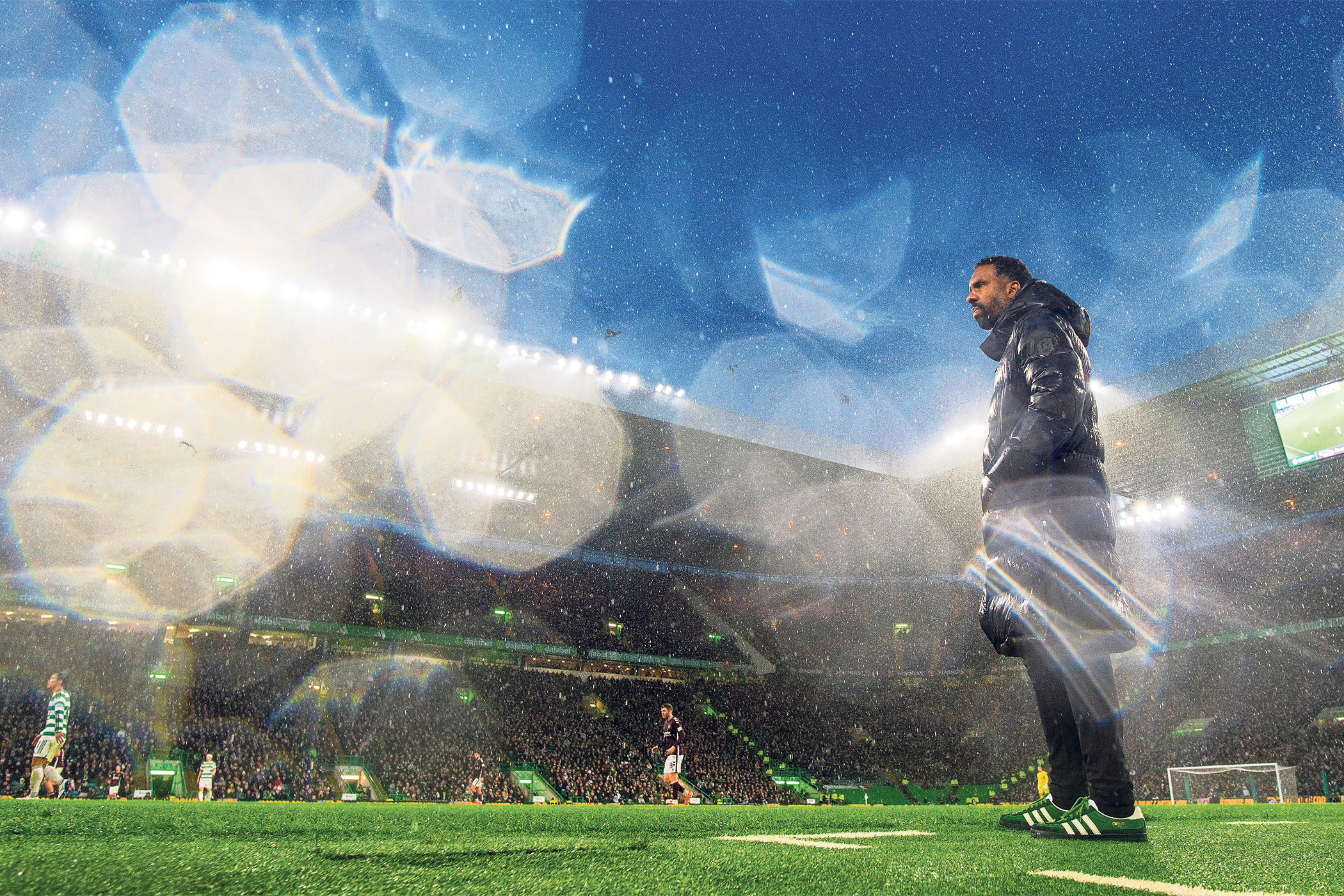

Wilfried Nancy will have known what he was walking into when, not even three weeks ago, he decided to take over at Celtic: the pressure, the expectations, the demands of the club’s board and their supporters. What will have come as more of a surprise, perhaps, is the amount of attention paid to his choice of footwear as he did so.
As absurd as it sounds – and as it is – shoes have provided one of the leitmotifs of the first five months of the Scottish season. It started with Russell Martin. Tradition dictates, apparently, that the manager of Rangers should be unveiled wearing brown leather shoes and a navy blue suit.
Martin, a dangerous renegade, elected to present himself to the Glaswegian public wearing what are colloquially known as “pundit trainers”: black patent leather top, bright white base, absolutely no sign of a logo. This, it turned out, ranked as evidence of a serious character flaw for a surprising proportion of the club’s fans.
‘If Nancy doesn’t learn quickly, this job is going to eat him up and spit him back out’
‘If Nancy doesn’t learn quickly, this job is going to eat him up and spit him back out’
Ryan Stevenson, ex-Hearts forward
More remarkable still is that, only a few months later, Nancy appears to have made almost exactly the same mistake. For his first game at Celtic Park, the 48-year-old selected a pair of green Adidas trainers. He may have envisaged this as a little populist gesture; the colour, he would have imagined, might have gone down well.
Apparently not. “There’s a certain DNA to clubs like Celtic,” the former Hearts forward Ryan Stevenson wrote in the Daily Record. That does not, in his view, include “gimmicks” like “tactics boards and green trainers. You have to ask yourself: ‘What are we actually dealing with here?’ If he doesn’t learn quickly and stop making the same mistakes, then I’m afraid this job is going to eat him up and spit him back out.”
It is easy to sneer at the furore caused by the shoes, to deploy both incidents as evidence of the pettiness of the rivalry that cleaves Glasgow, to weaponise them as a way to attack the culture of Scottish football itself. They seem to illustrate a small-mindedness, an inherent conservatism, a sort of toxic insularity.
But they are better considered as indications of something much deeper, something that deserves proper consideration. Martin’s time at Rangers lasted just 123 days in the end – what is known in the official unit of these things as a Treble Postecoglou – but that was, in its own way, fairly impressive. A few weeks into his tenure, the prospect that he might survive four months seemed a distant one.
At the current rate of progress, it would count as a minor miracle if Nancy gets anywhere close to him. He was appointed as Celtic manager on 3 December. In that time, they have played four games, and lost them all. If a defeat by Roma in the Europa League is forgivable, succumbing to Hearts, St Mirren and Dundee United – in ascending order of unacceptability – is not. Nancy’s fifth game is against Aberdeen on Sunday. Lose that, and he may well not see Christmas.
His dismissal, though, may well not solve the problem. In the circumstances, obviously, the 48-year-old would be pilloried. That is not especially palatable, but it is wholly inevitable. He would go down as the incompetent, hopelessly out of his depth, who oversaw the briefest reign of any manager in Celtic’s illustrious history by some distance.
And yet that argument, that Nancy simply is not a good enough coach, does not really stand up to scrutiny. His record in Major League Soccer, where he led Columbus Crew to a league championship in 2023, is commendable. It is worth noting that, according to Opta, the MLS is a significantly stronger competition than the Scottish Premiership.
Newsletters
Choose the newsletters you want to receive
View more
For information about how The Observer protects your data, read our Privacy Policy
There is a little more merit to the idea that whether Nancy was the right or the wrong man is not nearly as relevant as the fact that this was completely the wrong time. He should not have taken such an exacting job in the middle of a far more complicated season than Celtic would have been expecting; more importantly, the club’s board should not have offered him the chance to do so.
Even that, though, is a symptom of Celtic’s issues, not the cause. Both sides of the Glaswegian enmity are caught in what looks a lot like an existential crisis, but it is only Celtic’s strife that has now taken on the quality of a parable, a warning that there are only losers from the rampant inequality that now stalks so many of Europe’s middleweight leagues.
This is a club who have done nothing but win for more than a decade: they have won all but one of the Scottish Premiership titles since 2012, as well as seven Scottish Cups and eight League Cups bearing various sponsors’ names in that time. With each victory, the sense of achievement has diminished a little further, to the point now where there is no such thing as triumph. There is no such thing as success, domestically, for Celtic. There is only the avoidance of failure.
Instead, the club seek honour in Europe, but at a disadvantage: not just to rivals from richer leagues, larger countries, but to a class of insurgent clubs with little historical prestige but deep pockets, blank slates and the offer of the Champions League. Celtic’s fans are rightly angered by their club’s inability to adapt to that new reality. But it is valid to suggest that it is inherently hostile, a world in which crisis is much closer than glory.
They are not alone in that. Rangers have been experiencing something similar – much worse, in fact – for some time, but so are the likes of Benfica, Porto, Panathinaikos, even Ajax. No head coach has lasted more than a season at the Johan Cruyff Arena since Erik ten Hag left in 2022; they are currently on their fourth interim coach in three years.
Like Celtic, they are too big for their domestic league; like Celtic, they are not big enough to thrive in Europe. They are caught in European football’s great lacuna, lurching from crisis to crisis, unable to settle on an identity, neither what they were nor what they would like to be.
Photograph by SNS Group/Getty Images