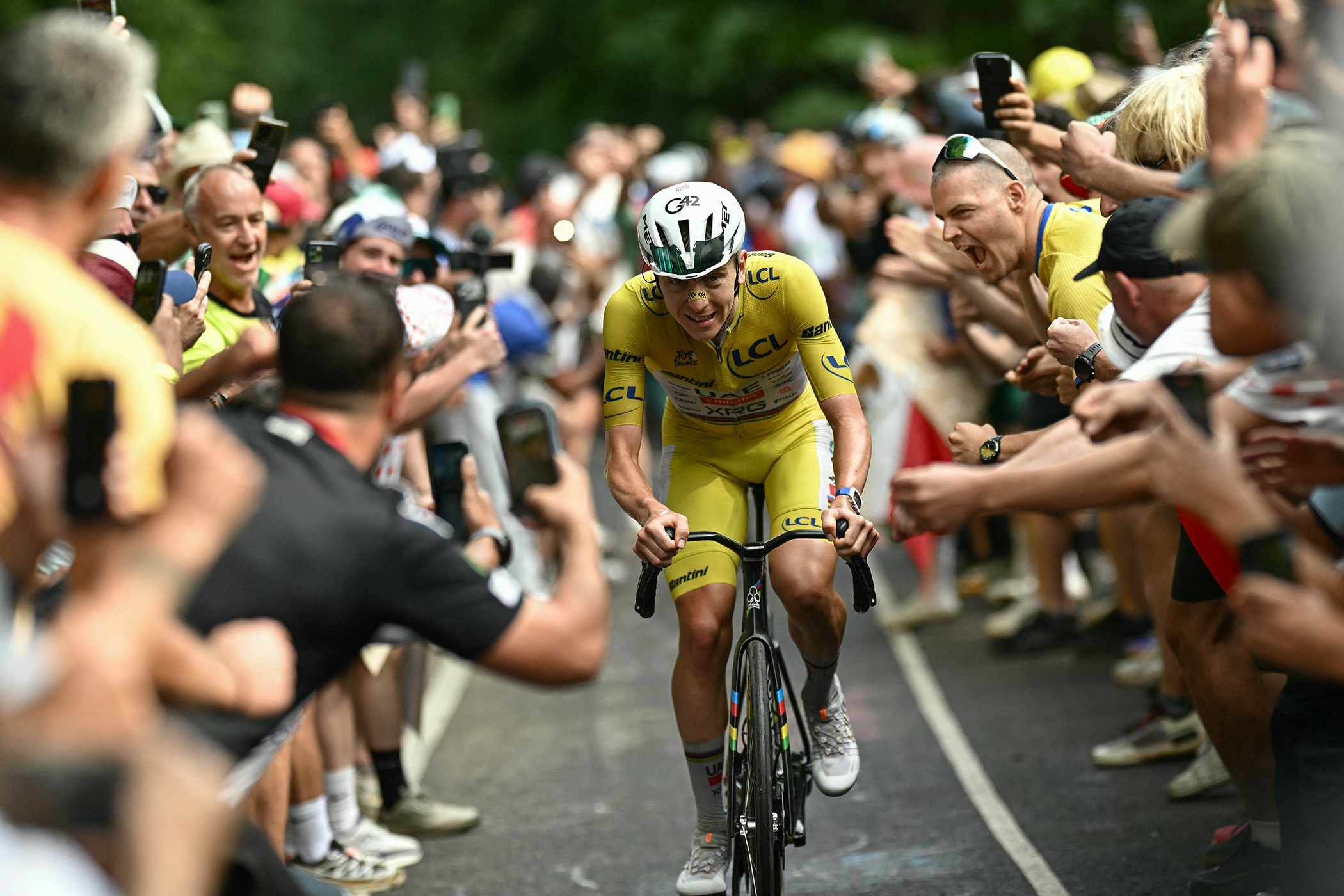

Tadej Pogačar’s stranglehold on the Tour de France was reinforced as he won his fourth stage and increased his advantage at the top of the general classification to four minutes and 30 seconds, with a week’s racing still to go.
In pursuit of a record-equalling fifth yellow jersey, his domination of the Tour has caused dejection throughout the rest of the peloton, with his lead after 14 stages the largest since 2014.
Pogačar’s desire to win all of the four mountain stages so far, coupled with his UAE Team Emirates-XRG dictating the rhythm and flow in almost every stage, has led to allegations from rivals that he and his team are greedy and that they are making the sport uncompetitive.
Tim Wellens, Pogačar’s teammate, further riled the opposing teams after stage 13 when he said: “Everybody wants to be in UAE Team Emirates-XRG because you can decide a little bit how the race happens. It’s super fun to decide the race.”
Asked if UAE – the richest team in the world with a reported budget of around €60m (£51m) per annum, more than triple the budgets of the smallest World Tour teams – were crushing the spirits of their rivals, a slightly irritated Pogačar said: “If you only go for second place, then it’s a pity.”
Jai Hindley, winner of the Giro d’Italia in 2022, defended Pogačar’s approach, but admitted that the 2026 Tour has been a largely stale and uninspiring affair. “So far there’s been a lot of passengers,” the Red Bull-Bora-hansgrohe rider said. “It hasn’t been the most exciting Tour to watch.
“But I can also understand them. If anyone else was in their position they’d also go for stage wins. That’s the reality of it. There’s no gifts in cycling and why should there be?”
Figuring out a way to even the sport’s playing field has been an ongoing discussion for a number of years, but the urgency to do so has only accelerated in the past fortnight.
“Right now, and this started with Team Sky 10-15 years ago, the big teams like UAE and Red Bull can literally outspend other teams by a ratio of 4:1. They’re just purchasing success,” Jonathan Vaughters, manager of EF Education-EasyPost said.
‘The worst suggestion is doing nothing’
‘The worst suggestion is doing nothing’
Jonathan Vaughters, EF Education-EasyPost manager
One idea doing the rounds is to establish a transfer market.
Newsletters
Choose the newsletters you want to receive
View more
For information about how The Observer protects your data, read our Privacy Policy
“Some teams can pay a buyout clause of €1-4m for a rider, no problem, and for some teams [receiving that transfer fee] that could be 20% of their overall budget. I think this is the only way to balance the budgets and close the gap,” said Lidl-Trek’s veteran rider Carlos Verona.
Other proposals have been tabled, including an NFL-like draft system where the lower-ranked teams would get first pick of the best U23 riders. Similarly, the UCI, cycling’s world governing body, is a long-time proponent of a budget/salary cap. Aso, the Tour’s organiser, has also championed the introduction of such a mechanism.
Doug Ryder, manager of Pinarello Q36.5 whose star rider, Britain’s Tom Pidcock, currently sits ninth overall, said limiting team budgets is a necessity. “You wouldn’t be limiting a rider’s earning potential but you’d instead do it on a team level,” he said. “You’d say that you can’t just buy the top-20 riders in the world.”
But Kurt Van de Wouwer, sports director of one of cycling’s lower budget teams, Lotto-Intermarché, questioned “how it could work practically”.
“They’d just game the system,” he said, pointing to wages being paid by additional sponsors.
Some have proposed a points cap in each race, which in theory would limit a team like UAE selecting a number of superstars in the same race. But there are question marks if that too would be viable. “Teams just wouldn’t send their best riders to many races, meaning that they wouldn’t gain many points that would rule them out of the Tour,” Vaughters said.
“But the worst suggestion is doing nothing,” Vaughters said. “The fastest-growing sports, from an audience, revenue and popularity standpoint, are the ones that have implemented some kind of financial fairness.”
While the debate rages about the sport’s competitiveness, the Tour’s race director Christian Prudhomme has ruled out tailoring future editions of the race to a rival of Pogačar, such as the young French hope Paul Seixas, 19, who is fourth overall. “We never build a route to be for or against anyone. Never,” Prudhomme told The Observer.
Strictly, that’s not true. The history of the Tour is littered with instances where the course has favoured a rider, including the 2012 edition that counted 101.4 time-trialling kilometres, a fact that heavily benefited Britain’s eventual winner Bradley Wiggins.
“Time trials are almost the only area where Pogačar is not invincible,” Prudhomme said. “But Pogačar is good everywhere. Even if we put 90km of time trialling in, it would still suit him.”
The upshot is that the race is essentially waiting for the Pogačar dynasty to come to an end before the battle for the maillot jaune becomes competitive once again. But still only 27-year-old, his rivals might be forced to hang around for quite some time.
Photograph by Loic Venance/AFP via Getty Images