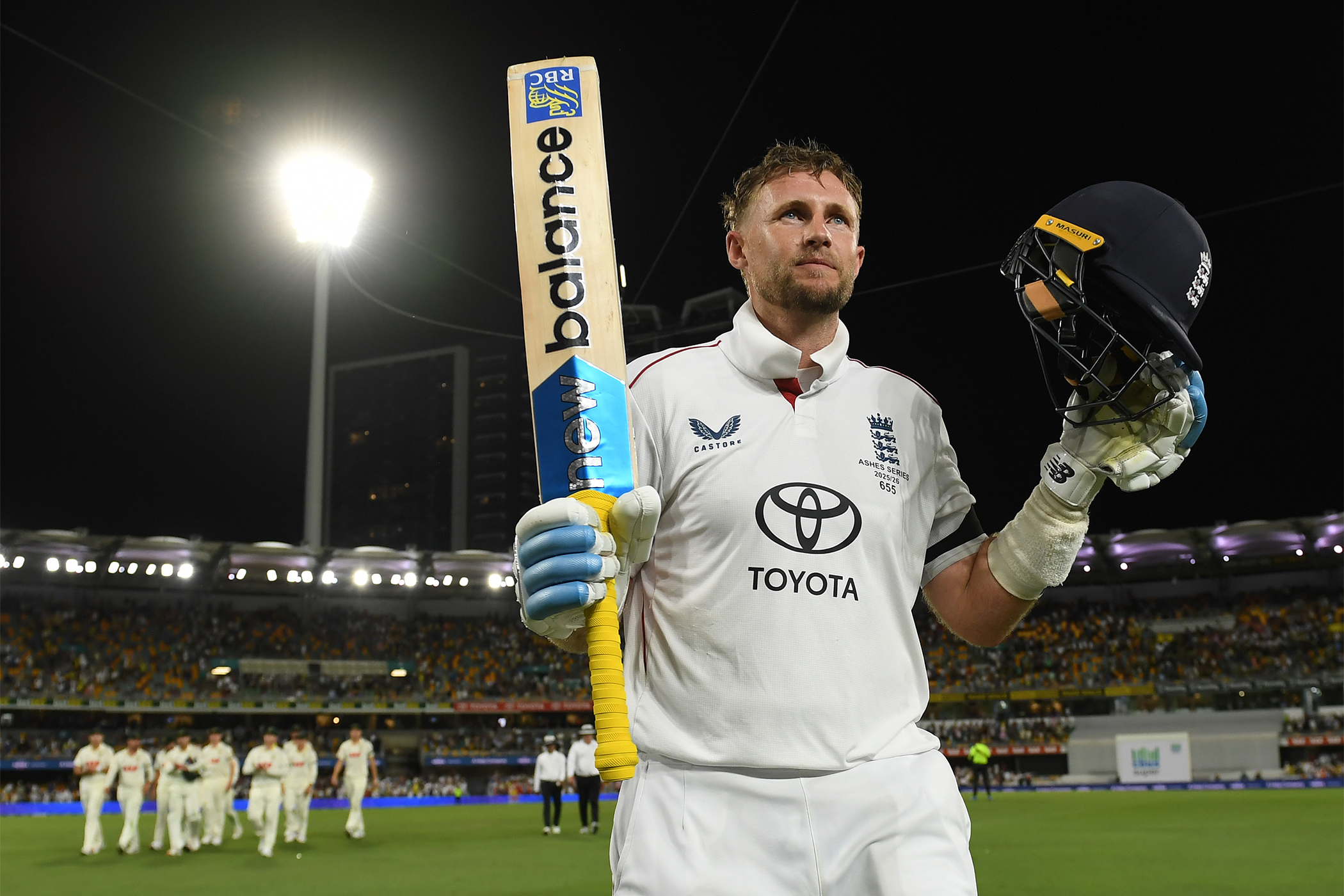


It should never have taken Joe Root as many as 30 innings to make a Test hundred in Australia. He may be as fine a batter as England have produced; he has made runs in all other climes and against all other comers. But there you are: sometimes cricket is as much about what doesn’t happen as what does. Root’s modest record in Australia, in fact, has been a leading indicator of the home team’s supremacy. There has been a sense over the years, not unfounded, of England as Root out, all out.
Anyway, the wait is over, and was towards the end even enjoyable. Root hooked Brendan Doggett fine for four, then square for four to transit to 96, whereupon the PA for a lark played London Calling by The Clash. Not quite yet – in the next eight deliveries, Cameron Green beat Root’s outside edge, Will Jacks turned Root back as he sought an ill-advised second to third man, and an inside edge into Root’s pad with Scott Boland bowling just eluded Alex Carey coming from behind the stumps – a last reinforcement of how much needs to go right to see a Test hundred through.
Finally, Root tucked Boland for four to fine leg, and celebrated, a little self-consciously, as though uncommonly aware of the 12-year wait. He gave a shrug in the direction of his team’s dugout and also to the slip fielder Marnus Labuschagne, who a couple of weeks ago had generously described him as “the best batter in the world”. Root is too well-mannered to make the claim himself, but maybe every so often sneaks a winsome peek at his statistics – they suddenly look better.
Roy Hattersley once described Root’s native Yorkshire as “an idea not a place”, possessed of both “an unrestrained aggression that gets men knocked down” and “the determined pride that makes them stand up again”. And while it’s hard to detect a streak of aggression in the softly-spoken Root’s make-up, he has been a great stander-upper amid much collective knocking down.
It might easily have been otherwise, too. On two, Root had offered a chance wide and low to the left of a diving Steve Smith. To be fair, it was a scintilla of a semblance of a snick – but you could imagine another day it sticking, another disconsolate trudge, and another anticlimactic headline. In that scenario, England would have been 7-3. Instead they finished the day 325-9, with Root enjoying his liberation – as his Bazbally reverse ramp off Boland soared for six over third man, Smith looked decidedly non-plussed. Despite Mitchell Starc’s six for 71, Root’s 61-run last-wicket partnership with Jofra Archer gave England the greater share of the day.
That day’s first surprise came when the teams were exchanged: Australia proved to have omitted Nathan Lyon in horses-for-courses favour of Queenslander Michael Neser. Neser duly made Crawley his 100th first-class victim at the Gabba at 20 runs each. But the pitch, with only 3mm of grass left on it, could hardly be more different from the pitch at Sabina Park where Lyon was previously excluded. That one, to borrow Steve Smith’s decorative phrase, had branches; this stretch of burned stubble will get a further baking, and the crack that Boland hit to dismiss Jamie Smith for a duck will only widen.
During the anthems, it can be tempting to try eavesdropping on a cricketer’s thoughts. So it was today with Zak Crawley, who showed off a crewcut as severe as the pitch’s. In Perth, he had been strung up to concert pitch and failed to survive the first over in either innings. Here, did he look… calmer? As his team-mates returned to the dressing room, Root gave a thumbs up, and Ben Stokes patted his shoulder – little gestures expressive of the faith that England have extended him these last few years, which he has only sporadically repaid.
Ah, but when he does – when he does, you see what they mean, for Crawley is like the male performer who from a certain angle in a certain light is, at once, ravishingly handsome. If only, like Julio Iglesias, he was able to insist on being photographed only from one side. His body made ugly shapes at two of his first three deliveries from Starc, arrowing across the face of his bat. Then, one in the slot, a step hit to swoon for, and it was Trent Bridge 2023 all over again.
Starc quickly worked his opening voodoo, nicking off Ben Duckett as he leaned slightly back then getting the inside edge of Ollie Pope’s diagonal bat. But there lay no demons in the pitch – the short thatch left them nowhere to hide. Crawley swatted Neser imperiously over midwicket and threw his hands at Starc, causing Smith to drop point and square leg back; between times, he was even seen to let the ball go, which was strangely more reassuring.
Height is a glory for Crawley, and a problem. Sometimes when the ball is just short of a drivable length, he seems slow to get moving – it’s as though the message takes a while getting through, like a brontosaurus feeling something in its tail. Crawley’s chunking straight drive avoided Starc’s outflung left hand on 28, went through Boland’s hands off 39 – both times, the contact was so good that the ball went for four. He even took singles. Although he prefers boundaries, he is fast between the wickets, seeming to get to the other end in three strides.
Newsletters
Choose the newsletters you want to receive
View more
For information about how The Observer protects your data, read our Privacy Policy
This should by rights have been the pay-off day, for the southern century for which Crawley has so long been groomed. He walked in at the first break with a mere nod to his dugout; he acknowledged his half-century with a perfunctory bat wave. The work, part of him knew, stretched out before him; another part, however, kept needling him for urgency. He had defended solidly three deliveries in Neser’s fifth over. The strain of self-containment was too great – Crawley edged a crabbed front-foot pull, went on his way without a look at the umpire, shaking his head as he crossed the boundary rope.
Harry Brook as a batter is starting to remind one of the gifted but restless toddler you are trying to control with a mix of bribes and pleas. In a run-a-minute 50-run partnership with Root, he brimmed with health and exuberance, but you could feel the tantrum round the corner – and, as any parent will aver, this always comes at the worst possible moment, at the checkout, in the library, when everyone is looking.
It was the 40th over. Starc had resumed for a spell it was clearly important to get through, a soft ball beckoning as night fell with no Lyon to tie things down. Brook, leaning lazily back, drove at a ball on fifth stump, and Starc hardly even bothered celebrating – for all Brook’s stats and strike rates, you get the feeling that the hosts find England’s prodigy a bit of a soft touch. He could change that, but hardly seems to want to.
That left Root to savour. When the likes of Crawley and Brook straight drive, it comes back so hard that you could imagine the ball running for eight. But there is no such thing as hitting an eight. Root hits the ball just hard enough for it to go for four – anything else might seem ostentatious. He had waved at a wide one in Perth – looking for it, a little; going searching for bat on ball. Here he was unchangingly measured – playing late, under the eyes, in the V, as if it stood for vigilance. In pressing forward and across to Boland, Root also soaked up two Australian reviews for lbw: on 62, ball tracker showed the ball bouncing over leg stump; on 73, the replay confirmed impact outside the line of off stump.
Carey confirmed the slowness of the pitch by continuing to stand up to the stumps, first to Neser, then to Boland – he was superb, in fact, all day. Around the second break, too, dry lines and ring fields slowed the scoring. With another straight drive, Root seemed to break the detente. But Stokes, unaccountably, pushed, ran, was correctly turned back by his partner, and thrown out from cover point by Josh Inglis.
Will Jacks, with a passing resemblance to an Action Man figurine, has a batting reputation to match. He defended a little tentatively at first; he played a foolish shot. He should by rights have been following Root’s studious example, even if, to be fair, at that point, both men had the same number of Test hundreds in Australia. He reproached himself for slashing at a wide one from Starc and missing, but somehow did not absorb the thought, and got out the same way next ball. Both Gus Atkinson and Brydon Carse showed in Perth that they can bat. Here they belied it.
Much has been made in the lead-up to this match of the volatility of the pink ball – how it can trick the eye, how under lights it can hoop and swerve. Now it showed a further quality – when soft, it does not even respond to Starc’s caress. Archer benefited as Australia were penalised for their tardy over rate by being deprived of a new ball; Root got to let his hair down a bit. After such a long wait he deserved it.
Photograph by Philip Brown/Getty Images