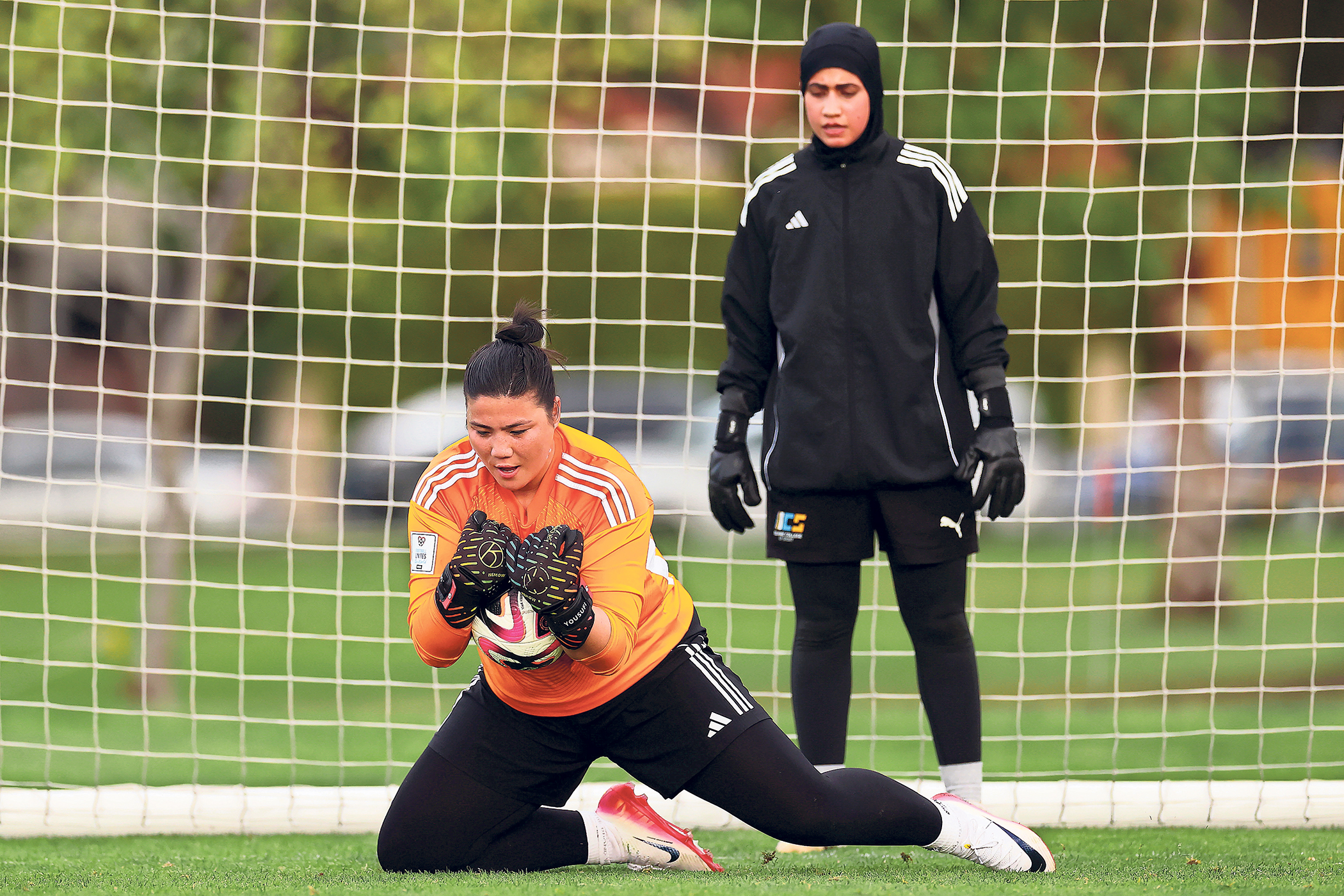
As Taliban fighters swept across Afghanistan to take the capital in the summer of 2021, Fatima Yousufi took her goalkeeping gloves, her football shirt and her player awards, dug a hole in the back garden of her home in Kabul, and buried them.
Like her team-mates, she had already erased her social media presence, and she had been told to burn every trace of physical evidence that she had ever represented Afghanistan on the international stage as a member of its women’s football team. But even as the Taliban bore down on the city and raided her coach’s home, she could not bring herself to do it. Perhaps, she thought, she could come back one day and find it.
“It wasn’t just an award, it wasn’t just a jersey,” she said. “It was a lot of memories and a lot of hardship; every moment of making it one step closer to my dreams. And I was just putting it in a hole, trying to just save people around me, and maybe myself too, in the end.”
Yousufi told me this story this time last year as we looked out across the Southern Ocean from a beachside cafe in Melbourne, where she and her family have been living in exile since 2021.
When Kabul finally fell, she had been among the thousands of people who crowded the Hamid Karzai International Airport in the aftermath of the US military’s chaotic withdrawal from Afghanistan, facing the threat of suicide bombs and Taliban fighters wielding cattle prods to try to get to safety.
Yousufi and her team-mates managed to flee, but they did not regain their right to play as a team.
From exile, the Afghan women’s team found themselves snared in a grotesque situation: they could not play football within Afghanistan because the Taliban banned women and girls from playing sport, but they could not play outside it either as a team, not without the recognition of the Afghan Football Federation, which they would never receive.
And so, due to the nature of its membership structure, Fifa found itself in the position of passively enforcing the Taliban’s system of gender apartheid on women living in Australia, the UK and Portugal; women who had risked everything to play.
For five years, as they have sought to rebuild their lives in new countries, the team have fought for the Fifa recognition that would allow them to represent their country on the international stage at a moment when women’s football has exploded in popularity but when the brutal oppression of women and girls in Afghanistan is being rapidly forgotten.
This week, their campaign paid off. At its annual congress in Vancouver, Fifa announced that it had amended its regulations to allow the Afghan women’s team, and any other international team that may struggle for recognition from its federation, to take part in official Fifa competitions, including the World Cup.
Newsletters
Choose the newsletters you want to receive
View more
For information about how The Observer protects your data, read our Privacy Policy
“This team is not only for Afghanistan, but this team is a beacon of hope for every girl around the world. They can look up to us and be like, ‘Dang, if they did it, so can we’,” co-captain Mursal Sadat told The Observer.
‘This is a message to those who try to erase women from society: you will not succeed’
‘This is a message to those who try to erase women from society: you will not succeed’
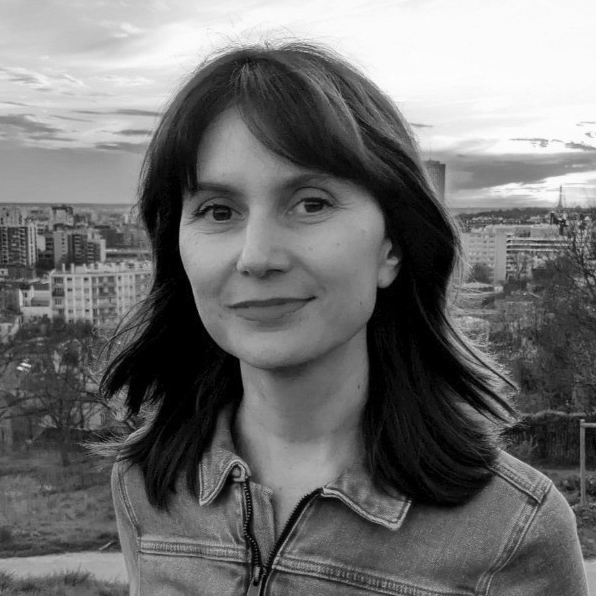
Khalida Popal
Before this change, the women had been able to play as “Afghan Women’s United” in a series of friendlies against Chad, Libya and Tunisia in Morocco last year. It was a stop-gap solution, but a cathartic moment for many players who had been shut out of representing their country for so long.
“Not to brag, but Afghans always make history,” said Sadat. “We made history not once but twice: by being the first ever refugee team to go and play friendly games and again as the first ever team to represent their country from exile.”
In a statement following Fifa’s announcement, player Nazia Ali said: “For the last few years, we have played under many names — as refugees, as ‘Afghan Women United’, and as guests of other clubs – but in our hearts, we were always the national team.”
Fifa president Gianni Infantino announced that “Fifa is proud to lead this historic initiative”. But much of the credit for this momentous victory should go to the woman sitting next to him in Vancouver: Khalida Popal.
It was Popal who created the conditions for these footballers to play in the first place. She not only co-founded the first ever Afghan national women’s team and acted as head of women’s football at the Afghanistan Football Federation, she also blew the whistle on the horrific sexual and physical abuse of players by federation president Keramuudin Karim and staff coaches. By the time she exposed this abuse in 2018, Popal was already living in exile herself, in Denmark, having faced death threats for her work in football.
It was Popal who told Yousufi and her team-mates to destroy the evidence of their football careers and it was Popal who helped get them on evacuation flights out of Afghanistan, while Fifa blithely told her it was “monitoring the situation”, as she recounts in her memoir, My Beautiful Sisters.
Yousufi said she had appealed to every organisation she had ever come into contact with as the Taliban bore down, to no avail. It was only when Popal was added to the players’ increasingly frantic group chat that they were offered a way out.
And Popal has championed the cause of the exiled players throughout their long fight for recognition. “This is the rebirth of hope and a strong message to those who try to erase women from society: you will not succeed. Women belong on the pitch, in public life, and everywhere decisions are made,” she said on Thursday.
The Afghan team’s long wait for recognition has taken a toll on those who have continued to fight. “Each year was just a knife straight to the heart,” Yousufi told me.
The players in Australia have now watched two international competitions go by, in the country where they live, from the sidelines of world football: the 2023 World Cup and this year’s Asian Cup. By the time the team work their way through regional competitions and up the international rankings, it may be too late for some of those who first started kicking a ball around in their schoolyards in Kabul, Herat or Kandahar to represent their country again. But it won’t be too late for the next generation.
“Some people believe football is a matter of life and death… I can assure you it is much, much more important than that.” When Liverpool manager Bill Shankly uttered those immortal words, it is unlikely he was thinking about Afghan women.
But few in football have genuinely risked their lives like the members of the Afghan women’s national team to play the game they love. None should have to.
Photograph by Kelly Defina/Getty Images