

In cricket, individual ascendancies rather creep up on you. For a while they are drowned out by the noise of the collective struggle, the knowledge of the influence of luck and chance. Then, one day, like someone caught in flagrante, or on kiss cam, it is suddenly out in the open: bowler x has the wood on batter y, and everyone seems to know.
Viz Pat Cummins versus Joe Root. They have been at each other for years on both sides of the world. They know each other’s games. They respect one another’s reputations. They understand their destiny to meet, as frontline bowler and top-order batter. Both have recollections of success to encourage them. But over Root, Cummins’s shadow has gradually lengthened: his 13th dismissal of England’s champion pushed the visitors deep into darkness.
At tea, England had achieved a rare, if not unprecedented milestone on this tour, edging Australia in consecutive sessions. Another half hour of Root’s budding partnership with Zak Crawley, and England’s target would be in the two hundreds of runs on a pitch at its kindest to batters. Having brooded on it through the interval, Cummins turned first to what might have been the people’s command: trying to parlay Travball into Travspin, he asked local hero Travis Head for a few of his part-time but hard-spun offies.
It was a feint, but a canny one, for Root coyly shuffled into padding one away, and was indulged by umpire Ahsan Raza – not inappropriately, as Ball Tracker predicted only the lightest of contacts, but inauspiciously, for a narrow squeak is a memento mori even for the best of batters. As Cummins took the ball himself, the replays were still rotating, on televisions screens, and in the rivals’ minds.
At this tipping point in the game, then, Root was perhaps already leaning ever so slightly. As in the first innings, he pushed out with that routinely open blade to a ball on fifth stump he might have left. Bowler and batter roared – Root with anguish, for only 13 individual batters in Test history have now been dismissed more often by 13 individual bowlers.
In the morning, England had achieved startling improvement by the simple expedient of pitching a consistently fuller length, and deploying the second new ball to advantage – the risk of being driven in Australia is always worth running. The hosts’s last six wickets went down for 38 runs in 64 balls. Optimistic projections of a 500-run Australian lead were confounded as Jofra Archer ended the innings with a desperate, scrambling caught and bowled.
Before English batting could recover encouragingly in the afternoon, it had to reach a kind of nadir in the morning. To Cummins’s second delivery, down a sixth stump channel, Ben Duckett held an exploratory diagonal bat – a reflex indecision, neither playing nor leaving, neither attacking nor defending. It was the stroke of a player who has given no thought to batting in Australia; the stroke of a player who has learned nothing from his half-dozen hits here. Neville Cardus once described a shot of Don Bradman’s as “unfit for public view”; this was its updated version. Had it appeared in the Epstein files, the Justice Department would have redacted it.
England’s opening partnerships this series now read like one of those telephone complaints lines that’s always engaged – 0, 0, 0, 48, 37, 4. It has referred pressure to Ollie Pope – pressure to which he again proved unequal.
There ensued, either side of lunch, three quarters of an hour of Pope whistling in the dark, always a hair’s breadth from harm. With those thrusting hands of his, it is though he wants to punch the ball rather than play it with his bat. One edge from Cummins flew at catchable height between third slip and gully; a second should by rights have fallen short of third slip but Marnus Labuschagne had stepped hungrily forward and caught it rolling one-handed to his left. Steve Smith, who brightened his own day with a net session, could have done no better.
As the ball softened and the pitch flattened, however, England added 101 runs between lunch and tea. Crawley, who at one stage was one from 28 balls, proved he can bat moderato rather than always allegro. He has played more majestically, but seldom with such solemn authority. Root disrupted Nathan Lyon with reverse sweeps, finer and squarer of the backward point – back-handed compliments to the bowler’s accuracy, forcing Cummins to post a sweeper. Raza disrupted Mitchell Starc by warning him about running in the danger area, twice, so that Australia’s number one striker had to skirt the return crease from round the wicket. The ball was doing so little, Starc was reduced at one stage to bouncers with three men on the fence.
Newsletters
Choose the newsletters you want to receive
View more
For information about how The Observer protects your data, read our Privacy Policy
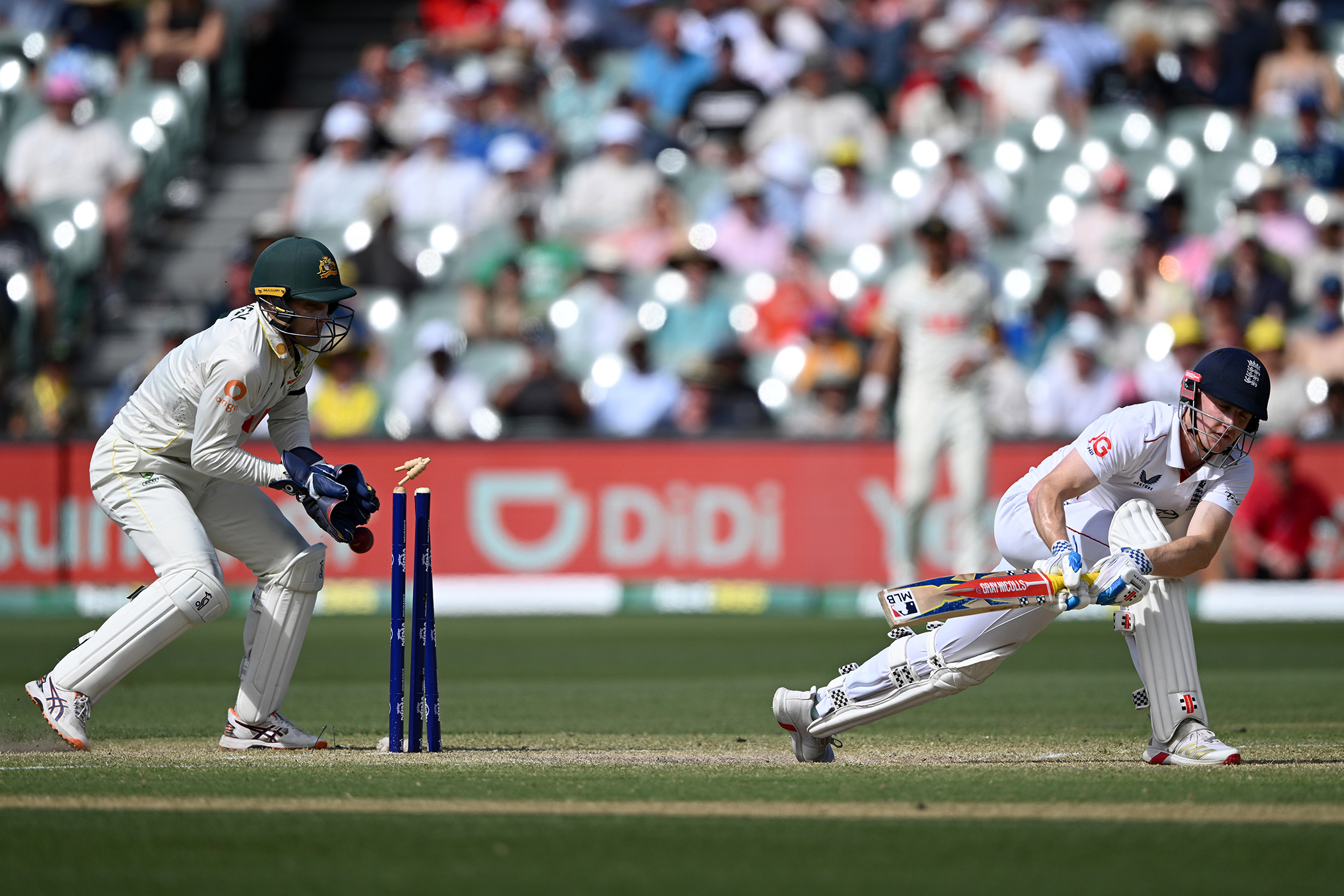
At length, another rivalry played out: Harry Brook versus himself. How long could England’s impatient innovator contain his imp of the perverse – that instinct to disrupt that at times disrupts his own game? On seven, he attempted a fall-over ramp to Boland and was almost run out from the same ball; on 19, he came dancing down the wicket to Head, and was saved from a stumping by the intervention of his pad. Looking covetously on Head, Brook nailed three consecutive reverse sweeps. Repeating the shot against Lyon, he was beaten by slower pace and sharper turn.
It was the breach Australia needed, and Lyon continued widening it. With drift and turn, he beat Ben Stokes’s studied defence; with flight and width, he lured Crawley out of his ground. In 37 deliveries, the visitors sank from the illusory comfort of 177-3 to the more familiar flimsiness of 194-6, with Jamie Smith and Will Jacks scoreless. Cummins’s eclipse of Root had proved a leading indicator of the overall rivalry, the Ashes, now bent decisively Australia’s way.
Photograph by Gareth Copley/Getty Images