

This article is part of the Rory Smith on Football newsletter – a guide to help understand what is happening on the pitch, off the pitch, and why all of it matters.
Throughout the tournament, Rory will be travelling across America, delivering daily commentary on the biggest World Cup ever direct to subscribers. Never miss a newsletter, subscribe now here.
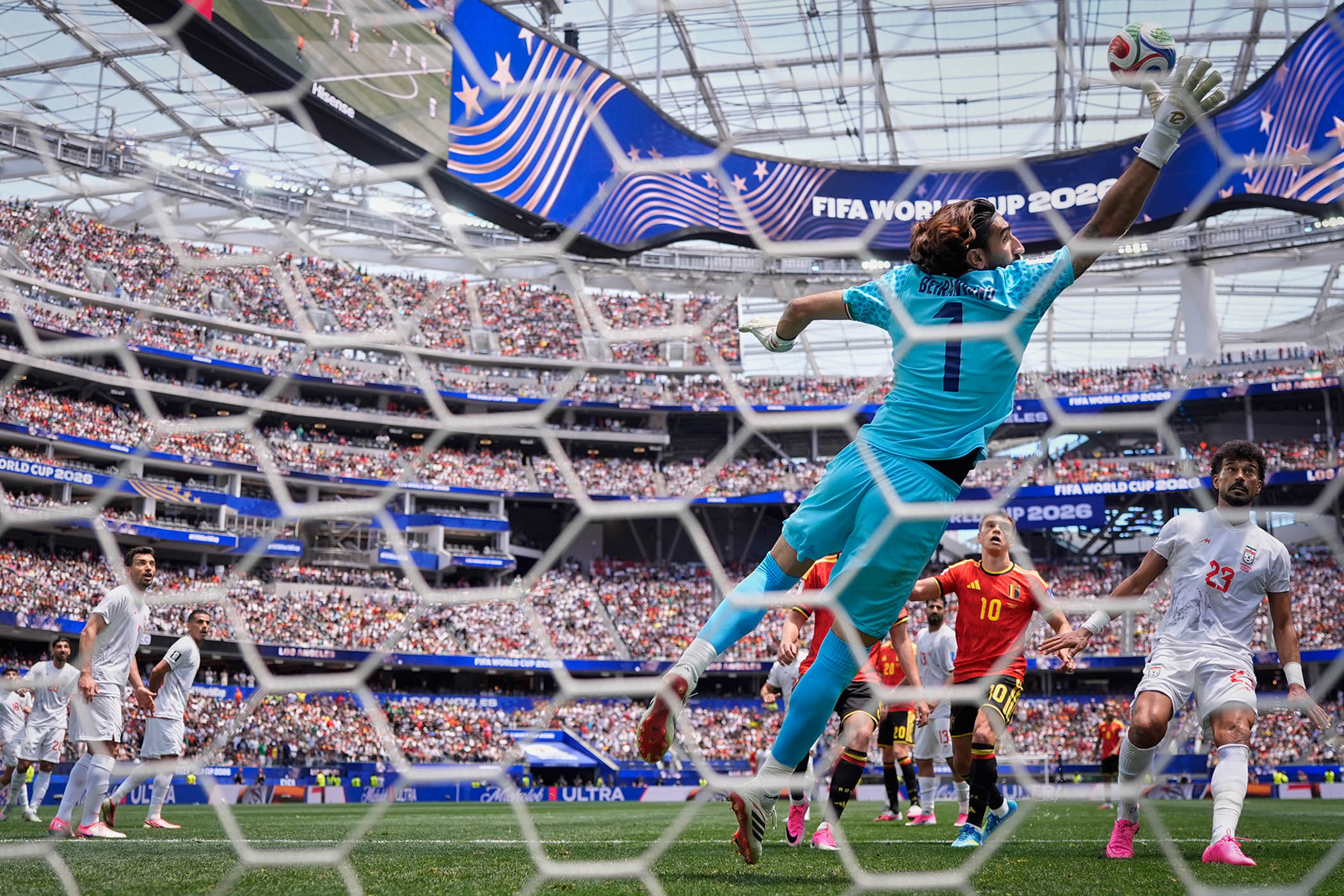
The numbers, as ever, did not quite paint the full picture. Officially, Alireza Beiranvand made seven saves during Iran’s goalless draw with Belgium in Los Angeles yesterday lunchtime. Not a bad figure, by any means. It’s a good day’s work. But it does not, on the surface, seem like anything especially out of the ordinary.
What it did not capture, though, was all the rest of it. That number does not, for example, include crosses caught. Or occasionally punched clear. It does not take into account the amount of loose balls hurriedly snatched into his grasp before they could fall at the wrong feet. It does not allow for command of his penalty area, or general purpose aura.
Beiranvand is 33 now, one of those characters who floats into the broader consciousness during a World Cup and then drifts away once his nation’s part in proceedings has drawn to a close. A glance at his name on a teamsheet might, for those of us who devote rather more of our mental space to this than is strictly necessary, trigger an echo of a memory.
Oh yes, that’s right: Beiranvand has a somewhat more compelling back story than most. He started life as a shepherd, working with his ethnically Kurdish family’s flock from the age of three. He also has – or had, at any rate, presumably these things exist in a permanent state of flux – the longest-recorded throw of any goalkeeper.
The vast majority of players in Europe’s elite leagues have essentially the same background. The details vary, of course, but the narrative thrust is always the same. They were good at football as children. They were taken into an academy, where they were taught to be better at football. As adults, it turns out they are – wait for it – good at football.
One of the charms of the group phase of the World Cup is that it offers players with slightly more engaging personal histories, ones which are not set exclusively in hot-house talent factories, the chance to stand in the global spotlight, however briefly.
The risk, of course, is that once they are there, they are treated as either lottery winners or novelty acts, presented for what they were – look, the guy in goal used to be a shepherd! Isn’t that weird? – rather than what they are, which is the same as everyone else involved in the tournament: elite athletes.
It is heartening, then, when they produce a performance so good that they are able to transcend our desire for curiosities and our fixation on trivia. In denying Belgium, ageing and creaking though the last wisps of their golden generation might be, Beiranvand did just that. His was not a good display for someone who used to be a shepherd. It was a good display for an elite goalkeeper.
Newsletters
Choose the newsletters you want to receive
View more
For information about how The Observer protects your data, read our Privacy Policy
He is not alone in that. These last few days have produced three defiant performances from three goalkeepers who might fit the description “journeyman.” First there was the astonishing afternoon produced by Vozinha, the 40-year-old playing for Cape Verde, in keeping Spain at bay, an achievement made all the more impressive by the European champions’ subsequent destruction of Saudi Arabia.
Vozinha ended that game in tears; his mother had not been able to secure a visa to come and watch her son play in the tournament. The image was so heart-rending that Hakim Jeffries, the leader of the Democrats in the House of Representatives, stepped in to arrange the paperwork. She was in Miami to watch him face Uruguay last night – a game that finished 2-2, further extending Cape Verde’s extraordinary story at this World Cup.
And then there was Eloy Room, Curaçao’s 39-year-old goalkeeper, who made 15 saves – just one shy of the record for a single World Cup game, set by Tim Howard in 2014 – to help the smallest nation ever to compete in the tournament secure its first point in their 0-0 draw against Ecuador on Saturday evening.
For all three, these are not just transformational moments – Vozinha will end this World Cup with millions more social media followers, the sorts of numbers that do tell the whole story – but defining ones: for their careers, and for the tournament as a whole. None of them will win the World Cup. But in some small way, it will always belong to them.
Photograph by Mark J Terrill/AP Photo