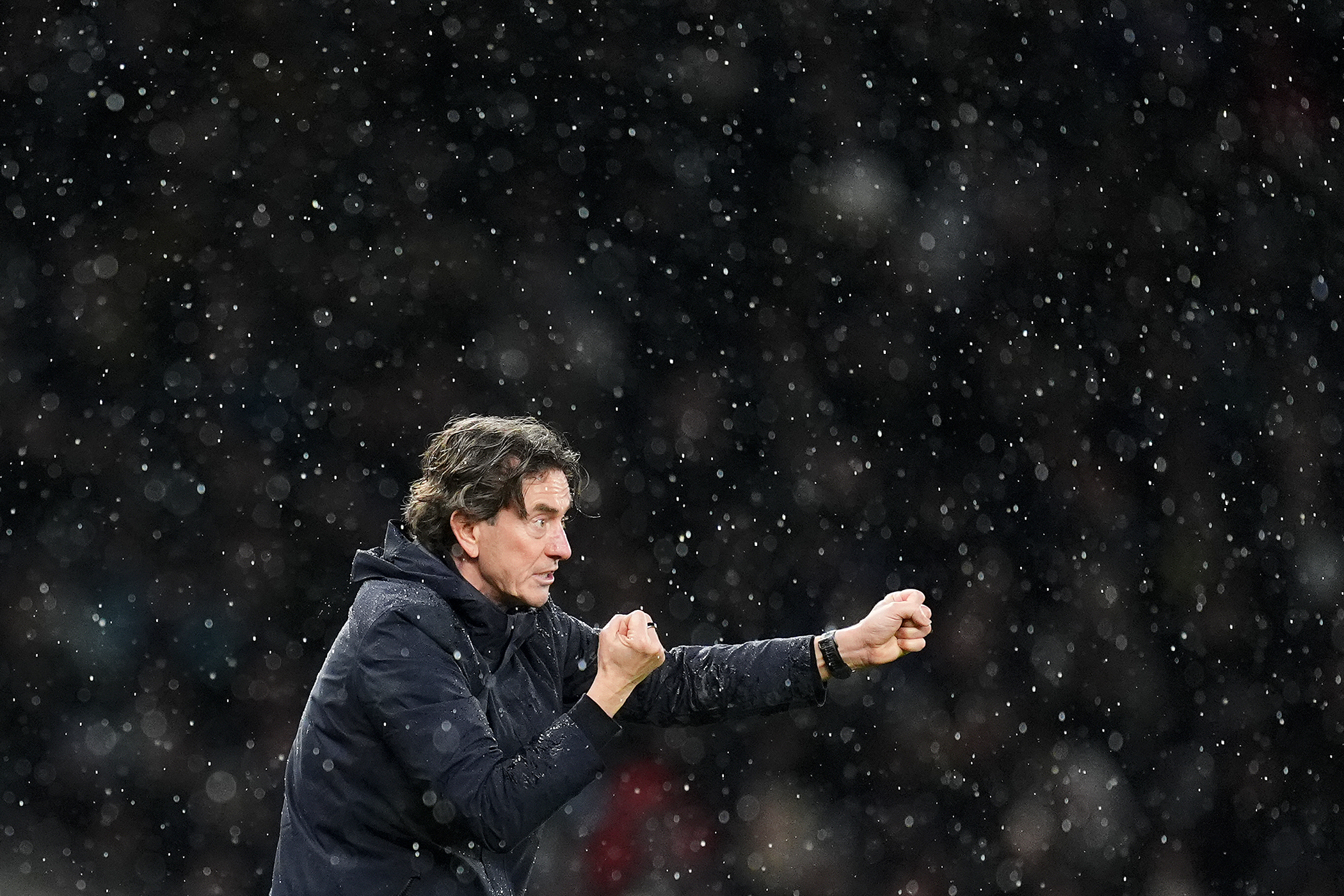



By the end, Thomas Frank had started to look like his own portrait in the attic. Prior to his arrival at Tottenham, the Dane had always been one of the Premier League’s fresher-faced managers: his hair buoyant, his skin bearing just the hint of a tan, even in the depths of the British winter. His disposition too tended towards the sunny.
In his time at Brentford, Frank wore the stresses and strains of his role a little more lightly than many of his peers. He seemed to have a rare gift for maintaining something approaching work/life balance. He turned his phone off at night. He escaped, whenever he could, to his holiday home in Nerja, an hour along the Costa del Sol from Malaga. He looked like he was able, despite the scrutiny and pressure, to keep things in perspective.
The last time I saw him – in the press room at Old Trafford, trying manfully to resist the temptation to shift all the blame for Spurs’ defeat to Manchester United onto the shoulders of Cristian Romero – the change was striking. Frank was Tottenham manager for almost exactly eight months; he was appointed on June 12, 2025. He looked haunted by the experience, haggard and drained, even as he was living through it.
Unlike most managerial dismissals, Frank’s was shocking because it had not come sooner. Tottenham had won just two of their last 17 league games. They had been sinking, silently and inexorably, towards the thick of the relegation battle since the autumn. Frank and his players had been booed off the pitch by their own crowd for weeks. In many ways it was remarkable he was still Spurs manager as late as February 2026.
There were, admittedly, some mitigating circumstances: Tottenham sailed through the Champions League group phase with an ease that was totally at odds with their struggles in the Premier League; the club has been in the grip of sweeping change in the boardroom for the last year or so; Frank has been without his two best attacking players, Dejan Kulusevski and James Maddison, for most of the season, as well as a raft of others. On the night he was sacked, they were among 11 players absent through injury.
They might explain why he was granted a stay of execution; it requires elaborate mental gymnastics to make the case that they should have allowed him a more permanent pardon. At the end of his last game in charge, a limp defeat to Newcastle on home soil on Tuesday night, the boos that greeted the final whistle seemed vaguely muted, as though the fans no longer had the energy to be splenetic. Those that remained, anyway. Whole swaths of the stadium were empty, and had been for some time.
There will be a temptation to declare all of this was predictable, to suggest that this outcome was inevitable, to retrofit an explanation for why Frank struggled so badly to adapt to the most high-profile job of his career. Some might suggest his preferred style of play is too reactive to work at a club that expects to dictate most games; some might believe that he was not sufficiently imposing a character to win over his squad.
Frank’s track record made him a suitable candidate for Tottenham, but his style, and his projected personality simply did not work
Frank’s track record made him a suitable candidate for Tottenham, but his style, and his projected personality simply did not work
It would be disingenuous, though, to pretend that it was easy to see this coming. Frank had done a wonderful job at Brentford. He was, certainly by the traditional mechanisms of football, the next one off the production line; he had cut his teeth at one of the league’s over-achieving lesser lights, and he had earned his shot at a team with deeper pockets, greater resources, loftier ambitions. His flexibility, his refusal to hew to a specific ideology, was one of his strengths, just the tonic for a team coming off the back of the ride-or-die style of Ange Postecoglou. He was, as far as anyone could tell, a good appointment, or at least a logical one.
Rather than disavowing that, then, his failure – a word that feels harsh but is accurate – is better seen as a learning opportunity: for Tottenham, first and foremost, but perhaps for the rest of us, too. Frank seemed like a sure thing, or at least as close to a sure thing as might be imagined. What was it that had not been factored in? What had the Tottenham board, and (most of) the rest of us, missed?
Two aspects feel particularly compelling. The first is on the pitch. It is not just that Frank’s team lost too many games; it is that they lost games without giving the fans any reason to believe the short-term pain might bring benefits further down the line. All fans think their club is special; all teams believe that their side’s history of attractive and expansive football is somehow unique.
Newsletters
Choose the newsletters you want to receive
View more
For information about how The Observer protects your data, read our Privacy Policy
Beneath that, though, there is a willingness – for most, maybe not all – to tolerate disappointing outcomes if the process itself contains promise. Fans can be almost unwisely patient if they believe they are on a journey, if they feel that the disappointment they are experiencing might prove to have a purpose. Frank never allowed Spurs’ fans to see what that might be. He did not sell them on a dream.
He also did not sell them on himself. Managing a club of the scale – and complexity – of Tottenham is different to taking charge of a team as bijou and as well-organised as Brentford. In west London, Frank’s cool, measured, deliberately placid approach played as smart, modern, emotionally intelligent. He had time and space, as well as the earned authority, to present himself as a paragon of technocratic rationality.
In north London, though, almost exactly the same approach served to undermine his authority; it made him seem distant, aloof, as though he did not grasp the inherent grandeur of the club. That he almost certainly did grasp it does not matter; the image is everything. His attempts to be reasonable in public had the unwanted effect of making him seem small.
That, in time, may prove a valuable and lasting learning not just for Spurs, but for others in similar positions; it is, perhaps, the sort of lesson that can only be taught in practice, rather than theory.
Frank’s track record made him a more than suitable candidate for Tottenham, but his style, his projected personality simply did not work. That was apparent almost from the moment he arrived; how much he was struggling, after all, was etched in the lines on his face.
Photograph by Adam Davy/PA Wire