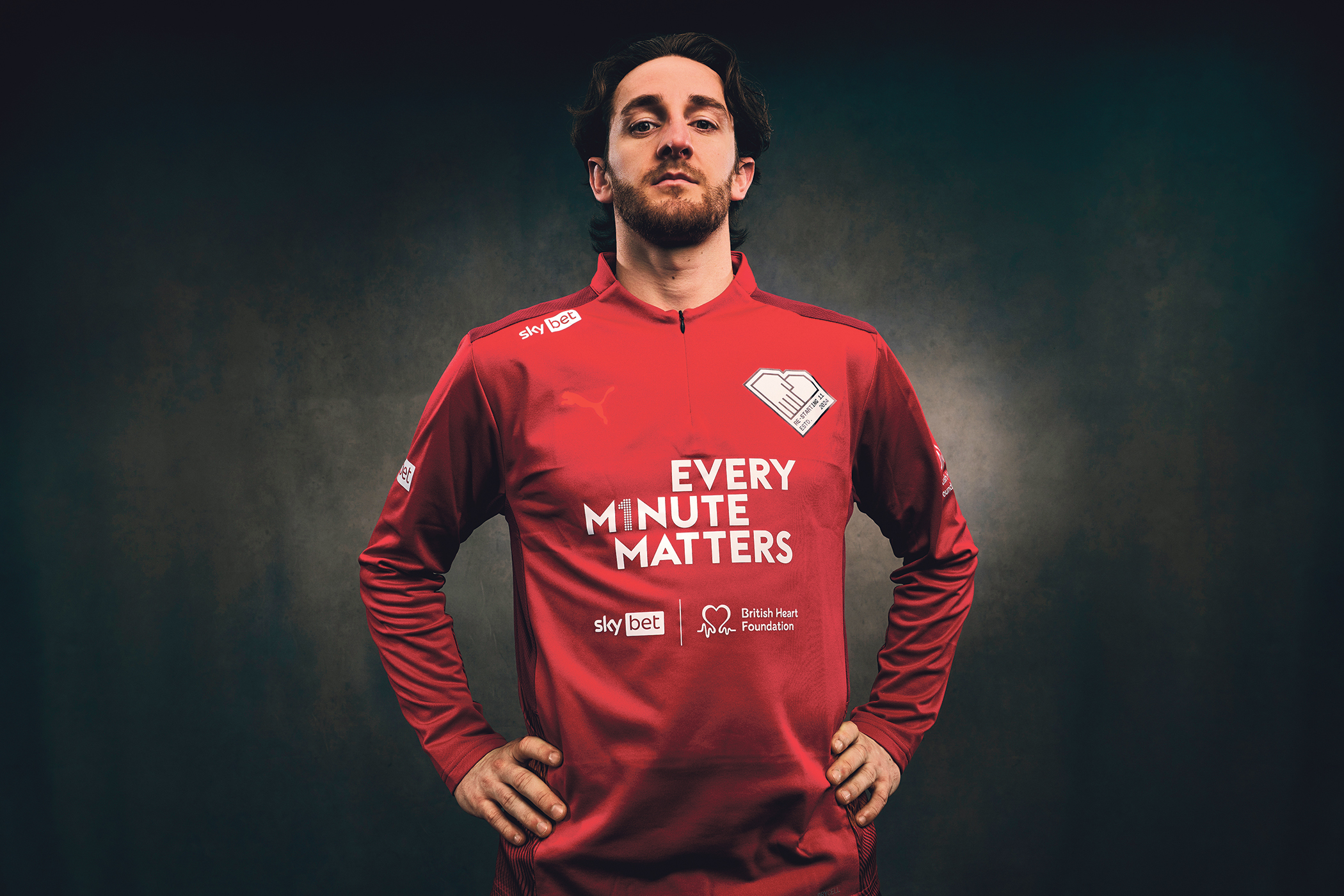


After being clinically dead for two minutes and 41 seconds, football has taken on a new light for Tom Lockyer.
His journey from paramedics restarting his heart with a defibrillator after he collapsed playing for Luton Town at Bournemouth in December 2023, to restarting his career with League Two Bristol Rovers, has been extraordinarily hard.
There have been setbacks, tears, moments of despair and deep concern from his fiancée. But, as he fights to remain in the English Football League, the experience has given him a beautifully fresh perspective.
“The way I look at it now, you were dead, what in football can bother you any more?” he tells The Observer. “You give the ball away – so what? You scored an own goal – it’s not the end of the world. Little things like that. It allows me to play with a bit more freedom, without worrying too much.”
That he has made it back at all is a remarkable tale of bravery and endurance. It has been particularly hard for his fiancée, Taylor, who was seven months pregnant with their daughter, Mila, when she watched him collapse on the Vitality Stadium pitch. For the first few days after he began running again, she followed him in the car. For the next fortnight she tracked his route on the Find My app on her iPhone.
“I guess with time it just makes it easier,” Lockyer says. “When she can see the journey I’m on and understands how much monitoring is done, it puts her at ease. She doesn’t really like coming to games now, which is understandable. But she’s also not worrying every time I go off to football. We’ve found a nice balance.”
Taylor was reassured in meetings with doctors, who explained the equipment that monitors Lockyer’s heartbeat and sends data to a cardiologist in Amsterdam – the same specialist who treated Christian Eriksen after his cardiac arrest on the pitch in 2020.
“Every time I exercised for the past 18 months it was mandatory for me to wear this belt and send off every heartbeat. When I’ve done that for 18 months and he hasn’t seen a single heartbeat he doesn’t like the look of it gives you assurance. The monitoring continues now.”
There were times when Lockyer, 31, considered giving up. The lowest moment came two days before he was due to play his first game back for Luton, when he landed awkwardly on his ankle in training and heard a sickening pop. A specialist in London told him he required surgery and would be out for three months. “I just burst out crying,” he says.
But it got worse. Two months later, scans revealed the surgery had been unsuccessful and he needed another operation.
Newsletters
Choose the newsletters you want to receive
View more
For information about how The Observer protects your data, read our Privacy Policy
“That was just like everything I felt before, times 10. I remember sitting with my fiancée and going: ‘Is this even worth it? Is this a sign you should just sack it in?’ It was pretty close. I thought: ‘I’ve come so far now, I’m not going to let this one beat me.’”
Doctors pointed out his ankle was “a bit of a mess” and that if he wanted to chase Mila around the park in the future, he would need it fixed properly regardless. “They said: ‘You might as well get the operation. Whether you want to rehab it like an athlete or a normal person, that’s up to you.’ That was the hardest time – not even in football, in my whole life.”
‘A lot of teams were saying we’d love to have him but we cannot take the risk – what if it happens again?’
‘A lot of teams were saying we’d love to have him but we cannot take the risk – what if it happens again?’
Like many footballers thrust out of the game, Lockyer suffered an identity crisis – “I was Tom Lockyer the footballer for so long, I had that stripped away from me overnight.” But being asked to front the Every Minute Matters campaign by Sky Bet and the British Heart Foundation, which is closing in on convincing 500,000 people to learn CPR, “gave me a sense of purpose”, he says.
Even after ticking every box required to play again, clubs were reluctant to take the risk. Last summer he wondered if his playing days were over. Unlike Eriksen, who had one episode, Lockyer had collapsed in the Championship play-off final at Wembley with atrial fibrillation – a less serious heart rhythm problem – only seven months before his cardiac arrest.
“A lot of teams were saying we’d love to have him but we cannot take the risk – what if it happens again? You said it wouldn’t happen after the first one.”
But a door opened when Darrell Clarke returned to manage Bristol Rovers. Clarke had been Lockyer’s manager for four years during his first spell at the club.
Many questioned Lockyer’s decision and told him to retire but “it was this itch I had to scratch”. And of course football was his job and he had to earn money. “Football has been good to me but I could definitely have done with a few more seasons in the Premier League,” he says.
Still, he felt pressure on his debut against Crawley, walking out with Mila in his arms, not to have a repeat episode. That, like his fiancée’s fears, has eased.
“If I get a stitch or something up around here” – he touches his chest – “I’m like, ah, what’s that? Then you have a bit of a worry. If I were to get light-headed in any way, especially on a football pitch, I’d be worried. It’s not worth the risk.”
His near-death experience has brought life full circle. The club, he says, has come a long way from the one he joined almost 15 years ago, when players had to clear dog muck off the training pitches and the physio room was a Portakabin shared with a school.
He experienced relegation back then in 2013-14, but believes that with the level of competition in the National League, coming straight back up is harder than before.
“It’s not life or death as such, but it’s vitally important,” he says. “It’s a club I love dearly. We’ll do everything we can to keep it in the Football League.”
He is reluctant to say this in front of his team-mates – not wanting to diminish their circumstances – but when you have tasted death, relegation is a trifling matter.