
A residential care home in a Birmingham suburb is not the normal place you would expect to discover the beginning of a revolution.
But a blue plaque on the wall outside Arden Lodge at 946 Warwick Road in Acocks Green begins to tell you the story. “John Curry, world champion ice skater and gold medal winner at the 1976 Winter Olympic Games, lived here,” it reads.
This is where, as a young boy, Curry would pirouette and glissé around the corridors of the family’s six-bedroom house where he lived with his mother, Rita, and his father, Joseph, a successful business executive before the War but who struggled with depression, insomnia and alcoholism.
It was Joseph who had denied a six-year-old Curry his wish to be allowed to take dance lessons after returning bewitched from his first musical and having watched Dame Margot Fonteyn on the television. Joseph deemed such activity to be inappropriate for a boy.
An uneasy compromise was reached: Joseph allowed his son to sign up for skating lessons after Curry watched Aladdin on Ice with France’s former world champion, Jacqueline du Bief, on television. Curry later explained that his father had agreed because “it was protected by the umbrella of sport” and that he would be considered an athlete. It was the start of a journey to Olympic gold achieved 50 years ago, the anniversary of which will be celebrated next month.
Mum Rita began taking him to Summerhill Road rink in Birmingham for 30-minute lessons with local coach Ken Vickers, who had helped coach former world champion Bernard Ford. It was clear from the start that Curry had exceptional talent and a unique artistic sensibility.
When Curry was 16, his father was found dead in a hotel in London, having taken his own life. Curry moved to London and was suddenly able to devote more time to his skating. But, as well as hours on the ice, he had to spend time each day working as a salesman, a cashier in a supermarket and a receptionist to fund his training.
At the time, men’s skating was largely focused on technical athleticism, emphasising difficult, aggressive jumps and strong, sometimes rigid, manoeuvres, with little emphasis on deep musical interpretation or balletic grace.
“I was told I shouldn’t use my arms, I shouldn’t do spirals, I shouldn’t try and make everything look so effortless and graceful,” said Curry. “I was actually told not to be so graceful.”
From the start, though, he had a vision of how he wanted his performances to be remembered. “I wanted to skate better than I’d ever seen anyone skate before, in a different way,” he said. “To convince people that skating had more to offer than was genuinely seen, and to work with people who were masters of movement and music.”
Newsletters
Choose the newsletters you want to receive
View more
For information about how The Observer protects your data, read our Privacy Policy
His determination to revolutionise skating was strengthened after he began taking ballet lessons in 1968. He struggled to find a coach who would allow him to express himself on the ice in the way he wanted.
Curry won the British Championship in 1971, but at the following year’s Olympic Games in Sapporo in Japan, he finished 11th after falling in the free programme.
In 1973, a benefactor, American Ed Mosler, president of the Mosler Safe Company, which made the vaults that guarded the nation’s wealth at Fort Knox, paid for Curry to relocate to the United States.
With rumours swirling about Curry’s sexuality, the subtext seemed to be that some did not want a gay man to be successful
With rumours swirling about Curry’s sexuality, the subtext seemed to be that some did not want a gay man to be successful
Curry first worked with Gustave Lussi, who had coached the 1948 and 1952 Olympic skating champion Dick Button, in Lake Placid. He improved Curry’s jumping and pirouette techniques. In 1975, Curry moved to Colorado Springs to be coached by the Italian Carlo Fassi. He refined his fusion of figure skating and classical ballet and put it into a better technical package for international competition.
Curry won a bronze medal at the 1975 World Championships with a free programme that included Claude Debussy’s Daphnis et Chloé and Maurice Ravel’s Boléro. The head circles, wing-flapping movements, variety of spins and means of expression were more avant-garde than anything ever seen on the ice before.
There was criticism from many within the sport about the feminine style of Curry’s skating. “In the men’s competition, I do not want to see a woman skate,” one judge said. With rumours already swirling about Curry’s sexuality, the subtext seemed to be that some people did not want a gay man to be successful.
To combat this, before the start of the 1976 season, Fassi persuaded Curry to strip back some of the more artistic elements of his programme. Fassi also arranged for Curry to undergo an intensive self-awareness course to help him overcome some of his nerves with Erhard Seminars Training, an organisation that had been founded in 1971 by the American Werner Erhard.
It paid off as, at the European Championships in Geneva, Curry produced a flawless free programme to Don Quixote by Ludwig Minkus to win his first major title. The programme included, for the first time, three different, flawlessly executed triple jumps. There seemed to be a new confidence about him.
He was chosen to carry Britain’s flag at the opening ceremony of the 1976 Winter Olympics in Innsbruck and by the time of his competition, Curry was unstoppable.
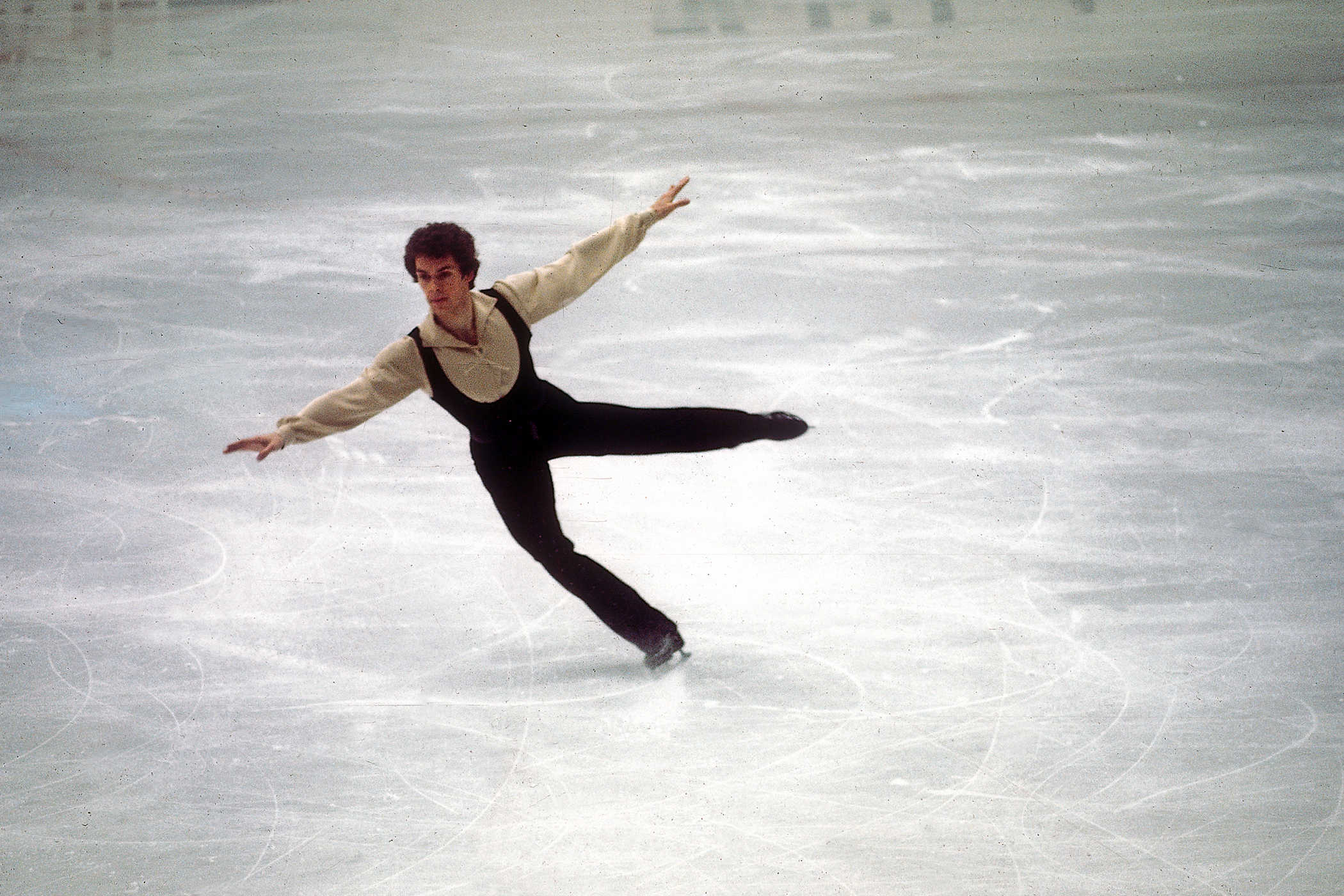
Wearing a dark green outfit matched with a light green blouse, created for him by the designer of the New York City Ballet, his five-minute free programme was watched by 20 million television viewers in Britain. He began with a triple toe loop and progressed with two other triple rotation jumps, the Salchow and loop, enough to satisfy even the strictest judges. Unlike most of the other routines, these highlights were interspersed with controlled spins and flowing footwork that transfixed his audience around the rink – and around the world.
Each fingertip was in the correct position to match each note of the music, while the final move in which Curry progressed from a double axel jump to a kneeling position was accomplished seamlessly. So many flowers rained on to the ice, Curry needed the help of two young girls to pick them all up.
Seven of the nine judges placed him first, with only the Soviet and Canadian judges, whose skaters were Curry’s main rivals, ranking him second. It made Curry the first British male skater to win an Olympic gold medal. His mother Rita, attending her first international competition, was there to see it.
“He completely changed skating, turning it into a real art.”
“He completely changed skating, turning it into a real art.”
Curry completed a grand slam at the World Championships in Gothenburg with another gold medal, even though his build-up was interrupted by publication of an article in which he discussed his sexuality with Associated Press journalist John Vinocur.
In 1987, Curry gave an interview about the experience to the BBC’s Barry Davies, the journalist he most trusted. “A lot of people said I ‘came out’ at the Olympics, but I didn’t,” he said. “I never intentionally set out to make a statement. But this man, John Vinocur, had made it appear that I wished I had done just that.
“And, of course, then, having done it, I’m not going to turn around and say that a) it’s not true or b) that I think it’s wrong, or I’m ashamed of it, which was not the case. I had simply allowed myself to be conned by a journalist.” It did not damage his popularity with the British public, who voted him BBC Sports Personality of the Year.
An Olympic gold medal presented opportunities and he founded the John Curry Theatre on Ice – fulfilling his dream of a ballet show on ice. It performed at the Royal Albert Hall and Palladium in London and the Met in New York City before having to close due to financial problems. Curry continued to skate in professional shows, but he had a reputation of being difficult to work with, pedantic and tough on skaters unable to meet his standards.
Even Curry admitted his ceaseless quest for perfection drove him mad. “Do you find John Curry difficult to live with?” Davies asked him in that 1987 interview. “Yes, I do,” Curry answered, before adding, “I’m stuck with him, aren’t I?”
After his Olympic triumph, Curry spent a lot of time in New York City, particularly Fire Island, the centre of the gay movement there. But AIDS claimed the lives of many of his friends. He was diagnosed with HIV in 1987 and returned home to live with his mother in Warwickshire after his AIDS diagnosis in the summer of 1991.
Before he died in 1994, aged 44, the penniless Curry invited the Mail on Sunday for a final interview. The pictures showed the formerly athletic and graceful Olympic champion ill and emaciated. Curry told the newspaper that he wanted to “demystify” the illness.
At a time when many celebrities, such as Freddie Mercury and Rudolf Nureyev, the ballet dancer Curry had been compared to on the ice, hid AIDS diagnoses, speaking out was seen as an act of immense courage.
Among those who helped nurse Curry was Alan Bates, the actor with whom he had enjoyed a two-year relationship.
Curry said he had known that he was gay since he was a teenager. “I lived in a homophobic world, and I was a homosexual, which made it very difficult,” he said.
After Curry’s death Fassi said, “He represented a milestone in skating. He completely changed skating, turning it into a real art.”
That is all he ever wanted to do.
Photograph by Donald Stampfli//Getty Images