

This article first appeared as part of the Rory Smith on Football newsletter – a guide to help understand what is happening on the pitch, off the pitch, and why all of it matters. To receive it in your inbox, sign up here.
The rhythm reverberating around Wembley Way, to an ear attuned to these sorts of things, felt distinctively German: a beat that might more immediately be associated with Bayern Munich, or, to the true connoisseur, Schalke 04, the Bundesliga’s great fallen giant. The banners, on the other hand, had a definite Greek inflection: the typeface and the iconography were redolent, I think, of Olympiacos.
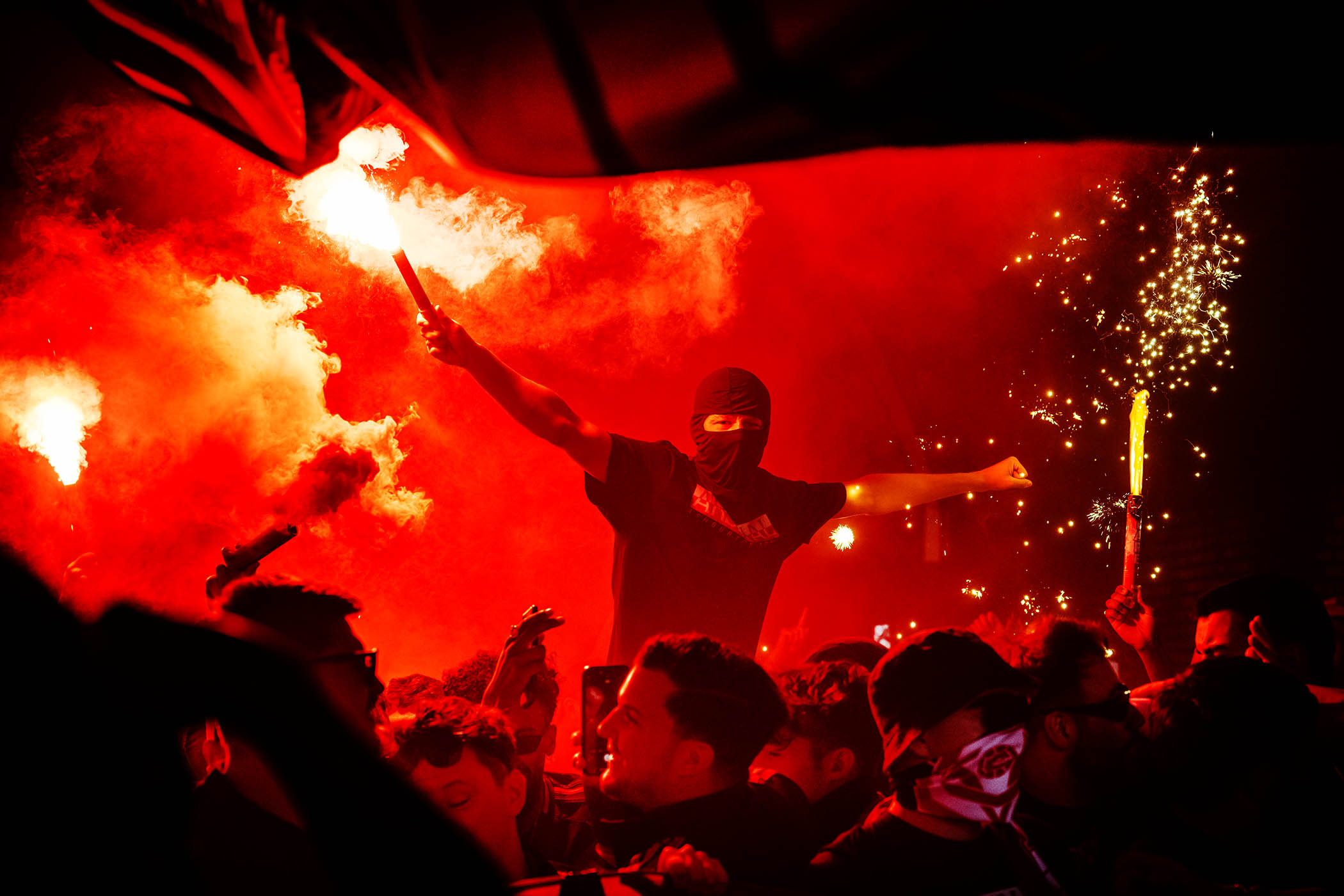
The event itself, in fact, was derivative, in a sort of inherent, essential way, although its inspirations and its influences were probably too broad to be pinpointed with any great precision. Before last month’s Carabao Cup final – a different world, before everything suddenly started to go wrong – the Ashburton Army, Arsenal’s ultra group, gathered outside the stadium, ready to march to the game.
This is a pretty standard sight across Europe and South America, with a pretty standard format. The ultras, clad all in black, will line up behind a banner bearing the name of their faction, or sometimes their club, or sometimes a more specific slogan. In front of them will be their capi, wielding megaphones, and often a handful of drummers. At a given signal, they will pound out a rhythm, the singing will start and, as smoke billows from flares, the walk to the stadium will begin.
It is not nearly so familiar in England. (Scotland is a different matter.) It is no longer quite as alien as it might be, of course, thanks not only to the increasing number of fans who travel abroad to watch games but to a growing interest in the idea of the ultra more widely.
Building on a canon that already includes James Montague’s outstanding book 1312, the BBC last month released a three-part documentary about the Scottish ultra scene; the Swedish director Ragnhild Ekner has explored the broader phenomenon in a film to be released next week. Confusingly, both are simply called Ultras.
And then, as in every sphere of human existence, there is the role of social media. When several thousand FC Köln fans marched along Wardour Street in Soho on their way to a Europa League meeting with Arsenal in 2017, it was still novel enough to attract at least a little astonishment. Since then, countless videos of fan marches, on YouTube and Instagram and X, have turned the march into an established and often admired aspect of theoretically exotic football cultures.
The reaction to the footage of the Ashburton Army’s march was notably less positive. It was, they were told, embarrassing. Tacky, try-hard, fake. And – the worst insult younger generations can imagine – cringe. Critics lined up to tell them they were effectively playing dress-up, a bunch of aspirant English kids basically appropriating a culture that did not belong to them and reproducing all of its imagery and sound without any real understanding of its soul.
This is, in part, because of a jarring and unavoidable discrepancy between the idea of ultras (raw, authentic, dangerous, and often – wrongly, admittedly – used as a shorthand for the most hardcore elements of the world’s most ardent fanbases) and the idea of Arsenal: middle-class fans, leafy north London, sky-high season ticket prices, Mikel Arteta talking about lightbulbs, Gunnersaurus, a stadium with no discernible atmosphere.
More interestingly, though, I think it is also a very English reaction – or at least a very English football reaction – to the sight of someone, anyone, doing something new, something different, something that breaks with the way things have always been done, even if the way things have always been done no longer really works.
The Ashburton Army are not the only relatively newfangled ultra collective to have received some pushback from the football public at large. The Holmesdale Fanatics, Crystal Palace’s more deep-rooted faction, have also been accused of being hobbyists; there are plenty who, certainly at the start, felt it was nothing more than an affectation, a sort of cosplay.
And yet, in both cases, it is hard to argue with their results. The Premier League, most fans would agree, has a genuine problem with atmosphere. What was once the league’s great selling point, at least in theory, has been diminished by a combination of success, complacency and, most pernicious of all, greed.
The Premier League cannot be blamed for the fact that it is so popular that people want to travel from all over Britain, and all over the world, to see the occasional game. Those people, in turn, cannot be blamed for the fact they do not know all of the words to the songs.
It can, though, be blamed for pricing younger fans, more likely to be raucous, out of games. It can be blamed for the increasing distaste its ownership class has for season-ticket holders. And it can definitely be blamed for not realising that the atmosphere at stadiums is not an adjunct to its product but is not far off the product itself.
The Holmesdale Fanatics and the Ashburton Army are at the very least an attempt to do something about that. They are fans, mostly in their late teens and early twenties, who have decided to turn football into an active experience, rather than yet another form of passive consumption. Their raison d’être, ultimately, is to confront an issue that pretty much all fans agree needs to be addressed.
They have done so with no little success. The atmosphere at the Emirates is much improved now; the stereotype no longer holds true. Arsenal, as a club, have tried to engage at least a little with the Ashburton Army’s organisers to make sure the relationship is as frictionless as possible. It is not hard to see why: Selhurst Park is possibly the most atmospheric ground in England, thanks, basically, entirely to the Holmesdale Fanatics.
That they have achieved that by borrowing aesthetics and ideas from global ultra culture is neither inappropriate – ultra scenes around the world are all based to some extent on each other – nor unexpected.
Their conception of what it looks like and sounds like and feels like to be an ultra has been learned from those social media videos. This is how all ideas spread now, as the writer Kyle Chayka noted in relation to the “AirSpace” sameness of new coffee shops and hotel lobbies. We exist in an endlessly algorithmically derivative world. At least, in acknowledging that, the Ashburton Army and the Holmesdale Fanatics are trying to do something new.
Photograph by Justin Setterfield/Getty Images
Newsletters
Choose the newsletters you want to receive
View more
For information about how The Observer protects your data, read our Privacy Policy