
Hearts believed, right until what passed for the end. They believed even after Daizen Maeda had broken their resistance and the intervention of a video assistant referee had shattered their dreams with just two minutes left of a second half that had lasted a week. They believed their story could not, would not, end like this.
That faith held right up until the moment when Callum Osmand found himself with the ball at his feet, 97 minutes on the clock and the great green expanse of Celtic Park at his mercy, his own private paradise. The stands began to melt as he ran towards Hearts’ unguarded goal, fans pouring on to the field in their thousands, the unbearable tension of the most meaningful game the Scottish Premiership has seen for a generation finally released.
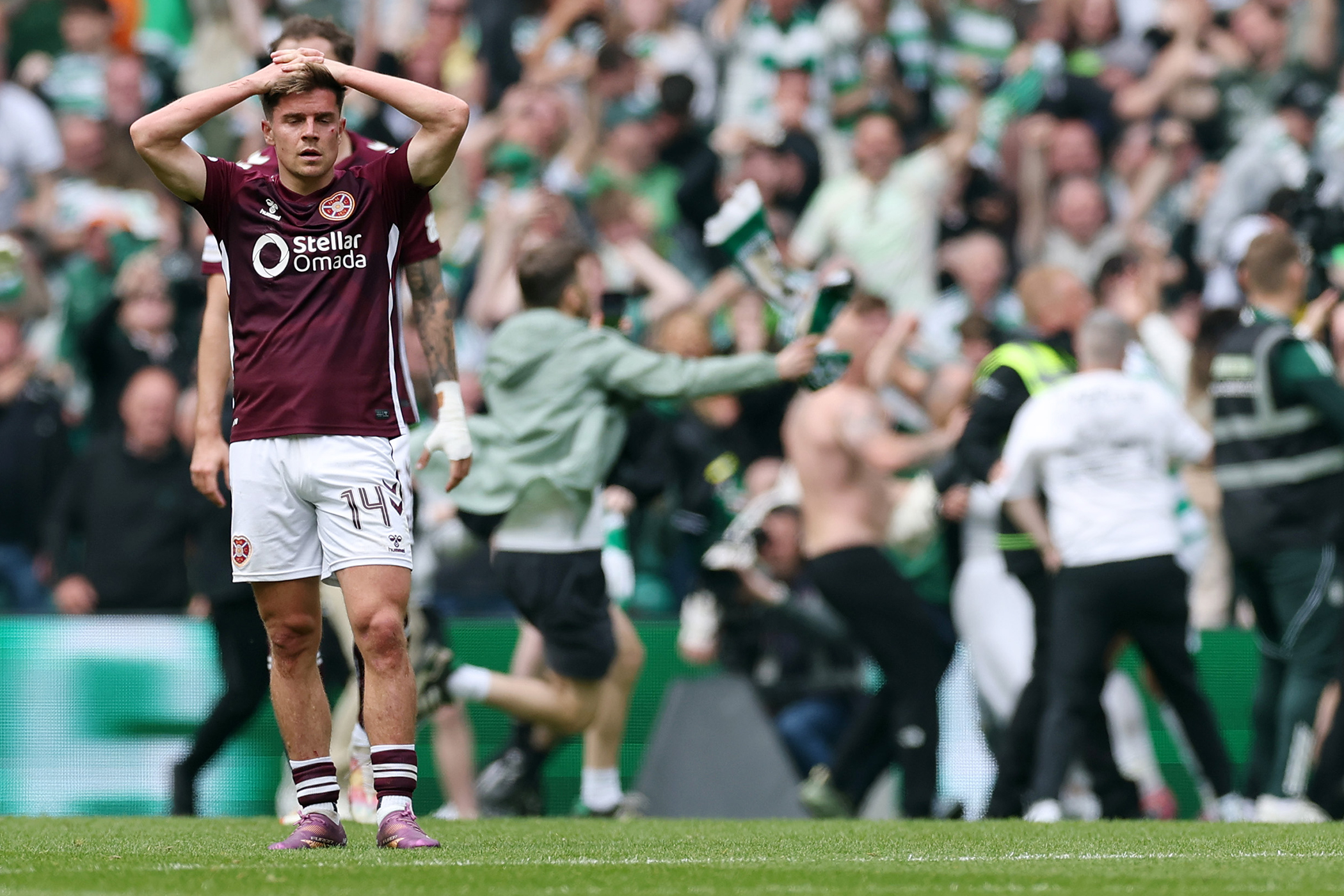
The euphoria was understandable; what came next much less so. As Hearts players consoled each other, they were confronted by dozens of fans, all over the pitch, verbally and physically. Lawrence Shankland, the Hearts captain, marooned in the onrushing tide, was a particular target. His teammates closed ranks around him to protect him; when that did not work, he was marched off the field by a phalanx of stewards.
At some point the game ended. Quite when that was remains a mystery. There was no final whistle. Technically, there remained a minute or so to play. Hearts did not return to the pitch. Martin O’Neill, the Celtic manager, only found out it had finished when his Hearts counterpart, Derek McInnes, sought him out in the tunnel to shake his hand. The most compelling season Scotland has produced for almost half a century ended not with a whistle but with an announcement over the public address system that Celtic were, once again, champions.
Derek McInnes and his team had boarded their team bus and left Glasgow before Celtic had even started their lap of honour. It should be no surprise they did not want to linger any longer than necessary. They did not want to listen to the celebrations, to experience what they hoped might have been theirs.
There is always more than one story, of course. As the players had made their way on to the field before the biggest club game Scotland had experienced for 20 years, Celtic’s reinstated ultra group, the Green Brigade, had unfurled a banner bearing the face of Martin O’Neill and the slogan: “There’s a fairytale about this club”.
That is true, of course. What O’Neill, at 71, has achieved this season is remarkable. He has stepped in to save Celtic from themselves not once but twice, replacing Brendan Rodgers after he resigned – following a defeat to Hearts – and then returning to put right the damage wrought by the appointment of Wilfried Nancy.
There is a beauty in that. O’Neill has done more, in those two spells, than guide the club to the title for the fourth time in his career: Celtic’s fifth in a row and the 56th in their glittering history. He has healed a rift between sections of the fanbase and Celtic’s hierarchy. In return, as he said, “these players and the coaches have given me a reason to live.”
But O’Neill has been around for long enough to recognise that not all stories are equal. “Hearts have been absolutely brilliant all season,” he said. “They were six or seven minutes away from winning it, and if they had won it, they would have deserved it.” That does not diminish the scale, or the romance, of his achievement.
Hearts have been the defining force in Scottish football this season; they have taken a league that had long felt moribund and reinvigorated it, attracting an international audience in the process. Not simply because they have been top, for all but a few hours, since September; not simply because there was a point, on the final day, when they were four points clear; not simply because they came within two minutes – plus injury time – not just of a place in history, but of immortality.
Newsletters
Choose the newsletters you want to receive
View more
For information about how The Observer protects your data, read our Privacy Policy
McInnes’s team had arrived in Glasgow on a bright spring morning knowing that simply avoiding defeat would not only make them the first Hearts team to win the championship for 66 years, but the first side to dislodge the Old Firm from the summit of Scottish football since Alex Ferguson’s Aberdeen in 1985.
The idea that Scotland is a closed shop has been an article of faith for 40 years; it has become the league’s calling card. In certain lights it has almost become a point of pride: an ardent football culture that is driven and to a large extent financed by the hatred between Glasgow’s twin poles.
Hearts have spent most of the season proving it does not have to be that way. When Tony Bloom, the Brighton owner, took a minority stake in the club last year, he insisted that Hearts could break the Old Firm’s duopoly within 10 years. (It attracted less attention, because it was a less provocative proclamation, but he also said that Hearts could “split” Celtic and Rangers this year.)
He was met with a barrage of derision. Everyone knows Bloom is clever; that his Jamestown Analytics platform, to which Hearts have exclusive Scottish access, is effectively a cheat code for recruitment.
But, the consensus was, the figures were against him. Celtic’s annual wage bill runs at about £75m, the highest in Scottish history. Hearts’ is only a little more than a quarter of that. The club made an operating loss of £400,000 last year; even that was only possible with £6m of donations from various benefactors. Most assumed even Bloom can’t be that clever.
That is not how he saw it. The financial gulf in Scotland reminded him of the situation he had found in Belgium when he invested there. “The difference in budgets with Union Saint-Gilloise when we got promoted, compared with the biggest two or three teams, was not so dissimilar to the different budgets between Hearts and the Old Firm,” he told The Observer earlier this season. Bloom, and possibly Bloom alone, looked at Scotland and saw possibility.
He has been proved spectacularly right. Hearts have led the table for months. They have, in Claudio Braga, the reigning Scottish Player of the Year. In a single season, the combination of Bloom’s expertise and McInnes’s astute management – as well as a degree of self-immolation on both sides of Glasgow – brought Hearts to the edge of a glory that would otherwise have been unimaginable.
That they could not quite make that final step will be an agony, of course, one made more pronounced by the manner in which they were denied. The final week of this season has been wreathed in controversy. Hearts were denied what seemed a clear penalty at Motherwell last Saturday. A few days later, Celtic were awarded a more controversial one after a surprisingly quick VAR review. They will, doubtless, grieve both for years.
Hearts could have no complaints about any of the decisions made at Celtic Park: a clear, if harsh, penalty, an offside correctly overturned. But that the season’s finale should not even, technically, have finished, that they should have had to flee the pitch, then hurriedly leave the stadium, reportedly under police advice, is both a shame and a source of it.
It will take the club some time to recover: not just the players, but the fans, too. Hearts know how livid scars can be. It is a club still haunted by 1986, the year they blew the championship on the final day; 2026 may, in time, feel just as haunting. The contingent of 800 or so supporters who had been allowed into Celtic Park for this game will have returned to Edinburgh with thousand-yard stares.
That will be the temptation to assume this is how the story ends, that things will revert to normal next season, that Hearts will drift back into obscurity. But that is not how Bloom works. Even in his moment of triumph, O’Neill recognised that. “This should absolutely be a wake-up call for Celtic and for Rangers,” he said. It might even be a boon; that it was celebrated so wildly is connected to how hard it was to earn.
More than anything, that is what Hearts have done this season; it is a message that should not be ignored because of the denouement. Bloom has only been involved for a year. When Hearts come to plan next season, they will do so with the prospect of their coffers being swelled by meaningful European income, with a couple of players who might be sold to fund more recruitment. They will be back, and they will be back stronger. This was not the end Hearts deserved, confused and chaotic. But maybe in this, they can choose when it ends. In time, it may turn out it was not the end at all.
Photo by Ian MacNicol/Getty Images