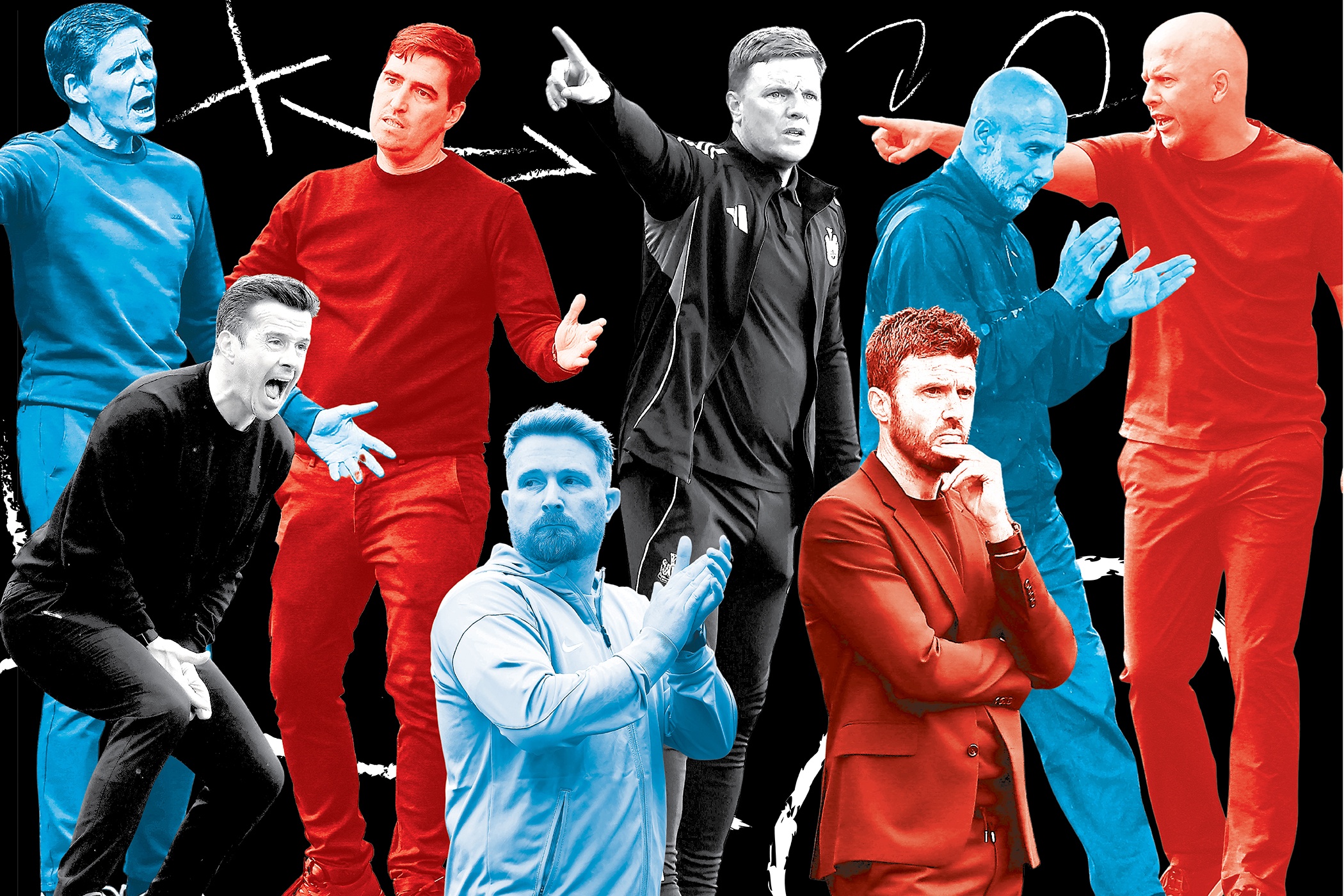



There were, by most estimates, roughly as many names on the shortlist to serve as Chelsea’s next head coach as there are executives presumably involved with making the appointment. Five or six candidates, one for each of the club’s sporting directors: Xabi Alonso, Andoni Iraola, Marco Silva, Oliver Glasner, Filipe Luís.
Alonso had also been mentioned in dispatches as a successor to Arne Slot at Liverpool so frequently that the club now gives the impression of being rather bored at having to insist they are not planning on appointing a new coach.
It is still just about possible that two more of the most coveted managerial posts in English football will be available this summer: Liverpool feasibly, and Manchester City theoretically. As things stand, there will be vacancies at Fulham and Crystal Palace, too. Bournemouth have already filled theirs. Newcastle are adamant they will not have one.
And yet it feels as though the pool into which all of these nets are being cast has never been more shallow. Alonso, despite his brief, unhappy sojourn at Real Madrid, has genuine pedigree: a domestic double in Germany with Bayer Leverkusen, including a maiden Bundesliga title, achieved without losing a game.
Iraola had to contend with Bournemouth selling half of his defence last summer and his best player, Antoine Semenyo, in January, but has still managed to take them to the cusp of the Champions League.
Glasner, despite his tendency toward self-immolation, has overseen the most glorious period in Palace’s history. Silva’s body of work is less spectacular, but may be the most consistent.
After them, though, the pickings seem distinctly slim. Most strikingly, there is no standout contender from one of Europe’s major leagues, not with Luis Enrique ensconced at Paris St-Germain and Vincent Kompany freshly armed with a new contract at Bayern Munich. There is no Jürgen Klopp, circa 2016, no equivalent to José Mourinho and Rafa Benítez in 2004.
Like everything else, that can be attributed to the warped economics of modern football. For a long time, the tendency of English football’s elite to look to the continent for managers was a source of outrage among the game’s punditocracy. Why would Chelsea go for Antonio Conte when Alan Pardew had taken Crystal Palace to the cup final?
Despite Sam Allardyce’s well-trodden quip about the value of having an exotic name, the answer had nothing to do with metropolitan snobbery.
England’s mega-clubs had just correctly identified that the experience of managing Borussia Dortmund and Inter Milan had more in common with managing Liverpool or Tottenham than having a good season at Norwich City.
Newsletters
Choose the newsletters you want to receive
View more
For information about how The Observer protects your data, read our Privacy Policy
A decade or more on, England’s elite now have to contend with the problem that everyone looks a bit like Norwich. There are plenty of promising young(ish) coaches working: Sebastian Hoeness has taken Stuttgart to the brink of the Champions League; Francesco Farioli has won the Portuguese title with Porto; Cesc Fàbregas, in charge of Como, is Serie A’s darling.
The problem is that they are all working at clubs that, thanks both to the collapse of what used to be called competitive balance and the distortive financial impact of the Premier League, have ceased to be the game’s striving middle-classes and become what we think of as springboards; coaching them is, more than ever, a development job. It is no more relevant training for taking charge of a multi-billion pound investment vehicle than getting Fulham to 10th.
In that light, perhaps it is no surprise that Liverpool would rather stick with Arne Slot – despite the now outright hostility of most of the club’s fans – or that United have decided that the feelgood factor brought by Michael Carrick is as good a bet as any.
There are no sure things out there. All that is left is to stick with what you know.
Movers and shakers – the clubs and managers facing change
Crystal Palace
Oliver Glasner announced in January that he would be leaving Crystal Palace at the end of the season, bringing an end to his two and a bit year stint at the club. Despite being offered a new deal, the Austrian, who won Palace’s first ever major trophy when he defeated Manchester City in last season’s FA Cup final, made the decision to leave in October. Glasner was reportedly disgruntled with Palace’s lack of recruitment as they embarked on European football, with club captain Marc Guehi later sold to City. Despite that they have made the Conference League final with a win over Rayo Vallecano guaranteeing them a spot in the Europa League next season.
That would make the managerial role a more attractive prospect with current Bournemouth manager Andoni Iraola thought to be Palace’s preferred choice. Ipswich’s Kieran McKenna, Coventry’s Frank Lampard and Fulham’s Marco Silva are all also set to be considered. Iraola’s proven ability to deal with significant player turnover would be a neat fit with Palace’s model, although he has significant interest from both the Premier League and abroad. But Glasner’s success demonstrates that the club can be a platform for managerial talent with less of the attention that comes from taking a leap to one of the Premier League’s bigger clubs.
Fulham
It finally appears Marco Silva might depart Craven Cottage. Silva was offered a new contract last November, but Chelsea, Benfica and reportedly even Nottingham Forest are circling.
There is a sense Fulham are stagnating, this squad operating at the upper limits of its capabilities. They increasingly feel trapped within a similar pattern to Crystal Palace over much of the past decade; safe but never exciting. Given they will likely be competing with Palace for similar names, but without the expected draw of Europa League football, replacing Silva could be an unexpectedly frustrating process. They have been linked with Filipe Luis and Thomas Frank but need someone to re-instil hope across the fanbase.
Manchester City
Replacing era-defining managers is something of a fools errand as Arsenal and United have discovered in recent decades. If Guardiola leaves this summer, City will have a difficult task on their hands.
Enzo Maresca’s abrupt departure from Chelsea on New Year’s Day has long been rumoured to be related to his supposed status as City’s prince in waiting. Maresca spent a season as Guardiola’s assistant manager as well as previously working at the club as an academy coach. He looks like an ideal replacement given his knowledge of the club, the tactical similarity with Guardiola and his experience at Chelsea where he led the team back to Champions League football and won them the Club World Cup. The achievements of Mikel Arteta at Arsenal has only added further credence to the idea that being a disciple of the current City manager is a pathway to elite success.
Newcastle
Newcastle are not where the fans or owners believed they would be almost five years after the Saudi takeover. For all the Champions League and injuries have strained the squad, finishing below Sunderland is a dishonour which will not be worn lightly. But club executives and PIF representatives met at Matfen Hall in late April, and have decided to continue trusting Eddie Howe into his fifth full season. But once again, Newcastle are likely to lose their most important player in the summer, with Howe saying Anthony Gordon being dropped in recent matches is “looking to next year”. Sandro Tonali is also reportedly considering his options. Given the unilateral failure of last summer’s recruitment, there will be significant pressure on getting Gordon’s replacement right. This is unquestionably Howe’s last chance, for all he has been instrumental in rebuilding the club. He could be the first head coach out in 2026-27.
Chelsea
Chelsea’s biannual search for a new football manager began again in April when they sacked Liam Rosenior after 23 matches. The candidate appointed, which looks likely to be Xabi Alonso, will become the fifth permanent manager chosen by BlueCo after Graham Potter, Mauricio Pochettino, Enzo Maresca, and Rosenior have all given the job a go. Those choices have seen Chelsea try out a range of different profiles – from the Premier League flavour of the month in Potter to the inexperienced Guardiola-disciple in Maresca – with mixed success. What comes next will indicate how much the ownership has learned from what has come before. Links to Xabi Alonso are surprisingly sensible, and testament to the pull a team like Chelsea still have regardless of what goes on behind the scenes. The key question Chelsea will have to negotiate with any candidate is how much power they will have.
Liverpool
It is baffling how Liverpool got here. For all the fanbase appear to hope otherwise, Arne Slot said on Thursday, before their 4-2 loss to Villa: “I have every reason to believe that I am the Liverpool manager next season”. Difficulties this season were inevitable given the scale of the change, but most concerning has been the lack of direction, jolting from one bizarre performance to the next with varying results. Slot has relied on individual excellence, mostly from Dominik Szoboszlai and Hugo Ekitike.
The arguments for Slot staying are that (beyond the fact he won the Premier League last season) over £400m was spent last summer on players to suit his system, and that assimilating this talent was always going to take time. They will still have Champions League football next season, and more realistic expectations with it. The arguments against are that fans have turned on him and some players seem unconvinced too.
Bournemouth
How organised is too organised? Bournemouth are 16 Premier League matches unbeaten and en route to the Champions League, but have long lost any leverage or ability to tempt Andoni Iraola into staying beyond the end of the season. Appointing Marco Rose in mid-April was hailed as another example of a club perpetually two steps ahead, a model of pragmatism and good practice, and yet you suspect guaranteed elite European football might have shifted the goalposts.
For one, here is a new danger of announcing your departure months in advance: becoming so good that leaving becomes both illogical and damaging to your career. For Bournemouth, this is both a dream and nightmare; their first season in Europe, but with such unreasonable expectations on their new head coach that he feels condemned to failure. The club have never previously had to balance European football with domestic duties and are largely unprepared to, meaning a summer of enforced signings carries yet more risk.