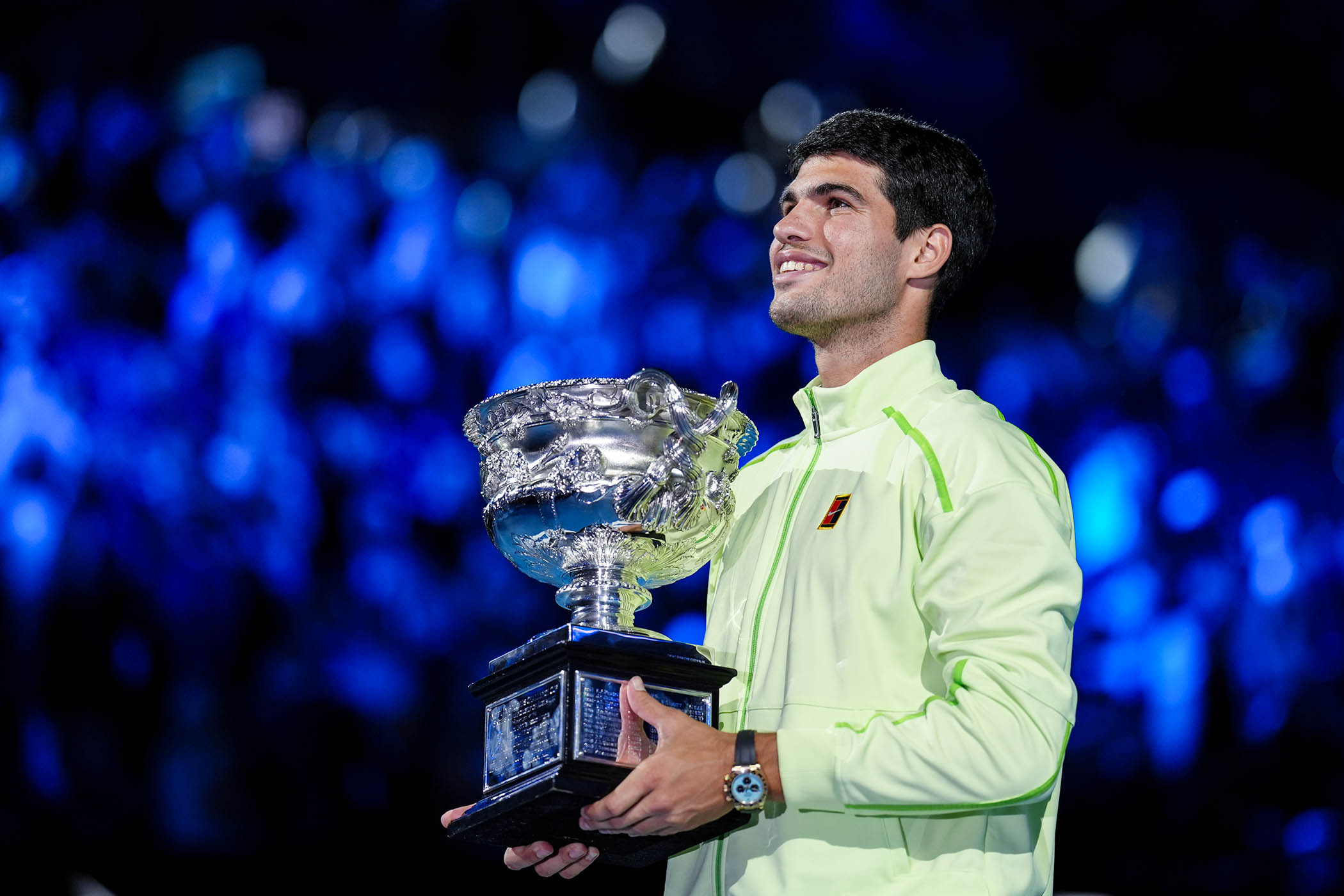

Welcome to Carlos Alcaraz’s imperial phase, his age of infinite possibility. For just over three hours, the Rod Laver Arena became the centre of the universe, pre-serve silences so oppressive they squeezed your temples. Seemingly intractable destinies collided like bumper cars in the soft Melbourne night, twin quests alike in dignity and majestic significance. In flickering glimpses this was as close to the heart and meaning of sport as one can hope to be, two players waging war on time and chance.
An ultimately emphatic Australian Open final victory over Novak Djokovic makes Alcaraz the youngest man to complete the career Grand Slam (lifting the Australian, French and US Opens, and Wimbledon) at 22 years and 272 days, a record which had endured since American Don Budge won the 1938 US Open. No tennis player has ever been as good as Alcaraz is as young as he is, certainly not with similarly relentless consistency and variation.
Even as 38-year-old Djokovic stretched while waiting for the coin toss, Alcaraz grinned and leapt on the spot, flexing and asserting his insolent youth. At 22-years-old, Djokovic had only won one Slam, and yet this was the Spaniard’s seventh, as many as John McEnroe and Mats Wilander, now one behind Andre Agassi and Jimmy Connors. Wimbledon 2025 is his only defeat in eight Slam finals, and he holds three titles simultaneously. On court, the Spaniard is an aesthetic treat; this snarling, swirling beast of biceps and joy in a luminous green tank top. Every ballistic forehand kisses the baseline, every miraculously-salvaged return screams “can you handle this?”. The answer is almost invariably no.
He is supposed to still be learning, growing, reconciling himself with the fact of having a body. The idea that this is not his peak is some absurdist joke. Alcaraz always seems to be playing with the limits of his own ability, learning in real time and inviting us to learn with him, infectiously fascinated by what he might do next. There must be a ceiling on this thing, but we appear some way from finding it.
And yet the first set was confirmation that Friday’s semi-final was not the death rattle of Djokovic’s greatness, that he can still thrive at the edge of the world, at least for a while. Across the initial 35 minutes he won 29 points to Alcaraz’s 15, seven of the eight rallies that lasted nine shots or longer, and 93% of his first-serve points. He called it one of the best sets he has played in the past few years, and that’s probably an understatement.
But in time Alcaraz resumed control and did to Djokovic what the Serbinator has done to all comers for two decades, absorbing his greatest weapons and launching them back with interest; mature and consistent yet as enthralling as he always has been. Djokovic’s big forehands were not unsettling Alcaraz, so he was forced to make them bigger. His drop shots were repeatedly chased down, so they had to get defter, ever-rising risk under ever-greater pressure. He sweated through one shirt, then another. In the third set Djokovic hit 11 winners to Alcaraz’s seven, but 14 unforced errors to five. In the fourth, the winners levelled out at 10 each, but Djokovic’s 17 unforced errors to Alcaraz’s eight betrayed his growing desperation, betrayed that he understood he might never get this opportunity again.
At 22-years-old, Djokovic had only won one Slam, and yet this was the Alcaraz's seventh, as many as John McEnroe and Mats Wilander.
At 22-years-old, Djokovic had only won one Slam, and yet this was the Alcaraz's seventh, as many as John McEnroe and Mats Wilander.
Djokovic and Alcaraz have the second-largest age gap of any two Open era Grand Slam men’s finalists, 15 years and 349 days. And yet maybe they were the only two people who really understood what this meant, quite why it mattered, bound by the shared pursuit of immortality, of unimpeachable greatness. Alcaraz talks a lot about wanting to be the best player ever. Djokovic has already scaled that mountain and still wants more.
He saved six break points early in the fourth set and 11 across the match, on top of 16 in his semi-final, but ultimately the windows of opportunity shrunk until they vanished into little more than tricks of the light. This is what Alcaraz does to you.
His talent feels so divinely inspired that you can forget the work required to get here. His serve was only broken twice en route to winning the 2025 US Open, and yet he emerged in Australia with a modified action. His natural gifts are so remarkable that his intellect is often overlooked. He is a keen chess player, a game he uses to develop his mental endurance and dexterity. His understanding of timing and momentum, of crowds and how to harness their energy is perhaps the only reason he survived his semi-final against Alexander Zverev for long enough to reach this final. After six fans had cheered throughout his straight sets win over Alex de Minaur, an act of bloodless violence, he gave them tickets for the last two matches and told them “make some noise”. They did.
Newsletters
Choose the newsletters you want to receive
View more
For information about how The Observer protects your data, read our Privacy Policy
How do you beat him? Where are the weak spots? You want nothing to do with his forehand, or his backhand for that matter. His serve is among the best on the ATP Tour. He moves like a gazelle on speed; everything, everywhere, all at once, with impossible elegance. The vague intimations at mental weakness and concentration problems have been wholly disproven. He occasionally cramps when stressed, but good luck stressing him. He is only getting faster and stronger and more durable both physically and mentally. Maybe relationships and children and injuries might complicate things, but that feels distant. Sinner is the only player still capable of regularly disrupting him but somehow does not feel like his equal, not as boundless or inventive, still having never won a match over three hours and 48 minutes.
Djokovic will continue in search of No 25, keep stretching and visualising and hoping and wanting and needing. His belief in his continued brilliance has never really deviated, and getting this far will do nothing to puncture that. But he only had to look across the net in Melbourne to understand he is no longer the one defining the parameters of this world, stretching its boundaries. Welcome to the Alcaraz era.
Photograph by Shi Tang/Getty Images