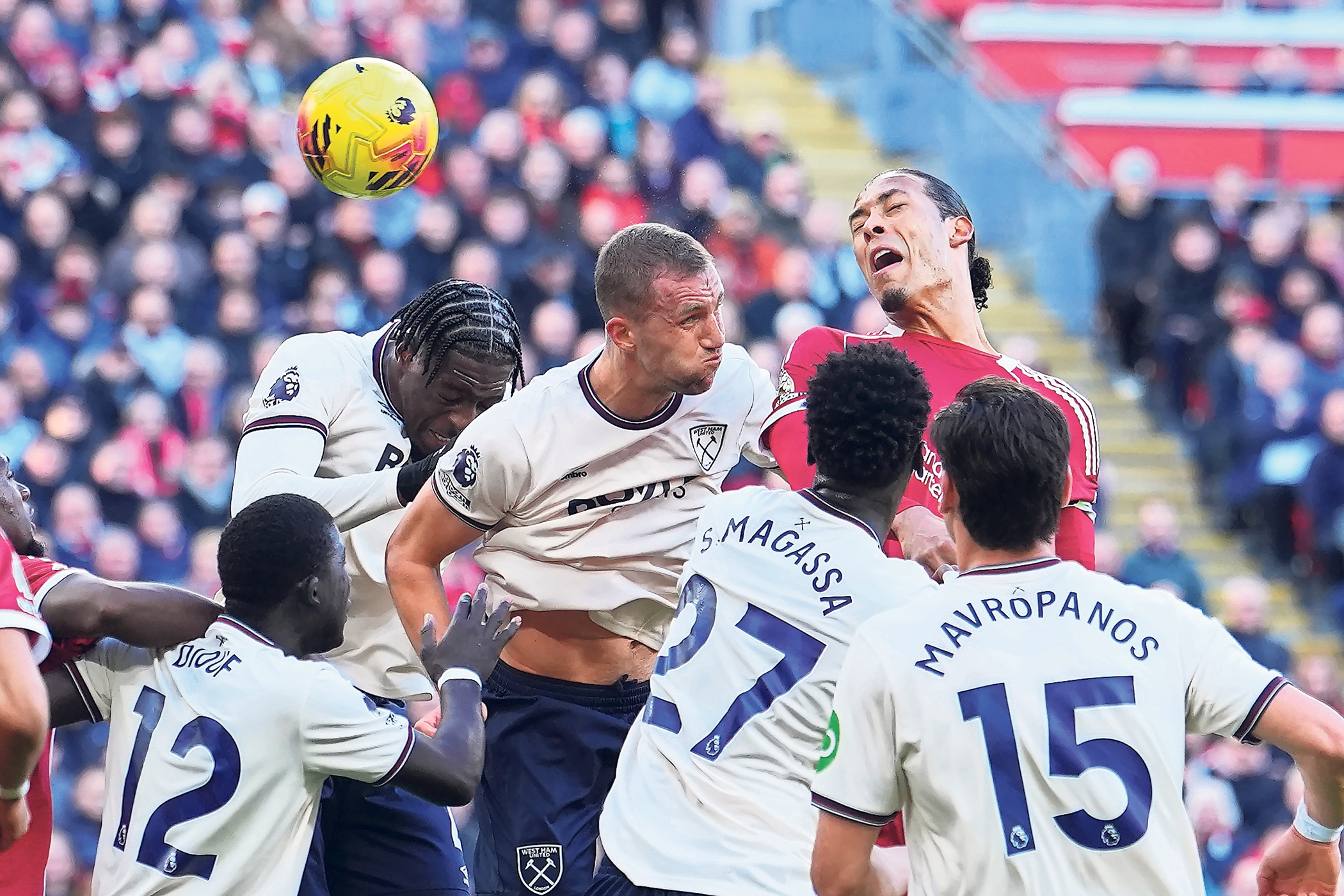


Six years and four days ago, West Ham fans arrived at Anfield with mutiny in mind, armed with black balloons and banners reading “Sold a dream, delivered a nightmare” and “Run like a circus, owned by clowns”. They were 18th in the Premier League, two months on from rehiring David Moyes, and lost 3-2 on a mild Monday evening.
Over the next four seasons West Ham finished in the top 10 three times and won the Conference League. And yet for all the hope and joy and memories, on Saturday they travelled to Liverpool once more racked by anger and desperation, by immediate fears of relegation and persistent crises of identity and faith which were not helped by a 5-2 defeat on Merseyside. Their slogan – “No More BS”, referring to vice-chair Karren Brady and owner David Sullivan – fits on placards rather than banners now. Little else has tangibly changed.
For all the signs of an on-pitch renaissance, the club’s accounts – released on Friday – exposed the scale of the decay of it. Last season West Ham lost £104.2m pre-tax, including a £42.1m decrease in revenue. Every income stream had decreased year on year, while wages and amortisation (money owed for player purchases) rose 9% and 19% respectively. Part of this is attributable to a lack of European football, part to the £126m spent on such club icons as Maximilian Kilman, Niclas Füllkrug and Luis Guilherme, more to a gradual but perpetual erosion of funding and caring. This has been coming.
Executives waited until 4pm on the last possible day to release these figures, conveniently after Nuno Espírito Santo’s press conference. Their announcement made no reference to the most concerning admission, that the club “is forecasting a liquidity shortfall in summer 2026” – also known as “not having enough money to pay the bills” – even if they stay up. Relegation is described as a “severe but plausible scenario” resulting in “a liquidity shortfall… to a greater severity”, requiring either significant player sales – some or all of Jarrod Bowen, Mateus Fernandes, Crysencio Summerville and El Hadji Malick Diouf – or owner investment.
The latter seems implausible given no money has been put into the club since Czech billionaire Daniel Křetínský acquired his 27% stake in 2021, and the ownership recently took out a £124m, five-year loan from Rights and Media Funding Limited. This is not unheard of for Premier League clubs – Everton borrowed from the same company while building Hill Dickinson Stadium – but doing so purely to pay operating expenses is as obvious an indicator of institutional incompetence as any other. It turns out that making repeatedly terrible decisions is expensive.
You have to question what Sullivan gets out of maintaining control of West Ham: loathed by fans and unwilling to change
You have to question what Sullivan gets out of maintaining control of West Ham: loathed by fans and unwilling to change
Given how grim this season has been, it bears repeating that West Ham wrangling relegation was not inevitable. Their wage bill last season – the clearest statistical indicator of success – was the 10th-highest in the Premier League and will be similar in 2025-26. They have all the financial resources not to be here, a global brand in the world’s most attractive footballing city. This is about consistently spending poorly without any direction or vision, about neglect and disregard in the face of all evidence.
There is little to suggest that Sullivan and Brady have the expertise or understanding or inclination to begin a sustainable reconstruction of their crumbling club. They are products of a footballing world long dead, railing against a game which has moved beyond their quaint days of favourite agents and un-pragmatic pragmatism. The margins are too fine now.
And if they do stay up, what’s next? Start this whole miserable process once more? Circle the drain time and again until gravity and reality take their inevitable course? Even if they were to find their way back to the Premier League after potential relegation, what hope is there of enough good decisions made to stay there? Further relegation, pain and anguish and apathy, feels far more likely.
Brady is believed to be considering imminent resignation, in part due to the dire accounts, but not helped by the December departure of her long-term friend and ally Tara Warren, who was announced as a non-executive director of the Independent Football Regulator nine days ago. If there are skeletons at the London Stadium, Warren would likely know where they are buried, and this cannot have been a popular decision given Brady’s vehement public opposition to the regulator.
Beyond that, you have to question what Sullivan gets out of maintaining control of West Ham: loathed by fans and unwilling to change. This is now a solely selfish pursuit, damaging a beloved club to soothe his ego. If Brady does leave, he will be the sole face of a failing institution, knowing deep down that he has failed it.
Newsletters
Choose the newsletters you want to receive
View more
For information about how The Observer protects your data, read our Privacy Policy
Perhaps Nuno, an admittedly masterful paperer of cracks, can help maintain the facade for a little longer with his cut-and-shut squad. They had won five of their eight matches across all competitions before this defeat, a monument in soft winter sun to how far West Ham have fallen and how unfeasible climbing that mountain once again feels. And so we roll on to a grim future; more severe, and ever more plausible.
Photograph by Jon Super/AP